


On this page
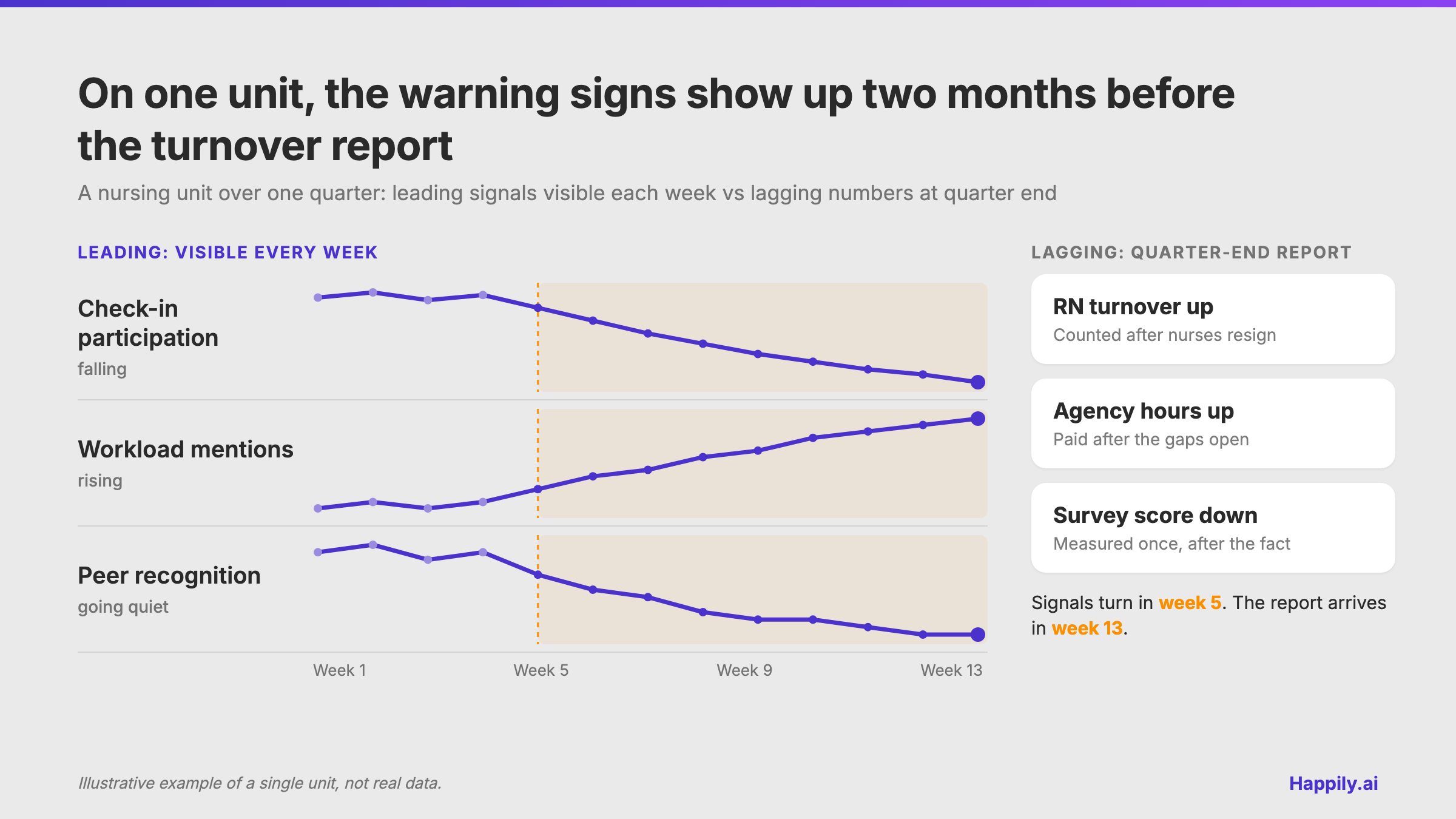
Your charge nurse on 4 West can tell you which nurse is close to leaving. She noticed the extra shifts, the quiet at handoff, the swap requests. Your quarterly dashboard finds out from the resignation letter.
That gap is what employee engagement software for healthcare has to close. Most engagement tools were designed for people at a desk with a company inbox and a free hour. A nurse twelve hours into a shift has none of those.
The cost of the gap is now well measured. The 2026 NSI National Health Care Retention & RN Staffing Report, covering 527 US hospitals, puts staff RN turnover at 17.6% in 2025 and the cost of losing one bedside RN at $60,090. For the average hospital, that adds up to a loss of $4.2 million to $6.2 million a year.
What is employee engagement software for healthcare?
Employee engagement software for healthcare is a mobile-first tool that lets shift-based clinical and support staff give quick, frequent feedback, and turns it into unit-level signals that warn of burnout and turnover while a manager can still act.
Unit-level matters most. A hospital-wide average hides the one unit that is struggling, and by the time turnover shows up in a report, the people are gone.
Turnover and burnout are lagging indicators
Turnover rates, agency spend and annual engagement scores describe what already happened. They are useful for the board and too late for the unit. The research shows how much happens before a resignation:
- Burnout is a stated reason for leaving. A 2021 study in JAMA Network Open by Shah and colleagues, using the 2018 National Sample Survey of Registered Nurses, found that 31.5% of nurses who had left a job named burnout as a reason. Of those, 63% also cited inadequate staffing.
- The first year is the riskiest. NSI reports that 22.7% of newly hired RNs left within a year in 2025.
- Intent comes before exit. The 2024 National Nursing Workforce Study from NCSBN found that 39.9% of RNs intend to leave the workforce or retire within the next five years, with stress and burnout among the leading reasons.
Workload, staffing and burnout build up week by week, on specific units, under specific managers. That is where a leading indicator has to come from. In Happily's language, this is the Feeling stream, and the leader question is plain: will this team hold up under load?
Why office engagement tools struggle on a hospital unit
Most engagement platforms assume things that rarely hold on a clinical floor.
- A quiet moment at a desk. Nurses have a break and a phone. A 40-question survey competes with eating and loses.
- A normal work week. Night shifts, 12-hour rotations and per diem staff mean a Monday 9 a.m. survey reaches half the team.
- A hospital-wide score tells you something. Turnover is uneven. NSI's 2025 data shows RN turnover highest in behavioral health, emergency, telemetry and step down, and lowest in pediatrics and surgical services. One average hides all of that.
- A manager with a small team. A nurse manager may be accountable for a large unit across every shift, with charge nurses carrying day-to-day leadership. Gallup found that managers account for at least 70% of variance in employee engagement scores, so the people closest to the shift need the signal, in a form they can use in two minutes.
- People will speak up if asked. In a hierarchy with physicians, managers and agency staff, honest answers depend on anonymity people trust.
A tool nobody uses can only report history. In a hospital, the units with the most strain respond least.
What to look for in a healthcare employee engagement platform
Use this table in vendor demos. The last column is the question that separates a tool built for shift work from an office tool with a mobile app.
| Criterion | Why it matters on a unit | Question to ask the vendor |
|---|---|---|
| Time per check-in | Breaks are short and often interrupted | "Time a check-in on your phone, right now, in this demo." |
| Shift-aware delivery | Night staff ignore prompts sent at noon | "Can prompts follow each unit's shift pattern?" |
| Participation after 90 days | Low response means the loudest voices set the picture | "What share of clinical users still respond each week after 90 days?" |
| Unit and manager view | Turnover clusters by unit and leader | "Show me one unit's trend, and what the charge nurse sees." |
| Anonymity thresholds | Small night teams can be identified | "What is the minimum group size before results are shown?" |
| Data scope | Staff feedback should not mix with patient records | "Do you store or touch any patient data? What does your security review cover?" |
| Per diem and float access | Floats and per diem staff are often left out | "How do float and per diem nurses join and get assigned?" |
5 types of healthcare engagement tools compared
Each tool below is described from the vendor's own published material. We don't list prices because they change with headcount; see our guide to employee engagement software pricing for how the models differ.
| Tool (type) | Primary strength | Rhythm | Access for clinical staff | Best for |
|---|---|---|---|---|
| Press Ganey (healthcare survey suite) | Healthcare benchmarks, links staff data with patient experience | Annual census, pulse and lifecycle surveys | Survey links and dashboards | Health systems that want staff and patient measures from one vendor |
| Workday Peakon Employee Voice (enterprise listening) | Frequent surveys at scale, 60+ languages | Regular pulse surveys | Mobile and kiosk | Large systems already on Workday |
| Workvivo by Zoom (frontline comms) | Mobile-first communications, recognition, polls | Continuous feed | Smartphone app | Systems whose first problem is reaching every shift |
| Connecteam (deskless operations) | Scheduling, time clock, chat, recognition | Daily operations | Mobile and kiosk app | Home care and care homes that need scheduling first |
| Happily.ai (daily signals) | Daily check-ins with unit and manager leading indicators | Daily | Mobile app, short daily habit | Owner-led and mid-size providers that want early warning by unit |
Press Ganey
Press Ganey offers annual census surveys, pulse surveys, lifecycle surveys and 360-degree assessments, and connects workforce results with patient experience and safety data in one platform.
Where it excels: healthcare-specific benchmarks and a single view of staff and patient measures. Limitation: the core rhythm is still survey cycles, so signals arrive in waves. Best for large health systems with an HR and quality team that wants comparable benchmarks.
Workday Peakon Employee Voice
Peakon is Workday's continuous listening product, with feedback collected in more than 60 languages through mobile and kiosk options.
Where it excels: frequent, multilingual surveys at enterprise scale. Limitation: it fits best inside Workday. Best for systems that already run Workday HCM.
Workvivo by Zoom
Workvivo describes itself as a mobile-first platform for healthcare, with real-time updates, recognition shoutouts, chat, and manager insights from polls and surveys.
Where it excels: getting the same message to every shift and making recognition visible. Limitation: it needs a steady flow of content from a communications team, and measurement is one feature among many. Best for multi-site systems that need one channel across hospitals and clinics.
Connecteam
Connecteam is an all-in-one app for deskless teams, with care-home features such as scheduling by qualification, time clocks on mobile or kiosk, chat, training and recognition.
Where it excels: replacing paper rotas and group chats. Limitation: surveys exist, but with little trend data per manager. Best for home care agencies and care homes that need scheduling fixed first.
Happily.ai
Happily.ai is the daily operating layer for team performance. Staff complete a short daily check-in in the Happily app, and leaders see leading indicators of focus, progress and team strain by team and manager. Happily reports 97% daily adoption, against an industry average of about 25%.
Where it excels: a daily signal per unit and manager, with recognition built into the same habit. Limitation: no scheduling, no patient surveys, no clinical system integrations. Best for owner-led and mid-size providers who want to see which unit is under strain this week.
Which one should you choose?
Many hospitals end up with two layers: a channel that reaches every shift, and a signal that tells leaders where to act. Start with your biggest problem.
- Choose Press Ganey if you need healthcare benchmarks and one vendor for staff and patient experience surveys.
- Choose Workday Peakon if you already run Workday and want frequent multilingual surveys inside it.
- Choose Workvivo if information doesn't reach night shift and you need one mobile channel across sites.
- Choose Connecteam if your rotas and timesheets still live on paper and spreadsheets.
- Choose Happily.ai if you want a daily, unit-level read on strain and recognition that nurse managers and charge nurses actually use.
How Happily works for a hospital unit
Happily is set up by team, so each unit, shift or clinic can be its own team. Four mechanisms do most of the work:
- Daily check-ins take a few taps on a phone. The daily rhythm is what produces a trend you can trust.
- DEBI, the Dynamic Engagement Behavior Index, is a 0 to 100 engagement score that moves day by day. Think of a bathroom scale: weighing daily changes what you do today. (What DEBI measures.)
- The hotspot map and manager scorecards show which units and managers are under strain, so a director of nursing knows where to round first. (See our manager effectiveness scorecard.)
- Gem-based recognition lets peers thank each other for work nobody else saw, and gems redeem for perks the organization chooses. People who give recognition are trusted 9x more, and falling recognition is one of the earliest signs that someone is about to leave.
Across customers, Happily reports a 40% reduction in turnover and a 48-point eNPS improvement.
Where Happily is not the right fit:
- You need HIPAA-specific integrations with patient data or your EHR. Happily handles staff feedback only.
- You want one vendor for patient and staff surveys. A healthcare suite like Press Ganey fits better.
- You need scheduling, time and attendance, or credential tracking. Use a workforce management system alongside it.
- Happily is not built specifically for hospitals. Ask us for the security documentation your compliance team needs before a pilot.
A 30-day test on one unit
- Pick one unit with turnover or sick calls you already worry about, ideally one with night shifts.
- Measure week-four participation, by shift. If fewer than half the unit still respond, the tool won't give you leading indicators.
- Compare the signal with the charge nurse's instincts. A good tool confirms what she knows and shows one thing she missed.
- Count changed decisions. Did the tool change one assignment, conversation or recognition moment inside the month?
For a deeper look at why daily beats periodic, see daily check-ins vs annual surveys. The same pattern applies on the factory floor, as our manufacturing buyer's guide shows.
FAQ
What is the best employee engagement platform for healthcare organizations?
It depends on your main problem. Press Ganey fits if you want healthcare benchmarks tied to patient experience. Workvivo fits if you need to reach every shift. Happily.ai fits if you want early warning by unit and manager.
How do I compare healthcare engagement tools?
Run the same test with each vendor: time a check-in on a phone, ask for participation after 90 days, and ask to see one unit's trend as a charge nurse would. Then pilot on one unit for 30 days.
Can engagement software reduce nurse turnover?
Software alone doesn't keep nurses. It helps managers see strain on a unit early, while staffing, scheduling or a conversation can still change the outcome. With each bedside RN costing $60,090 to replace, according to NSI, catching even a few departures early matters.
Is nurse engagement software safe for patient privacy?
Staff engagement tools shouldn't store patient data at all. Ask each vendor what data they hold, how anonymity works for small teams, and what their security review covers. If you need patient-data integrations, choose a healthcare-specific suite.
How often should nurses be surveyed?
Briefly and often. A check-in of a few taps, timed to the shift, gives managers a trend they can act on that week. An annual survey arrives after people have left.
See which unit needs you this week
Your KPIs tell you what happened. Happily tells you what's about to. If you run a hospital, clinic group or care provider and want an early read on which unit is under strain, book a 30-minute demo. Bring one unit you are unsure about. For the wider category, see what an employee engagement platform is.
Sources:
- 2026 NSI National Health Care Retention & RN Staffing Report - NSI Nursing Solutions (March 2026)
- Prevalence of and Factors Associated With Nurse Burnout in the US - Shah et al., JAMA Network Open (2021)
- NCSBN research highlights: 2024 National Nursing Workforce Study - NCSBN (April 2025)
- Employees Want a Lot More From Their Managers - Gallup (2015)
- Employee experience solutions - Press Ganey
- Workday Peakon Employee Voice datasheet - Workday
- Workvivo for healthcare - Workvivo by Zoom
- Care home app - Connecteam