


On this page
Employee listening software is technology that collects, analyzes and helps leaders act on what employees think and feel, across every channel a company uses to hear them: annual surveys, pulse surveys, lifecycle surveys, always-on feedback and passive signals.
Here is the number that should shape how you buy it. In a November 2024 report, Gallup found that only 8% of employees strongly agree that their organization takes action on surveys. Another 38% say they don't know if their organization does anything at all.
Most companies already listen. Very few are seen to respond. The best tool is the one that helps you hear a problem early, while it is still cheap to fix, and then shows people you heard it.
This guide covers what "employee listening" means, the three types of employee listening platforms, and how to choose for a company of 50 to 500 people.
What "employee listening" actually means
"Employee listening" is the enterprise term for the whole system a company uses to hear its people. A survey is one channel. A listening program is all of them together, with a plan for what happens next.
Most programs mix five channels:
| Channel | What it is | How often it hears you | Good at |
|---|---|---|---|
| Annual or census survey | A long survey sent to everyone | Once or twice a year | Deep, comparable data and benchmarks |
| Pulse survey | A short survey on a few topics | Weekly to quarterly | Tracking change between big surveys |
| Lifecycle surveys | Surveys tied to moments like onboarding or exit | When the moment happens | Understanding specific stages of the employee journey |
| Always-on feedback | An open channel, often anonymous, for comments any time | Whenever someone speaks up | Catching issues people would not raise in a meeting |
| Passive or daily signals | Short daily check-ins, recognition patterns, comment themes | Every day | Spotting change while it is still small |
"Continuous listening" is the name for running these channels so that something is always coming in, instead of one big read per year.
For the broader software category, see our explainer on what an employee engagement platform is. This article stays on listening: channels, cadence, and what you do with what you hear.
Why listening is worth paying for: catching problems while they are cheap
Every people problem has a price that rises with time.
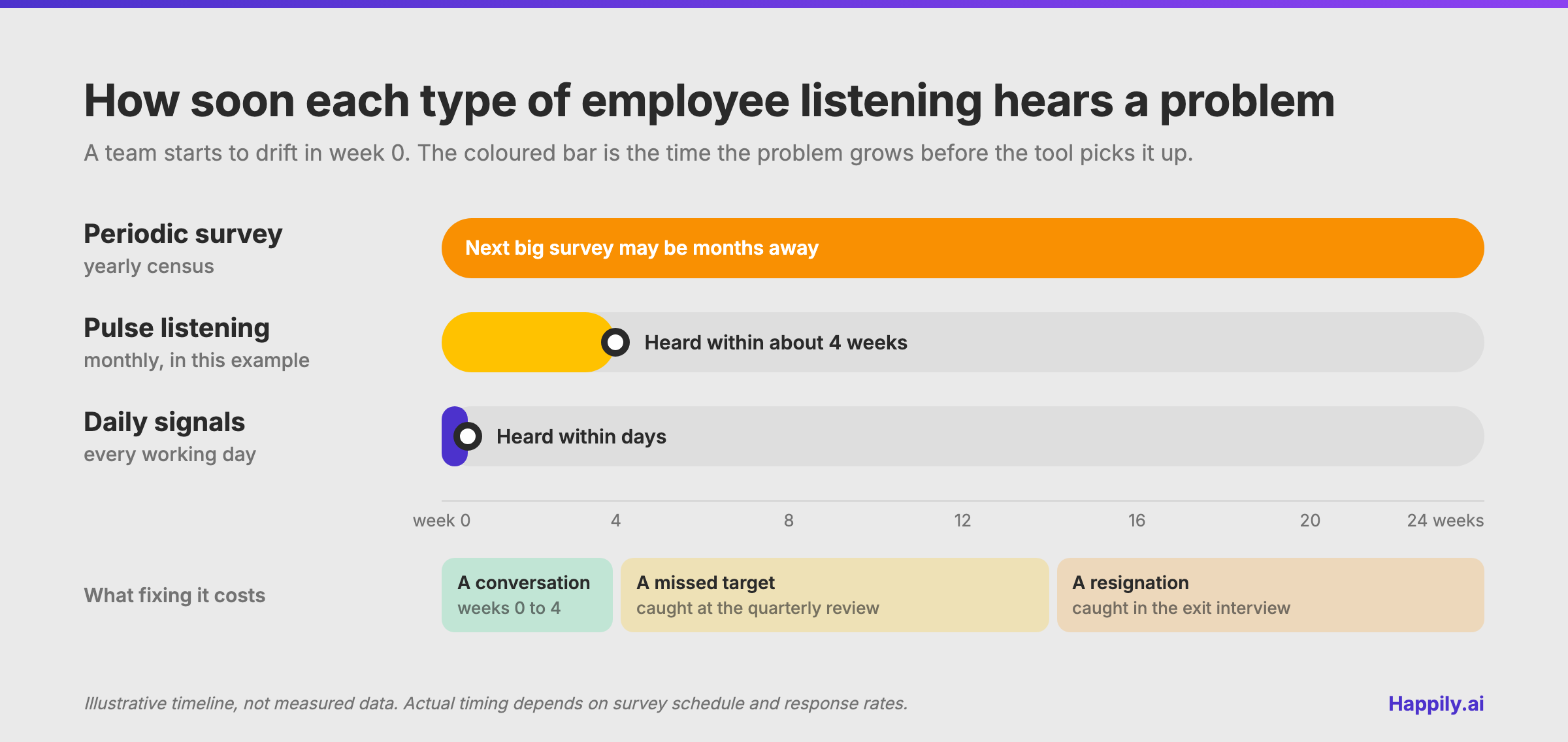
A team that starts to drift from the quarter's priorities costs a conversation if a manager notices in week two. It costs a missed target if it shows up in the quarterly review. It costs a resignation and a hiring cycle if it first shows up in an exit interview.
That is why cadence matters more than the number of questions. A score from last spring is a lagging indicator. It tells you what happened. A signal from this week is a leading indicator. It tells you what is about to happen while you can still change it. (Our guide to leading vs lagging indicators goes deeper on the difference.)
Listening also has to reach the right person. Gallup estimates that managers account for at least 70% of the variance in employee engagement scores across business units. A listening program that reports only to HR, and never to the manager who can act on Tuesday, misses the people who move the number most.
The 3 types of employee listening software
Employee listening tools fall into three broad types. The biggest difference between them is how soon each one hears a problem.
Type 1: Periodic survey suites
Full listening suites built for large organizations. They run census, lifecycle and pulse surveys, analyze written comments, and slice results by department, location and management layer.
- Qualtrics describes its employee experience product as capturing pulse surveys, always-on feedback, lifecycle moments and passive listening, with AI that surfaces trending issues from comments and gives managers recommended actions.
- Perceptyx markets itself as "Trusted by the Fortune 1000." Its listening formats include point-in-time surveys, lifecycle listening, conversational listening, crowdsourcing and 360 feedback, with nudges delivered in Teams, Slack and email.
- Culture Amp offers 40+ survey templates, including engagement, pulse, onboarding and exit surveys, and benchmarks it says cover over 1 billion survey responses. Many mid-size companies use it because it pairs survey science with action planning.
Where they excel: depth, benchmarks, complex reporting across many layers of an org chart, and governance for large programs.
Where they fall short: the main survey still lands once or twice a year, so the big read arrives months after a problem starts. Setup and analysis often need a dedicated people analytics owner.
Best for: organizations with 1,000+ employees, several management layers, and a team whose job is running the listening program.
Type 2: Continuous pulse listening
Pulse tools shorten the survey and raise the frequency: a handful of questions every week or month.
- Workleap Officevibe describes itself as survey and feedback software built for SMBs, with pulse and custom surveys, anonymous feedback and "Good Vibes" recognition cards.
- Many Type 1 suites, Culture Amp included, also run pulse surveys alongside their main survey.
Where they excel: lighter to run, faster reads on specific topics, and anonymous channels that surface things people will not say out loud.
Where they fall short: participation tends to fade when people answer repeatedly and see nothing change. Anonymity can also make it hard to follow up, which we cover in why anonymous engagement surveys often don't work.
Best for: companies of roughly 50 to 1,000 people that want more frequent reads without changing how managers work day to day. For a side-by-side of specific tools, see our pulse survey software comparison.
Type 3: Daily behaviour signals
The newest type makes listening part of the working day. The tool collects small signals daily: a short check-in, who recognizes whom, which priorities people are working on, and how those patterns change.
Where they excel: they hear change in days instead of months, and the same daily habit gives managers something to act on in their next 1:1.
Where they fall short: they only work if people use them every day, so adoption design is everything. They also trade the depth of a long survey for frequency, and they are lighter on formal benchmarking.
Best for: owner-led companies of 30 to 500 people where the real question is execution: are people working on what matters, are commitments moving, and will the team hold up.
Employee listening platforms compared
| Periodic survey suites | Continuous pulse listening | Daily behaviour signals | |
|---|---|---|---|
| Examples | Qualtrics, Perceptyx, Culture Amp | Workleap Officevibe, pulse modules in larger suites | Happily.ai |
| Main cadence | Yearly census plus lifecycle and pulse | Weekly to monthly | Every working day |
| How soon you hear a new problem | Often months later | Within weeks | Within days |
| What it asks of managers | Act on a results report and an action plan | Review results each cycle | A few minutes a day, folded into normal work |
| Strongest at | Depth, benchmarks, multi-layer reporting | Lightweight frequency, anonymous comments | Early signals on alignment, follow-through and strain |
| Watch out for | Long gap between reads | Survey fatigue if nothing changes | Needs leaders to act on what they see |
| Best for | 1,000+ employees with a people analytics team | 50 to 1,000 employees wanting regular reads | 30 to 500 employees, owner-led, focused on execution |
Listening without action makes trust worse
Asking people what they think creates a promise. If nothing visible happens, the next survey teaches them that speaking up is pointless.
So before you compare features, decide how your company will close the loop. A simple rhythm works at any size:
- Hear. Collect the signal through whichever channels you choose.
- Decide. Within a week, each manager picks one thing to act on with their team. One, not five.
- Tell back. Say out loud what you heard and what you are doing about it. "You said, we did" is enough.
- Check. Watch the next signal to see if the change landed.
The faster this loop turns, the more people trust it. A weekly loop becomes how the team works. Our guide on how managers should follow up after an employee survey has scripts for the "tell back" step.
When you evaluate employee listening software, ask each vendor three questions:
- "What share of employees respond in an ordinary month, six months after launch?"
- "What does a manager see, and when, without logging into a dashboard?"
- "How does the tool help us show employees what changed because they spoke up?"
How to choose employee listening software
Start with the problem you are trying to catch early, then match the type.
Choose a periodic survey suite if you run a large organization with many management layers, you need benchmarks against industry data, and you have someone whose job is to run the listening program. Our employee engagement survey software buying guide walks through that evaluation.
Choose continuous pulse listening if you want regular reads on morale and specific topics, your managers are ready to review results every few weeks, and an anonymous channel matters to your culture.
Choose daily behaviour signals if you lead a 30 to 500 person company, your real worry is execution, and you want managers to see problems while a conversation can still fix them.
Choose a combination if you are scaling past a few hundred people. Many companies keep one deep annual survey for benchmarking and add a daily or pulse layer for early signals.
Wait on software if you have under about 30 people. Consistent 1:1s and a weekly team check-in will tell you most of what a tool would.
For a wider list of named tools across these types, see our roundup of the best employee engagement tools for growing companies.
Where Happily.ai fits
Happily.ai is the daily operating layer for team performance: a Type 3 listening tool built for owner-led companies of 30 to 500 people.
A short daily check-in feeds DEBI, a 0 to 100 engagement index that moves day by day. The Focus Board shows whether daily work connects to company priorities. Manager scorecards show each manager's 1:1 cadence, follow-through and team health, and the hotspot map shows which teams are under strain. AI coaching nudges prompt managers on what to do next, and gem-based recognition gives employees something back for taking part. People who give recognition are trusted 9x more by colleagues.
The design goal is adoption, because listening only works if people answer. Happily sees 97% daily adoption, against an industry average of about 25%. Customers have seen a 40% reduction in turnover and a 48-point eNPS improvement.
Happily.ai is not a fit if you need a large-enterprise survey suite with complex org-hierarchy reporting, formal benchmarking against industry datasets, or a dedicated research team's toolkit. A Type 1 suite is built for that job.
Your KPIs tell you what happened. Happily tells you what's about to. Book a demo to see what your team's leading indicators look like.
Frequently asked questions
What is employee listening software in simple terms?
It is software that helps a company hear what employees think and feel, and act on it. It can run annual surveys, pulses, lifecycle surveys, open feedback channels and daily check-ins, then turn the results into something managers can use.
What is the difference between employee listening and an engagement survey?
An engagement survey is one channel. Employee listening is the whole program: every channel you use, how often each one runs, who sees the results, and how you respond. A company can run a survey without a listening program, but not the other way around.
What is continuous listening?
Continuous listening means collecting employee feedback all the time instead of once or twice a year. In practice that means frequent pulses, always-on feedback or daily check-ins, so leaders see changes as they happen.
What are the best employee listening platforms for a 200-person company?
It depends on the problem. If you want deep benchmarks and a formal annual program, look at survey suites like Culture Amp. If you want lighter regular reads, look at pulse tools like Workleap Officevibe. If your main concern is execution and early warning, a daily tool like Happily.ai fits better.
How do I stop employees from getting survey fatigue?
Keep each touchpoint short, act on one thing per cycle, and tell people what changed because they spoke up. Fatigue usually comes from asking without visible follow-through. When people see results, they keep answering.
Sources:
- Action Plans Propel Engagement - Gallup (November 2024)
- Why Great Managers Are So Rare - Gallup
- Employee Experience - Qualtrics
- Perceptyx and Perceptyx listening formats - Perceptyx
- Culture Amp Engagement - Culture Amp
- Workleap Officevibe - Workleap