


On this page
An employee engagement platform is software that helps leaders understand and improve how committed, aligned, and effective their people are, usually by combining feedback, recognition, manager tools, and analytics in one place.
That is the textbook answer. Here is the one that matters when you are about to spend money: a platform only tells you something useful if people open it. A tool that gets used once a year can describe last year. A tool that gets used every day can warn you about next month.
Gallup's 2026 State of the Global Workplace report puts global engagement at 20%, down from 23% in 2022. Companies have bought engagement software for two decades, and the number keeps sliding. So the better question is less "what is it" and more "which kind actually changes what happens on Monday?"
This guide covers the definition, the three generations of platforms, the features that matter, and how to decide whether you need one at all.
Looking for specific tools? This page explains the category. For a side-by-side comparison of named products, see our guide to the best employee engagement tools for growing companies.
What an employee engagement platform actually does
Strip away the feature lists and every platform does three jobs:
- Collects signals from employees (survey answers, check-ins, recognition, feedback).
- Turns those signals into a picture leaders can read (scores, trends, heatmaps, alerts).
- Prompts action so managers do something with the picture (nudges, 1:1 agendas, recognition, follow-ups).
Most platforms are strong at the first two and weak at the third. That gap explains the Gallup trend. Knowing a team is struggling does not fix the team. Someone has to act, and they have to act while the problem is still small.
A "digital employee engagement platform" is the same idea with the emphasis on where it lives: inside the tools people already use (mobile apps, Slack, Microsoft Teams) instead of a separate portal someone logs into twice a year.
The three generations of employee engagement platforms
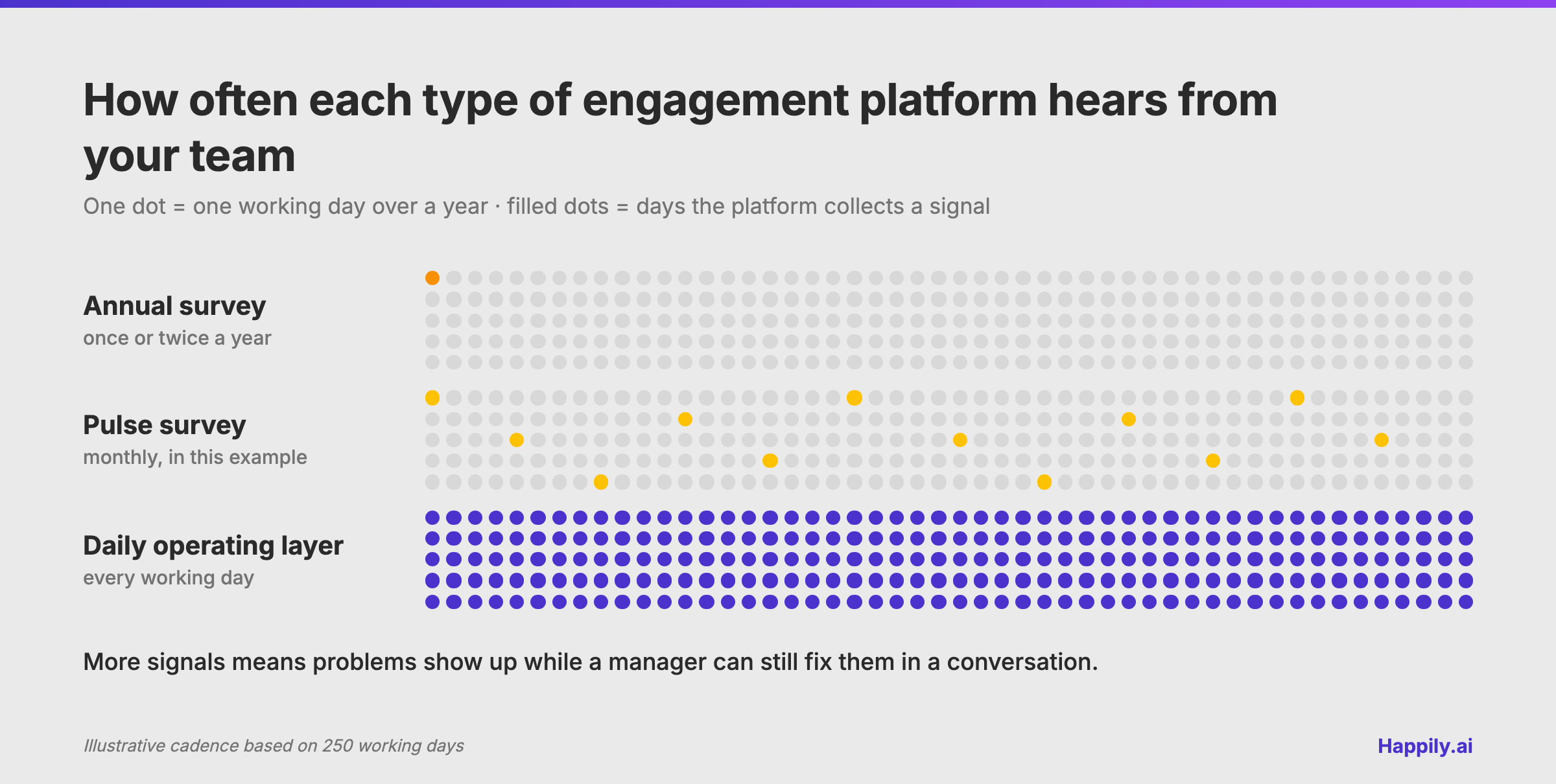
Engagement software has gone through three distinct designs. The difference between them comes down to one variable: how often the platform hears from your people. Cadence decides what a leader can learn, and when.
| Annual survey tools | Pulse survey platforms | Daily operating layer | |
|---|---|---|---|
| Cadence | Once or twice a year | Weekly to quarterly | Every working day |
| Typical usage | A burst during survey season, then silence | Declines as surveys repeat; industry average for ongoing use is about 25% | Built as a habit; Happily sees 97% daily adoption |
| What leaders learn | A detailed snapshot, benchmarked against other companies | Trends between snapshots, faster reads on specific topics | Day-by-day movement in alignment, follow-through, and team strain |
| When it's too late | Problems surface months after they started, often after the resignation | Problems surface weeks after they started | Problems surface while a manager can still fix them in a conversation |
| Best for | Large organizations that need deep benchmarking and formal action planning | Mid-size companies that want more frequent reads without changing daily work | Owner-led companies (30-500 people) that want early signals on execution |
Generation 1: Annual survey tools
The classic engagement survey. Fifty to eighty questions, a response window, a results deck, and action-planning workshops. These tools produce rigorous, benchmarkable data.
Their limit is timing. An annual survey is a lagging indicator by design. By the time results arrive, the people who were quietly checking out have often already left.
Generation 2: Pulse survey platforms
Pulse tools shortened the survey and increased the frequency. Five questions every week or month instead of eighty once a year. That was a real improvement. (We compare the leading options in our roundup of employee pulse survey tools.)
The catch is participation. Frequent surveys that never lead to visible change train people to stop answering. Response rates drift down, and the data drifts toward whoever still bothers to reply.
Generation 3: The daily operating layer
The newest design stops treating engagement as something you survey and treats it as something you run. The platform sits inside the daily rhythm of work: a short check-in, a recognition moment, a nudge to a manager, a look at this week's priorities.
Because it is used daily, it can surface leading indicators: whether people are working on what matters, whether commitments are moving, and whether the team will hold up under load. (If the leading versus lagging distinction is new, our explainer on leading vs lagging indicators covers it.)
Think of a bathroom scale. Weighing yourself once a year tells you what happened. Stepping on it every morning tells you which way you are trending, and the act of stepping on it changes what you eat that day. Engagement works the same way.
Employee engagement platform features: the core checklist
Most platforms offer some version of the following eight features. Use this list to compare vendors, and pay attention to the question in the right column. It separates a feature that exists from a feature that gets used.
| Feature | What it does | The question to ask the vendor |
|---|---|---|
| Surveys and check-ins | Collects structured feedback on engagement, alignment, wellbeing | "What share of employees respond in a normal week, not launch week?" |
| Recognition | Lets peers and managers thank each other publicly, sometimes with rewards | "Is recognition tied to company values and visible to the team?" |
| Continuous feedback | Two-way feedback outside formal reviews | "How does feedback reach the manager who can act on it?" |
| 1:1 support | Agendas, notes, and follow-ups for manager conversations | "Does it pull live team data into the 1:1, or is it a blank template?" |
| Goals and priorities | Tracks OKRs, goals, or weekly focus | "Can I see if people's daily work connects to company priorities?" |
| Analytics | Dashboards, trends, heatmaps by team or manager | "How fresh is the data? Days, weeks, or months old?" |
| Manager enablement | Coaching, nudges, and scorecards for people managers | "What does a manager receive on an ordinary Tuesday?" |
| Integrations | Connects with Slack, Teams, HRIS, SSO | "Can employees respond without opening a new app?" |
Two features deserve extra weight.
Manager enablement matters because Gallup's research finds managers account for about 70% of the variance in team engagement. A platform that only reports to HR skips the people who move the number most. For how this plays out in practice, see how to run 1:1 meetings that actually improve performance.
Goals and priorities matter because engagement without alignment can leave a highly motivated team working hard on the wrong things. The best platforms connect how people feel to what they are working on.
The adoption problem: why usage is the feature that decides all the others
Every feature on that checklist depends on one thing: people using the platform.
Here is the arithmetic. A 200-person company with 25% ongoing usage is hearing from 50 people. Those 50 are rarely a fair sample. They tend to be the most engaged and the most frustrated, while the quiet middle, where drift actually starts, says nothing. The dashboard looks precise. It is describing a minority.
This is why adoption is the leading indicator of whether any other feature matters. Analytics on silence is still silence. Recognition that nobody gives builds no trust. A 1:1 template nobody opens changes no conversations.
So when a vendor demos a beautiful dashboard, ask what it looks like at month six, not week one.
High adoption comes from design choices, and reminders are not one of them:
- Short interactions. Seconds, not minutes.
- Built into existing tools. No extra login.
- Visible follow-through. People keep answering when they see something change.
- Something in it for the employee. Recognition, rewards, or personal insight, not only a data request.
At Happily.ai, these choices produce 97% daily adoption, against an industry average of about 25%. That gap is the whole reason daily leading indicators are possible. A tool nobody uses can only report history.
How to evaluate an employee engagement platform
The right platform depends on who is buying and why. Use this if/then logic before you book a single demo.
If you run a company under about 30 people, you may not need a platform yet. Consistent weekly 1:1s and a shared priorities doc will tell you most of what software would. Revisit when you add a layer of managers.
If you are an owner-operator of a 30-500 person company and your real worry is execution (are people aligned, are commitments moving, will the team hold up), choose a daily operating layer. You need early signals and manager follow-through more than annual benchmarks.
If you are an HR leader at a 500+ person organization who needs formal benchmarking, validated survey science, and board-ready annual reporting, choose a survey-first platform. Our Happily.ai vs Culture Amp comparison walks through that tradeoff in detail.
If your main pain is performance reviews and calibration, you may be shopping for a performance management tool rather than an engagement platform. Many vendors now offer both, but they lead with one.
If your managers will not spend five minutes a week on their teams, no platform will fix that. Start with the manager conversation first.
What about cost?
Pricing varies widely by model (per employee per month, tiered bundles, or free entry plans) and by which modules you add. Rather than quote ranges that go stale, we keep a dedicated, regularly updated breakdown: employee engagement software pricing in 2026.
Honest tradeoffs
No design wins everywhere. Here is where each falls short.
Daily platforms need manager buy-in. A daily layer surfaces signals every day, which means managers have to respond every day. If leadership treats it as an HR project instead of an operating habit, the signals pile up unread. Daily platforms work best when the CEO or founder uses them too.
Survey-first tools are stronger for deep annual benchmarking. If you need to compare your engagement scores against large industry datasets, or you run a formal annual listening program with a dedicated people analytics team, tools like Culture Amp are built for that job. A daily check-in trades survey depth for frequency.
Pulse tools sit in the middle. They are easier to adopt than annual surveys and lighter than a daily layer. For teams that want more frequent reads without changing how managers work, that can be the right balance.
Where Happily.ai fits
Happily.ai is the daily operating layer for team performance, best for owner-led companies of 30-500 people that want leading indicators of execution instead of annual snapshots.
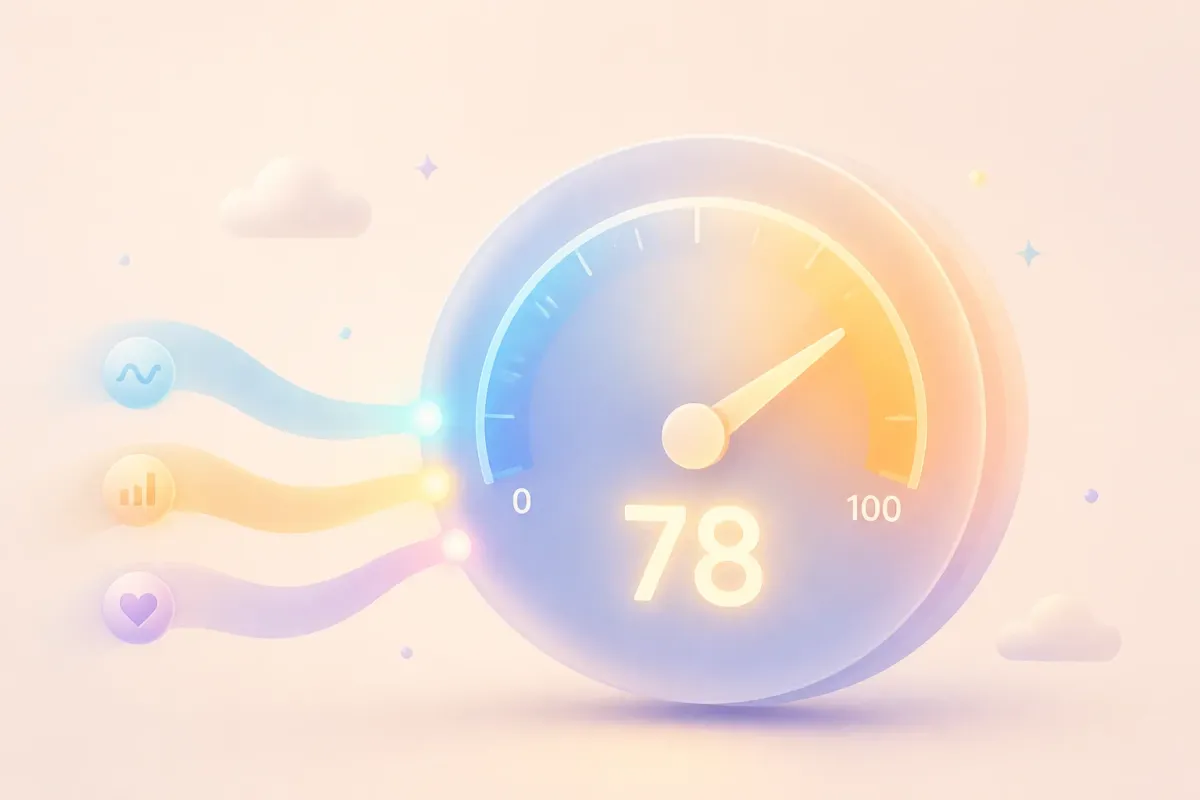
In practice that means a short daily check-in feeds DEBI, a 0-100 engagement index that moves day by day. Manager scorecards show each manager's 1:1 cadence, follow-through, and team health. A hotspot map shows which teams are under strain before a policy change or busy season lands. Gem-based recognition lets people earn rewards they can redeem for perks, and people who give recognition are trusted 9x more by colleagues. Customers have seen a 40% reduction in turnover and a 48-point eNPS improvement.
It is not the right fit if your priority is a deep annual benchmarking survey, or if your managers are not ready to act on what they see each week.
Your KPIs tell you what happened. Happily tells you what's about to. Book a demo to see what your team's leading indicators look like.
Frequently asked questions
What is an employee engagement platform in simple terms?
It is software that helps leaders see how committed and aligned their people are, and helps managers act on it. Most combine surveys or check-ins, recognition, feedback, manager tools, and analytics.
What is the difference between an employee engagement platform and an engagement survey?
A survey is one feature: a set of questions sent at a point in time. A platform wraps surveys in ongoing tools like recognition, 1:1 support, goals, and analytics, so the data leads to action between surveys.
What features should an employee engagement platform have?
At minimum: check-ins or surveys, recognition, feedback, 1:1 support, goals, analytics, manager enablement, and integrations with Slack or Teams. The feature that decides whether the rest matter is adoption. Ask for usage rates after six months, not at launch.
Is an employee engagement platform worth it for a 50-person company?
Often yes, if you have at least one layer of managers and your concern is execution rather than a yearly report. At 50 people a lightweight daily tool usually beats a heavyweight annual survey. Under about 30 people, strong 1:1s may be enough.
How much does an employee engagement platform cost?
Most platforms charge per employee per month, and some offer free entry tiers. Costs rise with modules like performance reviews. See our 2026 pricing guide for current figures.
Sources:
- State of the Global Workplace - Gallup (2026)
- Why Great Managers Are So Rare - Gallup