


On this page
Your night-shift supervisor knows which operator is about to quit. She knows who has been late three times this month and who stopped speaking up at the huddle. Your monthly report learns it from the resignation letter or the incident log.
That gap is what employee engagement software for manufacturing has to close. And most engagement software was built for people who sit at a laptop and read company email, which describes almost nobody on your floor.
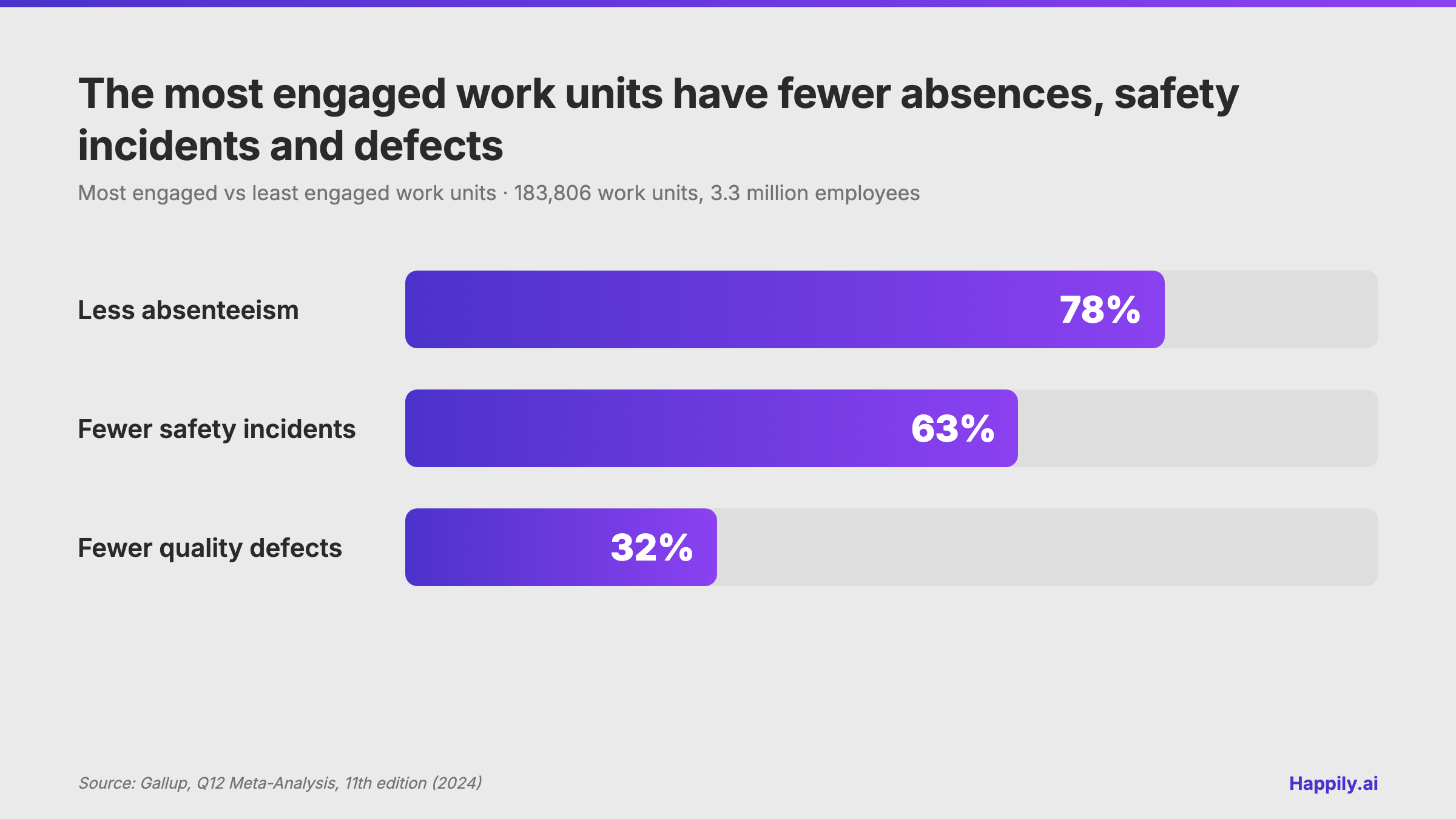
The stakes are measurable. Gallup's 2024 meta-analysis of 3.3 million employees across 183,806 work units found that the most engaged units, compared with the least engaged, had 63% fewer safety incidents, 78% less absenteeism and 32% fewer quality defects. Those are plant metrics, and they move first at the level of the supervisor.
What is employee engagement software for manufacturing?
Employee engagement software for manufacturing is a mobile-first tool that lets shift workers without a desk or company email give quick, frequent feedback, and turns that feedback into supervisor-level signals that warn of turnover, absenteeism and safety risk before they show up in monthly reports.
The last part matters most. KPIs, incident rates and turnover are lagging indicators. A good frontline tool adds leading indicators: early signals from each line and shift while there is still time to act.
Why office engagement tools break on the plant floor
Most engagement platforms assume four things that are false in a factory.
- Everyone has a company email. Operators often don't, so the people you most need to hear from never see the survey.
- People have a quiet moment at a desk. Shift workers have a break and a phone. A 40-question survey competes with lunch and loses.
- One language fits everyone. A survey in the head-office language gets thin answers from a multilingual crew.
- The plant-wide score is the useful number. Plant averages hide the one line where a new supervisor is losing people. Gallup's research on managers found they account for about 70% of the variance in team engagement. On a factory floor, the line supervisor is that manager.
The crews with the highest turnover risk respond least. A tool nobody uses can only report history.
What manufacturing engagement software must do differently
Seven requirements separate a real frontline tool from an office tool with a mobile app bolted on.
- Access without corporate email, on a personal phone or a shared device.
- A check-in short enough for a break: a few taps, a few minutes at most.
- A daily or near-daily rhythm, because people can leave within weeks of starting.
- Supervisor-level signals by line and shift, with anonymity thresholds for small teams.
- Multilingual by default, including the app itself, in Thai, Vietnamese, Burmese, Spanish or whatever your crews speak.
- Shift-aware delivery, so prompts never land at 3 a.m. after a night shift.
- Recognition that reaches the floor, for good work nobody in the office sees.
Evaluation criteria for a manufacturing employee engagement platform
Use this table in vendor demos. The third column is the question that exposes an office tool pretending to be a frontline one.
| Criterion | Why it matters on the floor | Question to ask the vendor |
|---|---|---|
| Access without email | Most operators have no company inbox | "Show me an operator signing in with no email address." |
| Time per check-in | Breaks are short and personal | "Time a check-in on your phone, right now, in this demo." |
| Participation rate | Low response means the loudest voices set the picture | "What share of frontline users respond each week after 90 days?" |
| Supervisor-level view | The supervisor drives most of the variance | "Show me one supervisor's team trend, and the anonymity threshold." |
| Languages | Crews answer honestly in their own language | "Which languages ship today, including the app interface?" |
| Shift awareness | Prompts at the wrong time get ignored | "Can prompts follow each crew's shift pattern?" |
| Scope | Some tools schedule shifts, others read signals | "What does your tool deliberately not do?" |
6 tools compared: frontline engagement options in 2026
These six cover the main types of tool manufacturers evaluate. Each is described from the vendor's own documentation. We don't list prices because they change with headcount. For a breakdown of pricing models, see our guide to employee engagement software pricing.
| Tool | Type | Primary strength | Frontline access | Best for |
|---|---|---|---|---|
| Beekeeper | Frontline communication app | Plant-wide comms, shift info, pulse surveys | Mobile app built for frontline | Large plants that need one channel to reach every worker |
| Connecteam | Deskless operations app | Scheduling, time clock, checklists, chat | Mobile app, GPS clock-in | Smaller operations that want scheduling and comms in one app |
| Workvivo by Zoom | Employee experience platform | Intranet, social feed, recognition | Mobile-first frontline app | Multi-site companies uniting office and frontline under one brand |
| Culture Amp | Survey and performance platform | Survey science, benchmarks, performance | SMS invites, kiosk codes, QR links | Companies with a strong HR team running periodic surveys |
| Workday Peakon Employee Voice | Enterprise continuous listening | Frequent surveys, 60+ languages | Mobile, SMS, kiosk mode | Enterprises already on Workday |
| Happily.ai | Daily operating layer | Daily check-ins, supervisor-level leading indicators | Mobile app, daily habit | Owner-led plants that want early signals by line and supervisor |
Beekeeper
Beekeeper is a frontline workforce platform for manufacturing, retail, hospitality and construction: chat, news streams, shift information, pulse surveys and AI sentiment analysis.
Where it excels: reaching every worker with safety notices and shift updates. Limitation: engagement measurement is one module among many. Best for plants with hundreds or thousands of workers whose first problem is that information never reaches the floor.
Connecteam
Connecteam is an all-in-one app for deskless teams: GPS time clock, scheduling, tasks and checklists, plus chat, surveys, training and recognition.
Where it excels: replacing paper timesheets and chat groups with one app. Limitation: you get surveys, but little in the way of a trend line per supervisor. Best for smaller operations that want scheduling and communication handled before anything else.
Workvivo by Zoom
Workvivo, acquired by Zoom in 2023, is an employee experience platform (intranet, social feed, recognition, analytics) with a mobile-first frontline app.
Where it excels: making frontline workers feel part of the same company as head office. Limitation: value depends on a steady flow of content from a communications team. Best for multi-site manufacturers that want one shared culture channel across plants and offices.
Culture Amp
Culture Amp is a survey and performance platform with strong research behind its question sets. For frontline staff it supports SMS invitations and kiosk codes for shared devices.
Where it excels: well-designed periodic surveys and benchmarking. Limitation: its design centers on email and web, and it works best with an HR team running survey cycles. Best for companies with a dedicated people team and mostly office-based staff plus some frontline sites. (See our full Happily.ai vs Culture Amp comparison.)
Workday Peakon Employee Voice
Peakon is Workday's continuous listening product, delivered by mobile, SMS, email or kiosk in more than 60 languages.
Where it excels: multilingual, frequent surveys at enterprise scale with HR data already in Workday. Limitation: it fits best inside the Workday ecosystem and an enterprise HR operating model. Best for large manufacturers that already run Workday HCM.
Happily.ai
Happily.ai is the daily operating layer for team performance. Employees complete a short daily check-in in the Happily app, and leaders see leading indicators of focus, progress and team strain by team and manager. Happily reports 97% daily adoption, against an industry average of about 25% for culture tools.
Where it excels: daily signals at supervisor level, plus peer recognition built into the same habit. Limitation: it does not schedule shifts, clock time, run payroll or replace a plant communication channel. Best for owner-operators and plant leaders who want to see which line is slipping this week, not next quarter.
Which one should you choose?
Most plants need two layers: a channel that reaches every worker, and a signal that tells leaders where to act. Few tools do both well, so start with your bigger problem.
- Choose Beekeeper if your biggest problem is that safety notices and shift changes don't reach the floor.
- Choose Connecteam if you still run schedules and timesheets on paper or spreadsheets and need that fixed first.
- Choose Workvivo if you run several sites and want one culture channel connecting plants and offices.
- Choose Culture Amp if you have an experienced HR team and want benchmarked surveys a few times a year.
- Choose Workday Peakon if you are already on Workday and need many languages at enterprise scale.
- Choose Happily.ai if you want early warning by line and supervisor on turnover, absenteeism and strain, and you want it to run as a daily habit without an HR team chasing responses.
Pairing a communication or scheduling app with a daily-signal tool is common. For a wider view of the market beyond manufacturing, see our comparison of the best employee engagement tools.
Where Happily fits in a plant, and where it doesn't
Alliance Laundry Thailand runs Happily in its factory. Managing Director Ben Dobbs describes a factory of 300 people growing quickly, and says of the platform: "We use it a lot to identify those risk employees."
That is the leading-indicator use case. Here is what sits behind it:
- Daily check-ins take a few minutes and are designed as a habit. See how this compares with other pulse survey tools built for daily use.
- DEBI (Dynamic Engagement Behavior Index) is a 0-100 engagement score for each team that moves day by day. Think of it as a bathroom scale. An annual survey is a yearly weigh-in. DEBI is the daily step on the scale that changes what you do today. (What DEBI measures.)
- Manager scorecards show each supervisor's team-health trend, recognition given and follow-through. Useful for coaching supervisors promoted from the line. (See our manager effectiveness scorecard.)
- The hotspot map shows which teams, managers and locations are under strain. Set lines or shifts up as teams and you see which one is slipping.
- Gem-based recognition lets peers and supervisors recognize each other. Gems redeem for perks the company chooses, such as a preferred shift, a late start or a team meal. People who give recognition are trusted 9x more by colleagues, and falling recognition is one of the earliest signs that someone is about to leave.
Across customers, Happily reports a 40% reduction in turnover and a 48-point eNPS improvement.
Where Happily is not the right fit:
- You need shift scheduling, time clocks or payroll. Use Connecteam or your workforce management system alongside it.
- You need a broadcast channel for plant-wide announcements. Beekeeper or Workvivo are stronger there.
- Most of your crew has no personal smartphone. Confirm the access model with us in a demo before committing.
- Your crews speak many languages. Most Happily customers are Thailand-based teams, so if your crews speak Vietnamese, Burmese or Khmer, ask for the current language list and test it with a real crew.
A 30-day test on one line
- Pick one line and one supervisor with turnover or absence you already worry about.
- Measure week-four participation. If fewer than half the crew still respond, the tool will not produce leading indicators.
- Compare the signal with what the supervisor already knows. A good tool confirms her instincts and surfaces one thing she missed.
- Count decisions changed. Did the tool change one schedule, conversation or recognition moment inside the month?
FAQ
What is the best employee engagement software for manufacturing? It depends on your bigger problem. If information doesn't reach the floor, a frontline communication app like Beekeeper fits. If you need early warning on turnover and absenteeism by line and supervisor, a daily-signal platform like Happily.ai fits. Many plants use one of each.
How do you engage frontline workers who don't have company email? Use a tool built for phones and shared devices, keep each check-in to a few taps, and deliver it during the shift. Then show workers their answers change something, or participation falls fast.
Can engagement software reduce safety incidents in a factory? Gallup's 2024 meta-analysis found the most engaged work units had 63% fewer safety incidents than the least engaged. Software doesn't prevent accidents. It helps supervisors see strain and fatigue on a line early enough to act.
Is Happily.ai a good fit for a 300-person manufacturing plant? It can be. Alliance Laundry Thailand uses Happily in a 300-person factory to identify at-risk employees. It is not a scheduling or payroll tool, so pair it with one if you need those.
How often should manufacturing employees be surveyed? Frequently and briefly. A short daily or weekly check-in gives supervisors a trend they can act on the same week. An annual survey arrives after people have left.
See your plant's signals before the monthly report does
Your KPIs tell you what happened. Happily tells you what's about to. If you run a plant and want to see which line or supervisor needs attention this week, book a 30-minute demo. Bring one line you are unsure about.
Sources:
- Q12 Meta-Analysis, 11th Edition - Gallup (2024)
- State of the American Manager - Gallup (2015)
- Employee app for manufacturing - Beekeeper
- Connecteam employee scheduling app - Connecteam
- Zoom to acquire Workvivo - Zoom (2023)
- Send survey invitations by SMS and Kiosk mode for employees without email - Culture Amp Support
- Workday Peakon Employee Voice datasheet - Workday
- Alliance Laundry success story - Happily.ai