


On this page
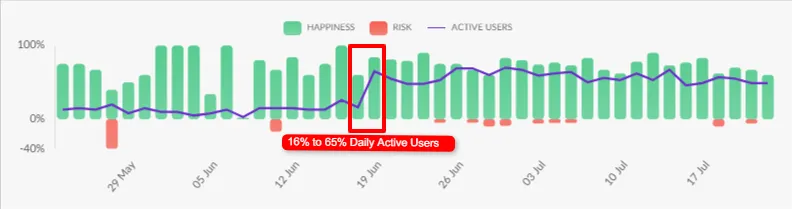
An employee engagement workshop created an immediate activity jump at one 248-person company. The increase did not disappear when everyone returned to work. After a rotating peer network launched six days later, weekday activity remained 39.6% above its matched baseline for 20 workdays.
That sequence offers a practical lesson for employee engagement workshops. The event creates shared attention. The next 30 days determine whether that attention becomes a workplace habit.
An employee engagement workshop is a structured session that helps employees understand, practice, or commit to behaviors that improve how they experience and contribute to work. It is best for organizations with a specific behavior to change, leadership support, and enough operational capacity to follow through after the event.
Why Employee Engagement Workshops Fade
A workshop temporarily changes three conditions. People share the same context. Leaders signal that the topic matters. Participants have time to reflect away from their normal workload.
The next morning, the old environment returns. The calendar fills. Team boundaries reappear. The new behavior competes with familiar cues and habits.
Workplace behavior-change research consistently points to the same transfer problem: insight during an event does not guarantee action afterward. People need a clear behavior, a low-friction prompt, visible progress, and reinforcement close to the moment of choice.
| Workshop design | What happens during the event | What happens after the event |
|---|---|---|
| Workshop only | Shared energy and commitment | Old cues regain control |
| Workshop plus reminders | The topic stays visible | Messages compete for attention |
| Workshop plus manager follow-up | Teams gain local accountability | Quality varies by manager |
| Workshop plus rotating peers | Progress becomes socially visible | Reinforcement can cross team boundaries |
The strongest approach can combine all four. The important decision is to design the follow-through before people enter the room.
Before the Workshop: Define One Observable Behavior
Broad goals produce broad conversations. "Improve engagement" does not tell an employee what to do at 10:15 on Tuesday.
Choose one behavior that a colleague could observe. Examples include:
- Share today's most important priority before noon
- Recognize one helpful action with a specific reason
- Record progress on a team commitment
- Ask for help before a blocker becomes a delay
- Check in on wellbeing at the start of a shift
Keep the first cycle narrow. A workshop that launches ten new behaviors creates ten weak signals. One visible behavior gives the organization a chance to build a real rhythm.
Establish the Baseline
Measure at least four complete weeks before the workshop when possible. Compare like with like. Monday activity should be compared with earlier Mondays because weekday patterns can differ sharply.
Track both depth and breadth:
| Measure | What it tells you |
|---|---|
| Daily active employees | Overall participation volume |
| Weekly unique participants | Whether the behavior reaches more people |
| Team coverage | Whether adoption is concentrated in a few groups |
| Repeat participation | Whether the action is becoming habitual |
| Peer-response rate | Whether visible progress prompts follow-through |
Annual engagement scores can remain part of the measurement system. They answer a different question. Daily behavioral signals show whether the intervention is operating now.
Day 0: Use the Workshop to Create a Shared Starting Point
The workshop should make the target behavior concrete. Give participants a chance to practice it, see an example, and decide when they will use it next.
End with a commitment that can survive contact with the calendar:
- What will you do?
- When will you do it?
- Who will be able to see that you did it?
- What should happen if you get stuck?
Avoid ending with a long action-plan document. A single visible next step is more useful than twelve intentions stored in a shared drive.
Managers need a specific role too. Their job during the first week is to remove friction and model the behavior. Asking them to "keep the energy going" is too vague to execute.
Days 1-5: Convert Workshop Energy Into a Daily Signal
The case company waited six days between its June 24 workshop and the first Triad cycle on June 30. Activity rose during those four intervening workdays, which suggests the workshop created the initial activation.
Use this bridge period to:
- Send one prompt tied to the exact behavior
- Let employees record the action in under a minute
- Show individual progress without public ranking
- Ask managers to respond to blockers
- Fix confusing language or access problems immediately
This is a diagnostic period. If people cannot perform the behavior during the first five days, adding more social pressure will not solve the underlying friction.
If participation is broad but inconsistent, add reinforcement. If participation is narrow, revisit access, relevance, and leadership modeling first.
Days 6-20: Add Small Peer Accountability Groups
The next step is a small social unit. Three people is large enough to provide more than one source of reinforcement and small enough for progress to remain legible.
In the case study, the first rotation created 82 small components. The second cycle introduced new pairings. Across both rotations, 248 employees gained 504 unique peer connections, with 51.2% crossing a team boundary.
Each group should be able to see:
- The shared target behavior
- Who has made progress
- How much of the cycle remains
- A simple way to encourage a peer
- Where to ask for help
Visible progress matters because it changes the timing of the prompt. Across 1,387 check-ins, employees followed through on 30.9% of opportunities after a peer had already checked in, compared with 26.9% without a peer signal.
That 4.0 percentage-point difference is an association, not proof that one check-in caused another. The pattern still gives leaders a useful design hypothesis to test in their own organization.
Keep Accountability Supportive
Peer accountability should reduce friction, not create surveillance. Avoid public leaderboards, punishment for missed days, or language that turns colleagues into monitors.
Use progress visibility to help people notice and support one another. A peer can send a helpful prompt that feels different from another automated reminder or manager escalation.
The principles behind employee engagement gamification apply here: make the action small, show progress, provide meaningful social reinforcement, and keep participation psychologically safe.
Days 21-30: Rotate the Network and Measure the Shift
Fixed groups eventually become another silo. Rotate members before the structure gets stale, while avoiding recent repeats and direct manager-report pairings where possible.
The second rotation in the case study connected all 248 active employees into one cumulative network. That did not create 248 direct relationships for each person. It created bridges through which information and reinforcement could move across the organization.
At day 30, compare:
- Weekday-matched activity before and after
- Weekly unique reach
- Participation by team
- First-time versus repeat participants
- Cross-team connections created
- Peer-response patterns
Use the following decision rules:
| What you observe | What to do next |
|---|---|
| Activity and reach both rise | Continue the cycle and test a second rotation |
| Activity rises but reach stays flat | Reduce friction for nonparticipants and inspect team coverage |
| Reach rises but repeat activity falls | Simplify the action or strengthen its relevance |
| Only manager-led teams improve | Add manager enablement before expanding |
| Peer prompts feel coercive | Redesign language, privacy, and group expectations |
| No meaningful shift appears | Stop scaling and revisit the target behavior |
This is how leaders protect the organization from "successful workshop" stories that cannot be found in the data a month later.
What the 60-Day Case Study Found About Employee Engagement Workshops
The anonymized enterprise IT services company averaged 65.7 active employees per matched baseline workday. After the workshop and Triad launch, the observed average was 91.7.
Complete-week reach increased from 112.9 across eight pre-workshop weeks to 153.3 across four post-launch weeks. Eighteen of 20 post-launch workdays were above expectation.
A broader production cohort also moved. Nineteen other qualified companies with a June 30 Triad cycle averaged 10.9% above matched expectation through the first full cycle and 9.7% above expectation through four weeks. Thirteen of 19 increased.
The study cannot isolate the workshop from Triad because they launched six days apart. All active employees at the case company received Triad, and only two qualified non-Triad companies met the same activity thresholds. Treat the results as strong evidence for the combined sequence, not a guaranteed Triad effect.
How Happily.ai Supports Workshop Follow-Through
Happily.ai is a Culture Activation platform for organizations that want culture-building behaviors to operate daily. Triad creates rotating groups of three or four colleagues, makes progress visible, and introduces new cross-team connections.
DEBI, the Dynamic Engagement Behavior Index, measures engagement through ongoing behavioral signals. It complements engagement surveys by showing whether participation and follow-through are changing between survey cycles.
This approach is best for companies that have a clear behavior to activate and leaders willing to respond to the data. A survey-only tool may be a better fit when the priority is annual benchmarking or compliance reporting. A facilitation partner may be more important when leadership has not yet agreed on the behavior or operating change the workshop should create.
For a broader buying framework, see engagement platforms that change behavior.
FAQ
How long should an employee engagement workshop be?
The right length depends on the behavior and group size. A focused half-day can establish shared language and practice one behavior. Longer events are useful when teams need to resolve deeper operating issues. Event length does not replace follow-through.
What should happen after an employee engagement workshop?
Launch one observable behavior within the first working week. Provide a low-friction way to record progress, give managers a clear support role, and add small peer groups when the behavior is workable.
How do you measure whether an engagement workshop worked?
Compare weekday-matched activity, weekly unique reach, team coverage, and repeat participation against a pre-workshop baseline. Add survey measures when you also need sentiment or benchmark data.
Do accountability groups improve engagement?
Small groups can provide timely social reinforcement. In this case, peer-visible progress was associated with 4.0 percentage points more follow-through. The study was observational, so companies should test the mechanism against their own baseline.
Is Happily.ai a replacement for engagement workshops?
No. Happily can provide the daily activation, measurement, and rotating peer structure that follows a workshop. The workshop still plays an important role when people need shared context, discussion, and practice.
Key Takeaways
- Choose one observable behavior before the workshop begins.
- Use the first five workdays to remove friction and establish a daily signal.
- Add supportive groups of three when the behavior is ready for social reinforcement.
- Rotate groups to create cross-team bridges.
- Measure weekly reach and repeat behavior, not only workshop ratings.
Read the complete methodology in When Engagement Became Social.
Want a follow-through system for your next culture or engagement workshop? Book a demo to see how Triad and DEBI work together.
To cite this research: Happily Research, "When Engagement Became Social: A 60-Day Network Case Study," July 2026. Available at https://happily.ai/research/networked-behavior-change/
Sources:
- When Engagement Became Social - Happily Research (2026)
- The Spread of Behavior in an Online Social Network Experiment - Damon Centola, Science (2010)
- Network Interventions - Thomas Valente, Science (2012)
- Structural Diversity in Social Contagion - Ugander, Backstrom, Marlow, and Kleinberg, PNAS (2012)