


On this page
For six months, Progression Group had low engagement on Happily. Check-ins were sparse. Feedback sat unanswered. Monthly Active Users had dropped to 40% of their 36-person team.
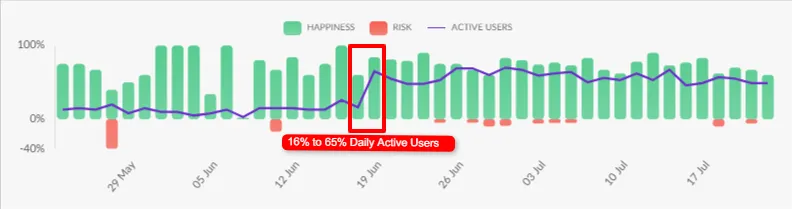
Then, on June 19th, daily check-in participation jumped from 16% to 65% in a single day - and stayed there. By July, their org health metrics had moved from critical territory into the “good” range across almost every dimension: Daily/Weekly/Monthly Active Users, Manager Reply Rate, Recognition Participation, and more.
We asked them what happened.
Their answer wasn’t a new feature, a surprise team outing, or a company-wide mandate about app usage. It was something more fundamental: their leaders decided to show up differently. And their people followed.
The habit had broken
The team had used Happily well in the past. But when peak business season hit, the platform moved to the back burner — and without any formal expectations or accountability structures in place, there was nothing to catch the drift. Managers got busy, check-ins got skipped, and the habit gradually dissolved. Once that happens, it rarely restarts on its own. It needs a deliberate push.
This is a pattern our research has documented carefully. In The Ripple Effect: How Leader Behavior Spreads, and What Happens When It Stops, we found that when leaders stop recognizing people or responding to feedback, their teams gradually do the same. The encouraging part of that finding is buried at the end: teams can recover when leaders restart. But restarting requires intent.
Progression Group got intentional.
What they actually did
The management team moved on five fronts at once.
They made it visible.
The leadership team sent a direct message to all staff through the internal chat and brought it up at the Town Hall and the weekly team meeting, making clear that re-engaging with Happily wasn’t a background suggestion. It was something the leadership cared about and wanted people to act on.
They made it accountable.
Managers were asked to check in with their teams through Happily at least once a week and to respond to any feedback they received promptly. More than that, their usage as a manager became a formal factor in their performance evaluation. The platform wasn’t optional; it was part of how a good manager was defined in that company.
They made recognition tangible.
A small internal recognition initiative encouraged managers to give shout-outs to team members who showed initiative or went beyond what was expected. But the piece that really moved people was the rewards. Employees earn coins through Happily and can redeem them for rewards, and Progression Group added their own custom option: vouchers for a service their staff loved. Recognition stopped being symbolic. It had real, specific value to the people receiving it.
They followed up in person.
After receiving responses through Happily, managers didn’t just reply in the app. They followed up face-to-face with each staff member. That personal touch reinforced that the feedback wasn’t going into a void; it was being taken seriously by a real person.
And they were genuine about it.
This last point is the one the team at Progression Group emphasized most. Their company has six core values that they take seriously, and when employees saw managers stepping up by responding to messages, acting on what they heard, and showing through their behavior that this mattered, it built the kind of trust that makes people willing to participate.
"When employees saw managers stepping up, taking the lead, and following through with real actions, it built trust and encouraged even more participation."
Why manager behavior is the variable that explains almost everything
What Progression Group did intuitively aligns with what our research has been pointing to for some time.
In The Manager Gap: Why Two Teams in the Same Company Diverge, we found that nearly half of the observed differences in team engagement appear between managers, even when they’re working inside the same organizational culture. Same company, same HR policies, same benefits. The variable that explains why one team thrives while another quietly disengages is often the person leading them.
And it’s not about skill or personality. It’s about consistency.
Teams respond better when managers show up and reply regularly, not necessarily when they reply quickly, or when they write longer responses, or when they run more elaborate programs. The research in The Engagement Cascade: How Far Each Management Layer Reaches found that the effect of leader behavior is strongest close to the leader and grows weaker as it travels down through layers of management. Most managers reliably influence their direct teams. Only the top leader consistently reaches two levels down.
This is why what happened at Progression Group on June 19th makes complete sense in retrospect. The founder’s company-wide message wasn’t just a reminder. It was an act of leadership that was visible to everyone at once. And because the managers had been made accountable through performance evaluation and expectation-setting, they had a structure that reinforced the behavior rather than leaving it to goodwill alone.
The result
By July, their numbers looked like this:
| Measure | Reported change | Comparison in the case study |
|---|---|---|
| Weekly Active Users | 25% → 87% | Weekly Active Users went from 25% before the meeting, to 87% by the end of the month |
| Monthly Active Users | 40% → 92% | Monthly Active Users went from 40% in June to 92% in July |
| Recognition | 31% → 71% | Recognition Participation climbed from 31% before to 71% after |
| Manager Reply Rate | 27% → 78% | Manager Reply Rate to employee feedback moved from 27% to 78% |
| Dynamic Engagement Behavior Index (DEBI) | 43.0 → 74.4 | Overall engagement scores jumped from 43 to 74.4 |
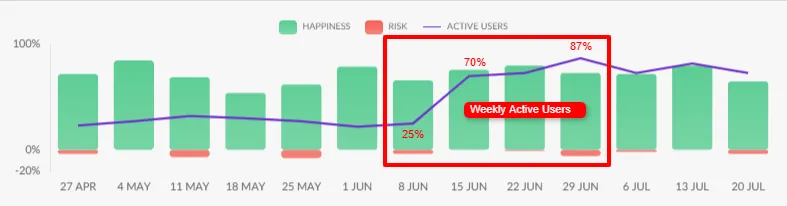
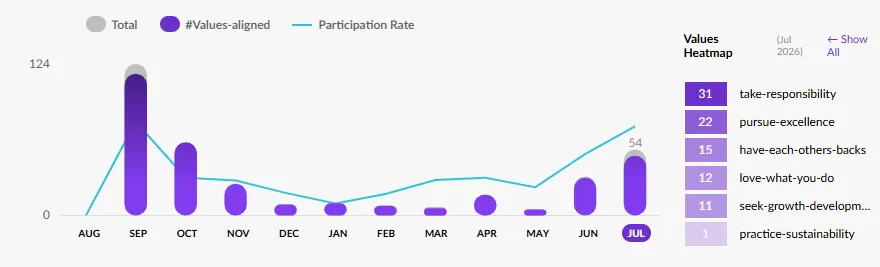
Six months of drift reversed in a single month. And based on the daily data, most of that reversal happened in the first week.
"The core success really came from the genuine commitment of our managers to listen, respond, and take meaningful action based on what they learned."
That’s not a product insight. That’s a leadership insight. The platform gave them the signal. The managers gave it meaning.
The thing worth borrowing
Not every company has the same structure as Progression Group. But the core of what they did is transferable.
They stopped treating engagement as something that happens to a team and started treating it as something managers are responsible for modeling. They made that responsibility explicit, tied to evaluation, recognition, and personal follow-up. And when their managers showed up consistently, their people did too. The harder lesson, in their own words, is that this structure should have been in place from day one; not introduced as a recovery measure after months of drift.
Our research keeps arriving at the same conclusion: habits outperform skills. A manager who replies regularly, every week, does more for team engagement than one who occasionally writes the perfect response. The behavior needs to be consistent enough to become the culture, and culture needs someone at the top to keep modeling it.
Progression Group found that out the hard way, then found their way back. Their story is worth knowing.
Considering a restart for your team? Explore Happily to see how check-ins, recognition, and manager replies work together.
Measurement note: These are reported before-and-after comparisons with different time windows. The changes were introduced together, so the figures do not isolate the effect of any one action. The charts show participation in Happily; they do not establish a matching change in employee wellbeing or business performance.