


On this page
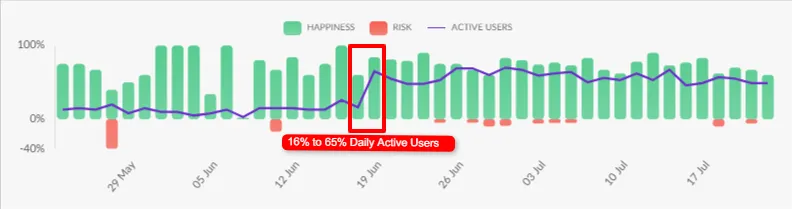
A global technology company began its Happily.ai pilot without switching on rewards. Weekly active participation reached 93%. After the pilot ended and ownership became unclear, participation fell. When leadership committed to continuing, the team rebuilt the habit.
The recovery involved four changes: clear expectations, practical manager training, accountability in manager appraisals, and rewards built around what employees had already said they valued.
This is the story of one business unit, and what other teams can borrow from its experience.
A strong pilot, followed by a loss of direction
The company piloted Happily with a business unit of roughly 100 employees and 25 managers across seven countries for three months. Its challenges were familiar: psychological safety, communication and collaboration across teams, and friction that was difficult to surface through normal management channels.
During the pilot, everyone knew why they were participating and how long it would run. Managers were replying, too: the pilot recorded a 44% Manager Reply Rate and 58% Responsive Managers.
The team reached 93% weekly active participation without redeemable rewards. In this business unit, rewards were not necessary for a strong start.
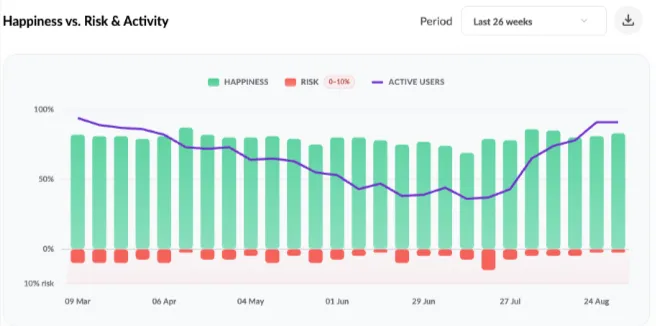
Then the pilot ended. The decision about whether to continue took time. While it was pending, the platform stayed available, but there was no clear owner or continuing expectation. Managers' attention moved to the things their organisation was explicitly measuring.
By July, Manager Reply Rate had fallen to 13%, and Responsive Managers to 6%.
The manager numbers showed the drift
From April to July, the reported share of responsive managers fell from 55% to 6%. Manager Reply Rate fell from 46% to 13%, while recognition participation fell from 40% to 13%.
The platform was still there. The reasons to keep using it had become less clear.
Reported happiness stayed between 75% and 82%, and the reported risk measure between 3% and 4%. Those readings did not show the same deterioration as participation. They also could not establish that everything was fine: as fewer people participated, the people represented in the data may have changed.
The practical lesson is to look at who is still responding, alongside what their responses say.
Four actions helped rebuild participation
1. Leadership gave direction and reinforced it
At the end of July, leadership communicated the decision to continue directly to the business unit. Using Happily was expected, and manager participation would form part of the appraisal process.
Leadership followed the announcement with reminders. The expectation became something managers heard repeatedly, rather than a launch message they were left to interpret on their own.
For a team restarting a habit, that continuing attention matters. It makes clear that the decision still stands after the first announcement.
2. Managers received practical support
Two weeks later, the company brought the Happily team in to run a Manager Success Workshop, its second after onboarding.
Telling managers to respond is one thing. Helping them work through a useful response is another. Managers need to decide what to do with critical feedback, when to ask a follow-up question, when something needs escalation, and what to say when there is no immediate solution.
The workshop focused on making those behaviours practical. Readers planning a similar restart can also use this 30-day workshop follow-through plan.
The source account reports improvements in manager behaviour through August, including a rise in Manager Reply Rate from 13% to 34%. Those changes are consistent with renewed manager attention, although the workshop's contribution cannot be separated from the other changes introduced alongside it.
3. Responding became part of manager accountability
Happily became a formal KPI in the manager appraisal process. Responding to the team now had a place alongside the other responsibilities managers were being assessed on.
The account describes the emphasis as whether managers responded to their teams, rather than time spent in the app. That distinction matters when adapting the approach: a useful reply is the behaviour to encourage, and activity alone does not tell you whether a conversation helped.
For teams defining their own measures, this guide to measuring manager effectiveness offers a broader starting point.
4. Rewards reflected what employees had asked for
Monetary vouchers were not a comfortable fit for the company. Employee feedback pointed to a different option.
Through daily check-ins, employees had described the strain of commuting to the office five days a week: travel time, fatigue, rigid hours, heat and traffic. Several had said that a three-day office week would give them back energy and focus.
The company made time the reward. Under its programme, a work-from-home day could be redeemed for 150 coins or one gem, and a day off for four gems. Coins were earned through feedback and recognition, and gems through performance.
In the first three weeks, 35 rewards were redeemed by 25 people, roughly a quarter of the participating business unit.
The useful idea is the connection between listening and action. Employees had described something they valued, and the company used that information to shape the programme. Another organisation would need to choose benefits and eligibility rules that fit its workforce.
What changed
The case report's comparison of its latest 30-day period with the preceding period showed improvements in participation, replies and recognition:
| Measure | Previous period | Latest period | Change |
|---|---|---|---|
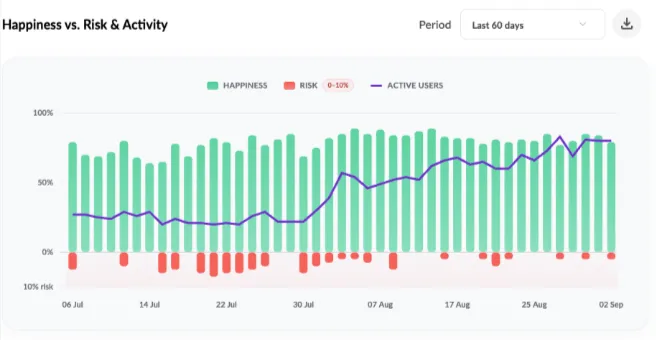
| Weekly active users | 45% | 92% | +47 percentage points |
| Monthly active users | 57% | 93% | +36 percentage points |
| Manager Reply Rate | 34% | 62% | +28 percentage points |
| Responsive Managers | 12% | 44% | +32 percentage points |
| Recognition Participation | 30% | 57% | +27 percentage points |
| Feedback Rate | 59% | 68% | +9 percentage points |
Weekly active participation was close to the pilot's reported 93%. Recognition participation reached 57%, matching the level reported during the pilot months.
The report also recorded improvements in happiness (75 to 83), psychological safety (83 to 88), and employee Net Promoter Score, or eNPS (48 to 56). These are accompanying survey results, rather than evidence that the programme caused a wider business improvement.
Measurement note: Figures are taken from the customer case report and describe one business unit. Several changes were introduced together, so their individual effects cannot be separated. Platform participation measures describe use of Happily; they do not directly measure productivity. Changes in survey participation may also affect comparisons of survey scores.
The thing worth borrowing
Treat the four actions as connected parts of a rollout:
- Give people a clear reason to participate and make ownership explicit.
- Help managers practise the responses expected of them.
- Include those responsibilities in how managers are evaluated.
- Use employee feedback to choose rewards people value.
Then keep reinforcing the expectation. In this case, the recovery followed a renewed leadership commitment supported by training, accountability and relevant rewards.
Not everyone will use a platform every week, and that is not automatically a rollout failure. The goal is a reliable majority, and managers who respond.
Planning a rollout or restarting one? Explore Happily to see how check-ins, recognition and manager feedback can support that work.