



On this page
Emotional intelligence training for managers works. The evidence on that is clear. The catch is where it works: in the weeks after the workshop, inside the manager's actual team, when nobody is taking notes.
A 2019 meta-analysis by Victoria Mattingly and Kurt Kraiger pooled 58 studies of emotional intelligence training and found a moderate, positive effect. EI can be trained. But a separate body of research on training transfer shows that for "soft" skills like leadership and empathy, what happens back at work after the course matters far more than the course itself.
So the useful question for a CEO or HR lead is this: what will make managers practice EI on a Tuesday afternoon when a deadline is slipping?
This guide covers what EI looks like in manager behavior, a curriculum built on daily micro-practices, how to measure whether it worked using signals from the team, and a 30-day plan.
Emotional intelligence training for managers is a development program that builds a manager's ability to notice, name, and respond to emotions (their own and their team's) in ways that improve how the team works. The best programs are measured by what changes in the team, not by how the manager rated the course.
Why one-off EI workshops fade
Two findings explain most of the gap between a great workshop and no change on the floor.
Forgetting starts immediately. Hermann Ebbinghaus first mapped the forgetting curve in the 1880s. When Jaap Murre and Joeri Dros replicated his experiment in 2015, the curve held up: most forgetting happens in the first hours and days after learning, then levels off. A one-day workshop fights that curve with no reinforcement at all.
Soft skills depend on the environment you return to. Brian Blume and colleagues analyzed 89 studies of training transfer in 2010. For "open" skills (interpersonal and leadership skills, where the learner chooses when and how to apply them), the work environment after training was linked to whether the skill got used (a correlation of .26). For rule-based "closed" skills, the environment barely mattered (.04). Supervisor support showed one of the strongest links of all (.31).
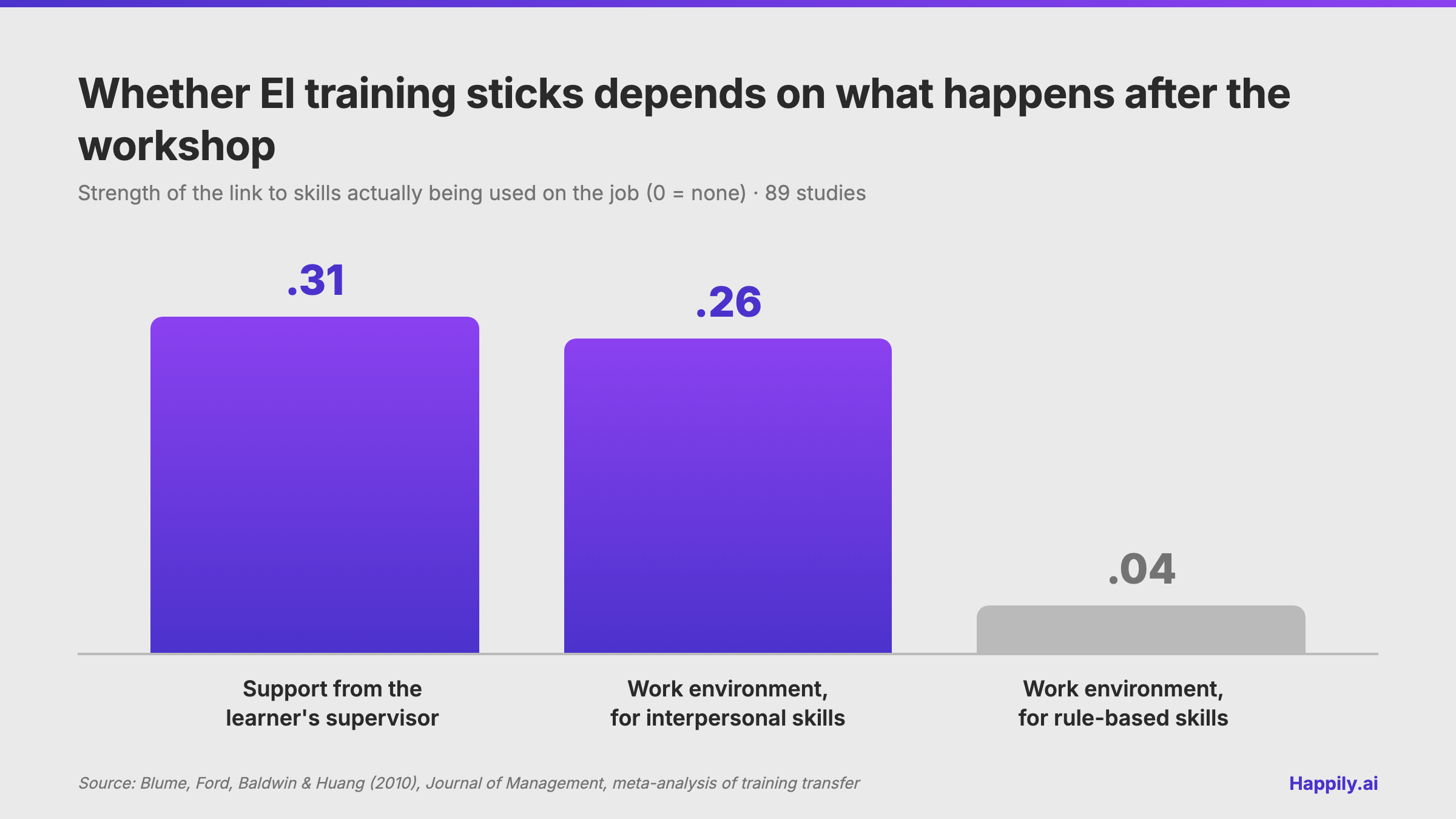
Put plainly: a manager who learns to "pause before reacting" will only keep doing it if something in their week prompts it, rewards it, and makes it visible. EI is exactly the kind of open skill that dies in an unsupportive week.
That is also why most emotional intelligence corporate training gets rated highly on the day and forgotten by the next quarter. The satisfaction score measured the event. Nobody measured the habit.
What emotional intelligence looks like in a manager's day
EI sounds abstract until you watch a manager in a hard moment. Four behaviors carry most of the weight.
- Noticing. Picking up that someone went quiet in stand-up, or that their own irritation is rising before they reply to a message.
- Naming. Putting a plain label on it, privately or out loud: "You seem stretched this week. Is that right?"
- Responding. Choosing a response that fits the person and the moment, instead of the default one.
- Regulating under pressure. Staying steady when a launch slips or a client escalates, so the team takes its cue from calm instead of alarm.
This order matters. Dana Joseph and Daniel Newman's 2010 meta-analysis in the Journal of Applied Psychology found support for a "cascading" model: perceiving emotions comes first, understanding them builds on that, and regulating them builds on understanding. Managers who try to "regulate" without first noticing tend to suppress, which teams read as coldness.
Joseph and Newman also found that the link between ability-based EI and job performance depends on the job. It was positive in roles with heavy emotional labor and weaker or negative in roles with little. Managing people is high on emotional labor, which is why EI shows up so clearly in how teams experience their manager.
An EQ training curriculum for leaders built on daily practice
Here is a curriculum that turns each skill into a small daily action and tells you what you should see in the team if it is working.
| Skill | Daily micro-practice (under 5 minutes) | What you would observe in the team |
|---|---|---|
| Noticing (self) | Before your first meeting, rate your own energy 1-5 and write one word for your mood | Fewer sharp replies late in the day; team says the manager is "consistent" |
| Noticing (others) | In each 1:1 or stand-up, note one person whose tone or energy changed | Issues surface earlier; fewer surprises in retros |
| Naming | Once a day, check an observation out loud: "I noticed X. Am I reading that right?" | People correct the manager more often, a sign they feel safe to |
| Responding | Before replying to a tense message, ask "what does this person need from me right now?" | Shorter conflict threads; more follow-up questions, fewer defensive ones |
| Regulating | When stress spikes, take one deliberate pause before deciding or replying | Team stays on task during incidents; fewer escalations to you |
| Recognizing | Give one specific piece of recognition daily, naming the behavior | Recognition starts flowing peer to peer, not only top-down |
Each practice is small enough to survive a bad week, happens inside work the manager already does, and has a signal in the team you can measure.
If your managers are building related skills, pair this with communication skills training for managers. The two overlap heavily in practice.
How to measure whether emotional intelligence training worked
Most programs measure the manager: a post-course survey, or a before-and-after EI assessment. Both have value. Neither tells you whether the team feels the difference.
Measure the team instead. These are leading indicators: they move weeks before turnover or performance data does.
| Signal | What to track | Why it predicts |
|---|---|---|
| 1:1 quality | Are 1:1s happening on cadence, and do people say they were useful? | Skipped or shallow 1:1s are often the first visible sign of a strained relationship |
| Feedback flow | How often the manager gives specific feedback and recognition | Specific recognition requires noticing, the first EI skill |
| Psychological safety | Do people raise problems, disagree, and admit mistakes? | Amy Edmondson's study of 51 work teams linked psychological safety to team learning behavior, which in turn linked to performance |
| Team pulse | Short, frequent check-ins on energy and workload | A dip in one team, week over week, is a prompt the manager can act on now |
| Escalations | How often issues reach you that the manager could have handled | Better regulation shows up as fewer fires reaching the top |
Why focus here? Gallup's research across 2.7 million employees found that managers account for at least 70% of the variance in team engagement. If EI training changes the manager, the team's signals will move. If they don't move, the training didn't transfer, whatever the course rating says. For a fuller framework, see how to measure manager effectiveness and the Gallup 70% rule.
Emotional intelligence in the workplace training: your options compared
No single format does everything. Here is how the main options stack up.
| Option | Where it excels | Honest limitation | Best for |
|---|---|---|---|
| Workshops (1-2 days) | Shared language, fast rollout, low cost per head | Fades fast without reinforcement | Companies launching EI as a shared vocabulary |
| 1:1 executive coaching | Deep, personal, handles complex situations | Expensive; hard to scale past senior leaders | Senior leaders with high-stakes teams |
| Assessments (EQ-i 2.0, MSCEIT) | Baseline data and self-awareness | A score is a starting point, not a behavior change | Programs that want a before-and-after benchmark |
| Daily practice platforms | Reinforcement inside the workday, team-level signals | Needs manager buy-in; not a substitute for a hard conversation | Companies that want habits and measurement across all managers |
On the two main assessments: the EQ-i 2.0 from MHS is a self-report questionnaire of 133 items covering 15 subscales across five composites (such as self-perception and stress management). The MSCEIT is an ability test of 141 items that asks people to solve emotional problems rather than rate themselves. Self-report tells you how managers see themselves. Ability tests tell you what they can do on a test. Neither shows what the team experiences.
Choosing between them:
- Choose workshops if you need a common vocabulary quickly and will add reinforcement afterward.
- Choose coaching if a small number of senior leaders drive most of your risk and budget allows.
- Choose an assessment if you want a baseline, and pair it with team signals so the retest is not the only proof.
- Choose a daily practice approach if you have more than a handful of managers and want the skill to survive the first busy quarter.
Most strong programs combine two: a workshop or assessment to start, and a daily layer to make it stick.
A 30-day plan for emotional intelligence training for managers
Days 1-3: Baseline. Pull current team signals: 1:1 cadence, recognition frequency, pulse trends. Optionally run an EQ-i 2.0 or MSCEIT. Tell managers the goal is team signals, not their score.
Days 4-5: Kickoff. A half-day session on the four behaviors (noticing, naming, responding, regulating) with the curriculum table above. Each manager picks two micro-practices to start with.
Days 6-20: Practice. Managers run their two practices daily. Their own manager (or you) asks one question in each weekly check-in: "When did you use it this week, and what happened?" This is the supervisor support Blume's research flagged.
Days 21-25: Add one. Managers add a third practice, usually recognition or naming, whichever felt hardest.
Days 26-30: Read the signals. Compare team pulse, feedback flow, and 1:1 quality to the baseline. Look for direction, not perfection. Thirty days is enough to see whether habits formed, not enough to judge outcomes. Keep going.
Where Happily.ai fits
Happily.ai is the daily operating layer for team performance. For EI development, three mechanisms do the reinforcement work that workshops can't.
- AI coaching nudges prompt managers with a specific action tied to what's happening in their team that day, such as a person whose check-ins have dipped.
- Daily check-ins give every team a short pulse, which becomes the signal you measure against.
- Manager scorecards show 1:1 cadence, recognition behavior, and team-health changes per manager, so you can see whether training transferred.
Because the check-ins are daily, adoption matters. Happily sees 97% daily adoption, against an industry average of about 25%, and customers have seen a 40% reduction in turnover. See how it compares in our guide to manager effectiveness software.
Where Happily is not the right fit: if you need a validated clinical-grade EI assessment for certification or selection, use EQ-i 2.0 or MSCEIT. If you have one or two leaders who need intensive personal work, a human coach will go deeper. Happily is built for companies with several managers who want the skill practiced and measured every day.
Frequently asked questions
Can emotional intelligence actually be trained in managers? Yes. Mattingly and Kraiger's 2019 meta-analysis of 58 studies found a moderate positive effect of EI training, holding up across different designs and types of EI measure. The harder part is transfer to daily work, which depends on reinforcement after the training.
How long does emotional intelligence training for managers take to show results? Habits can form within a month of daily practice, and team signals like 1:1 quality and feedback flow can shift in that window. Outcomes such as retention take longer. Plan for at least a quarter before judging.
What is the difference between EQ-i 2.0 and MSCEIT? EQ-i 2.0 is a self-report questionnaire (133 items, 15 subscales). MSCEIT is an ability test (141 items) where people solve emotional problems. Self-report shows self-perception. Ability tests show capability on a task.
Is emotional intelligence training worth it for a 100-person company? Usually, if you have five or more managers, because managers drive most of the variation in team engagement. Skip standalone workshops unless you also add a way to reinforce and measure practice afterward.
How is EI training for managers different from EI training for employees? Manager training adds responsibility for the emotional climate of a team: noticing others, regulating under pressure, and creating safety. See our guide on emotional intelligence training for employees for the individual contributor version.
The takeaway
EI training works. What decides whether it sticks is the week after, and the one after that. Build small daily practices, give managers support from their own leader, and measure the team instead of the course.
Book a demo to see how Happily.ai turns manager development into a daily habit you can measure.
To cite this article: Happily.ai Editorial, "Emotional Intelligence Training for Managers: What Sticks," Happily.ai, October 2026. Available at https://happily.ai/blog/emotional-intelligence-training-for-managers/
Sources:
- Can emotional intelligence be trained? A meta-analytical investigation - Mattingly & Kraiger, Human Resource Management Review (2019)
- Transfer of Training: A Meta-Analytic Review - Blume, Ford, Baldwin & Huang, Journal of Management (2010)
- Emotional Intelligence: An Integrative Meta-Analysis and Cascading Model - Joseph & Newman, Journal of Applied Psychology (2010)
- Replication and Analysis of Ebbinghaus' Forgetting Curve - Murre & Dros, PLOS ONE (2015)
- Psychological Safety and Learning Behavior in Work Teams - Edmondson, Administrative Science Quarterly (1999)
- Managers Account for 70% of Variance in Employee Engagement - Gallup (2015)
- The EQ-i 2.0 Framework - MHS
- MSCEIT - Consortium for Research on Emotional Intelligence in Organizations