


On this page
A senior engineer leaves a one-line comment on a pull request: "Why would you do it this way?" He meant it as a real question. The author read it as a verdict, rewrote the code without replying, and stopped asking him for reviews. Emotional intelligence training for engineers is practice in noticing, naming and responding to emotions in the moments where technical work happens, such as code review, incident response, design debates and 1:1s, so that teams share problems early and decide well under pressure. Most EI courses teach the vocabulary. Engineers need the reps.
Why generic EI workshops miss engineers
Engineers use emotional intelligence all day. What trips up a typical workshop is the format, which looks like almost nothing else engineers learn at work.
It is abstract. A slide on "the four domains of EI" has no obvious link to a heated thread about a database migration. Engineers learn by working on real problems. A course that never touches a real pull request or a real incident leaves the translation to the learner, and most people never do it.
It is unmeasured. Engineering teams measure build times, error rates and lead time for changes. An EI course usually ends with a satisfaction survey. Nobody checks whether review threads got calmer or whether quieter engineers started speaking in design reviews.
There is no practice loop. This is the biggest gap, and the research explains why. Brian Blume and colleagues pooled 89 studies of training transfer in 2010. They found that motivation and the work environment mattered more for "open" skills, like leadership development, than for "closed" skills, like learning computer software. Engineers spend their careers on closed skills: learn the tool, use the tool. EI is an open skill. Whether it gets used depends on what happens in the team the week after the course.
The good news is that EI can be trained. Victoria Mattingly and Kurt Kraiger's 2019 meta-analysis of 58 studies found a moderate positive effect of EI training. The open question for technical teams is where the practice happens.
Where EI shows up in an engineer's week
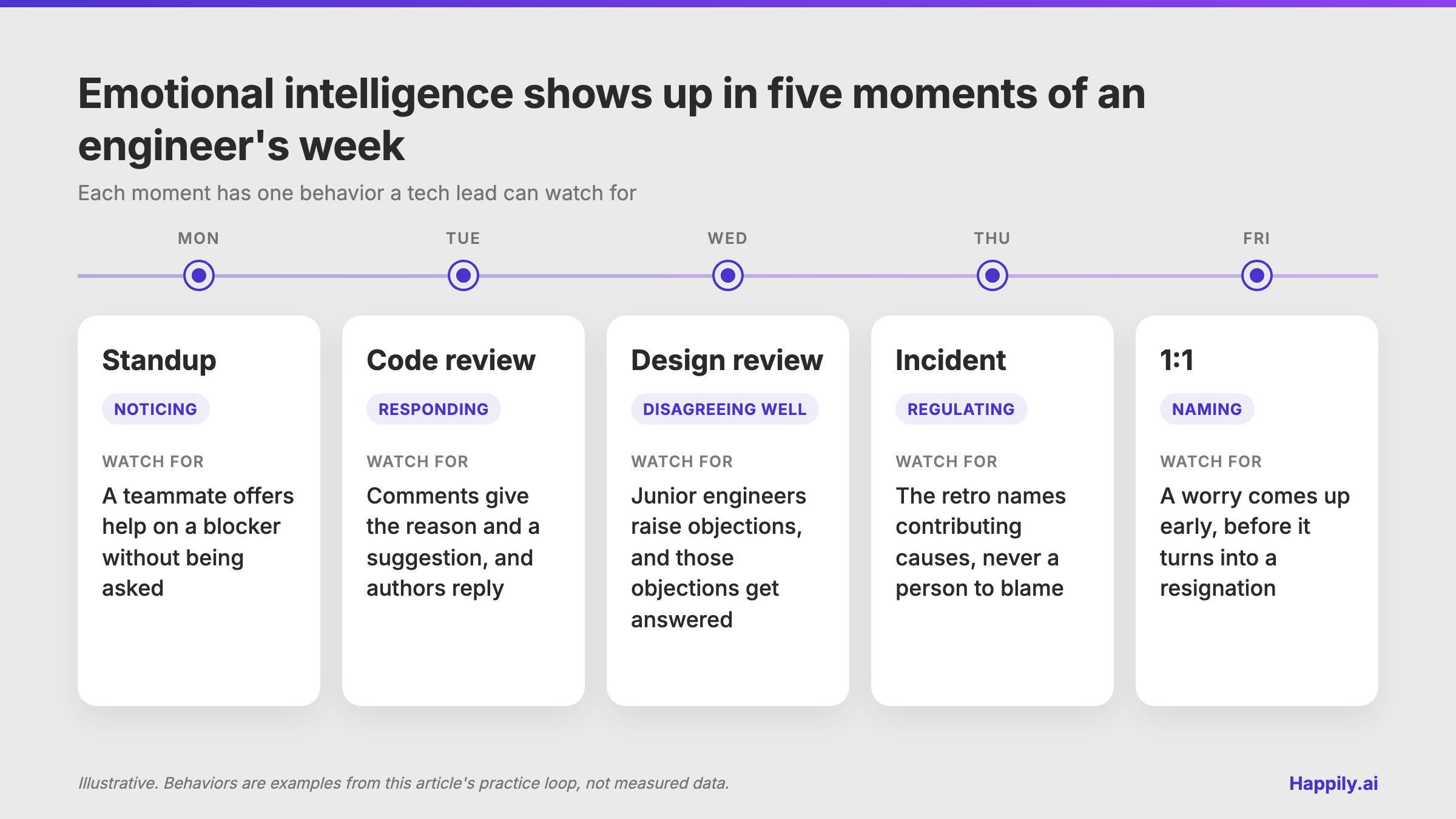
EI gets concrete when you tie it to rituals engineers already run, each with one behavior you can watch for.
| Moment | What EI looks like here | One observable behavior |
|---|---|---|
| Code review | Reading how a comment will land before posting it | Comments explain the reason and offer a suggestion, not only a question |
| Standup | Noticing when someone is stuck or overloaded | A teammate offers help on a blocker without being asked |
| Incident | Staying steady so the team can think | The retro names contributing causes, never a person to blame |
| Design review | Disagreeing without making it personal | Junior engineers raise objections, and those objections get answered |
| 1:1 | Hearing what sits under the status update | The engineer brings up a worry before it becomes a resignation |
| Receiving feedback | Treating critique as information | The author replies to review comments instead of silently rewriting |
Code review deserves extra attention. Researchers at Google surveyed 1,317 developers about negative interpersonal moments in code review, which they called "pushback." They found pushback was relatively rare, but that it caused frustration and stress when it happened (Egelman et al., ICSE 2020). Rare and costly is exactly the profile where a small, repeated habit pays off.
What the research says matters for technical teams
Two bodies of research point at the same thing: how safe it is to say "I'm not sure," "I broke it," or "I disagree."
Google's Project Aristotle studied 180 teams, of which 115 were engineering project teams. Researchers found that what mattered was less about who was on the team and more about how the team worked together. Of the five dynamics they identified, psychological safety ranked first. The others were dependability, structure and clarity, meaning, and impact. The construct comes from Harvard's Amy Edmondson, who describes team psychological safety as a shared belief that the team is a safe place to take interpersonal risks, like admitting a mistake or asking a question. For a leader's view of building it, see our CEO guide to psychological safety.
DORA's research on software delivery reaches a similar place from the engineering side. DORA uses Ron Westrum's model of organizational culture, where in a "generative" culture failure leads to inquiry and people who bring bad news are trained, not punished. DORA reports that a high-trust, generative culture predicts software delivery and organizational performance. In the 2023 Accelerate State of DevOps Report, teams with generative cultures had 30% higher organizational performance than those without.
Google's SRE book makes the link to incidents explicit. In a blame culture, it warns, "people will not bring issues to light for fear of punishment." A blameless postmortem is an EI skill written down as a process.
So EI for engineers is mostly about keeping information flowing when stakes are high. That is a team habit first.
What transfers: a practice loop for engineering teams
The workshop starts it. A four-part loop makes it stick.
- Attach each behavior to a ritual. Pick two behaviors from the table above, tied to rituals the team runs every week. "In code review, every blocking comment includes the reason and a suggestion." "In retros, we describe what the system allowed, not who slipped."
- Practice on real work. Use the team's own pull requests and incident docs as training material. Ask each engineer to rewrite three of their own past review comments. Rehearse a design disagreement using a real decision the team is facing.
- Have the lead reinforce it weekly. Blume's review linked a supportive work environment to transfer, especially for open skills. In practice that means the tech lead or engineering manager asks, once a week, "When did you use it, and what happened?"
- Watch the team, not the course. Track the signals in the leading-indicators section below. If they are not moving after a month, change the behavior you are practicing.
The loop looks slightly different by role:
- Individual contributors: focus on receiving feedback and writing review comments that land as intended.
- Tech leads: focus on design reviews, where they set the tone for disagreement, and on incident calm.
- Engineering managers: focus on 1:1s and on reinforcing the loop. Gallup found that managers account for about 70% of the variance in team engagement, so the manager is the multiplier here. Our guide to emotional intelligence training for managers covers the people-manager curriculum in depth, and how to run effective one-on-ones covers the meeting itself.
Emotional intelligence course for engineers: formats compared
Here is how the four common formats compare for a technical team. Costs are relative to each other.
| Format | Relative cost | Time per person | Transfer to daily work | Best for |
|---|---|---|---|---|
| Workshop (half day to two days) | Low per head | 4 to 16 hours, once | Low unless followed by a practice loop | Giving a whole team shared language fast |
| Cohort course (several weeks) | Medium | 1 to 2 hours a week | Medium, since peers practice together between sessions | Tech leads and new managers learning as a group |
| 1:1 coaching | High | An hour every week or two | High for the person coached, hard to scale | Senior engineers or managers in high-stakes roles |
| In-the-flow nudges (daily prompts tied to real work) | Low to medium per head | A few minutes a day | High when leads reinforce it, low if ignored | Whole teams that want the habit to survive a busy quarter |
Choose a workshop if your team has no shared vocabulary for this yet and you will add a practice loop right after. Choose a cohort course if you are promoting several engineers into lead or manager roles at once. Choose coaching if one or two leaders shape the experience of a large group and the budget allows. Choose in-the-flow nudges if you have several teams and want the behaviors practiced inside code review, standups and 1:1s every week.
Most teams get the best result from combining two: a short workshop to start, then a daily or weekly layer that keeps the practice going.
Leading indicators that EI training is working
Attrition and delivery metrics are lagging. By the time a strong engineer resigns or a project slips, the training has already succeeded or failed. These team-level signals move first.
- Review threads resolve with replies. Authors answer comments instead of silently rewriting, and fewer threads stall for days.
- Quieter people speak in design reviews. More objections come from engineers who rarely raised them before, and they get engaged with.
- Retros name systems. Incident write-ups describe contributing causes, and people volunteer their own part in what happened.
- Risks surface earlier. "I'm blocked" or "this estimate is wrong" shows up in standup days before the deadline, not on it.
- Mood holds up under load. Short daily check-ins stay steady through on-call weeks and launches, or recover fast when they dip.
- 1:1s stay on cadence. Engineers report their 1:1s are useful, and the manager hears about concerns before they turn into exits.
A tech lead can track most of these by reading the team's pull requests and retro docs once a week. For a wider framework, see how to measure manager effectiveness.
Where Happily.ai fits, and where it doesn't
Happily.ai is the daily operating layer for team performance: it runs inside the team's daily rhythm and surfaces the leading indicators of execution, including whether people feel safe and steady enough to do their best work. For EI development on technical teams, three mechanisms do the reinforcement work.
- AI coaching nudges give tech leads and engineering managers a specific prompt tied to what is happening in their team that day, for example an engineer whose check-ins have dipped during an on-call week. More on how this works in AI coaching for managers.
- Daily check-ins take seconds and become the team signal you measure training against, rolled into the DEBI engagement index.
- Manager scorecards show 1:1 cadence, recognition and team-health changes per manager, so you can see whether the training reached the team.
The signal depends on people using it, so adoption decides everything. Happily sees 97% daily adoption, against an industry average of about 25%. A tool nobody uses can only report history.
Best for engineering organizations with several teams and leads who want EI practiced and measured every week.
Not a fit if you need a certified EI assessment for development plans or research. Use the EQ-i 2.0 from MHS, a self-report questionnaire of 133 items across 15 subscales (with a 360 version, the EQ 360 2.0), or the MSCEIT, an ability-based test of 141 items covering four branches: perceiving, using, understanding and managing emotions. Happily does not replace either. It is also more than a five-person team with healthy weekly retros needs.
FAQ
Do engineers really need emotional intelligence training?
Engineers already use EI in code review, incidents and design debates. Training helps when it turns those moments into deliberate practice. Google's Project Aristotle, which included 115 engineering teams, found psychological safety was the most important dynamic of effective teams.
What is the best emotional intelligence course for engineers?
The best course is one tied to real engineering work, followed by weekly practice that a lead reinforces. A short workshop or cohort course can start it. Without a practice loop afterward, most of it fades, because EI is an open skill that depends on the work environment.
How do you measure emotional intelligence training for a software team?
Track team behavior, not course ratings: replies on review threads, quieter engineers speaking in design reviews, retros that name systems instead of people, and check-ins that hold steady during on-call weeks.
Is EI training for engineers different from EI training for managers?
Yes. Engineers practice EI inside technical rituals like code review and incidents, mostly as peers. Managers carry responsibility for the climate of a whole team. See emotional intelligence training for managers and, for the general version, emotional intelligence training for employees.
Should we use EQ-i 2.0 or MSCEIT with engineers?
Use one if you want a personal baseline. EQ-i 2.0 is self-report and shows how people see themselves. MSCEIT is an ability test and shows how people solve emotional problems on a test. Neither shows how the team experiences someone, so pair either one with team signals.
The takeaway
Engineers learn by doing, and EI is no different. Tie each behavior to a ritual the team already runs, practice it on real pull requests and real incidents, have the lead ask about it every week, and watch the team's signals instead of the course score.
To cite this article: Happily.ai Editorial, "Emotional Intelligence Training for Engineers: What Works for Technical Teams," Happily.ai, October 2026. Available at https://happily.ai/blog/emotional-intelligence-training-for-engineers/
Sources:
- Transfer of Training: A Meta-Analytic Review - Blume, Ford, Baldwin & Huang, Journal of Management (2010)
- Can emotional intelligence be trained? A meta-analytical investigation - Mattingly & Kraiger, Human Resource Management Review (2019)
- Predicting Developers' Negative Feelings about Code Review - Egelman et al., ICSE (2020)
- Guide: Understand team effectiveness (Project Aristotle) - Google re:Work
- Generative organizational culture - DORA
- Announcing the 2023 State of DevOps Report - Google Cloud / DORA (2023)
- Postmortem Culture: Learning from Failure - Google, Site Reliability Engineering
- Psychological Safety and Learning Behavior in Work Teams - Edmondson, Administrative Science Quarterly (1999)
- Managers Account for 70% of Variance in Employee Engagement - Gallup (2015)
- The EQ-i 2.0 Framework - MHS
- MSCEIT - Consortium for Research on Emotional Intelligence in Organizations