


On this page
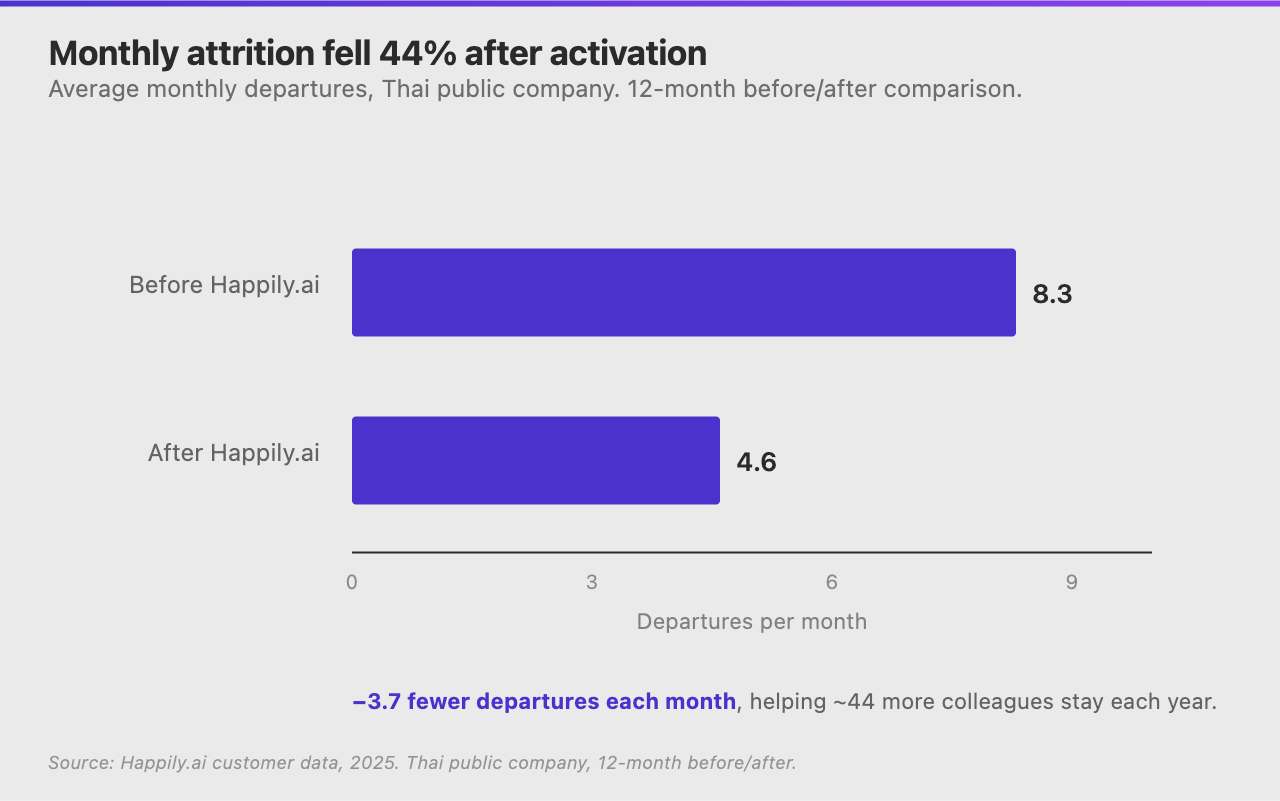
A Thai public company recently cut its monthly attrition from 8.3 employees to 4.6. A 44% improvement, sustained over time. The change did not come from a bigger perks budget or a new compensation cycle. It came from giving managers a clearer, real-time view of how their teams were doing, then making it easy to act on what they saw.
Looking back across twelve months and 62 departures, the team found that 50 of those colleagues had given off an early signal that something was shifting. That is 81%. The opportunity to start a supportive conversation was there. What had been missing was a way to see those signals in time, and a habit of acting on them.
This is the story of how raw data became intelligence the moment it reached a manager who could do something with it.
Two Signals That Turned Data Into Intelligence
Most analytics dashboards show what already happened. The real shift at this company came when two signals started arriving in time for managers to use them.
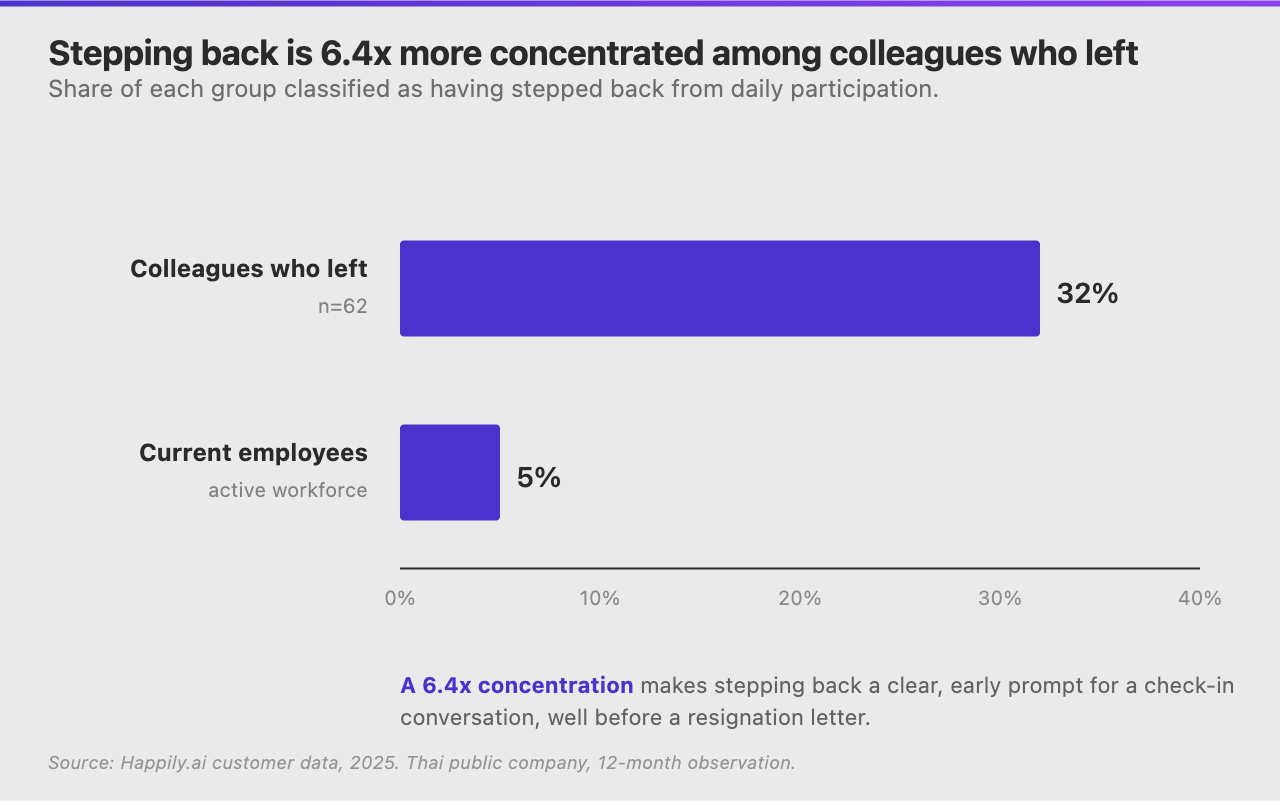
Signal one: participation. Daily check-ins, peer recognition, and feedback prompts are part of the company's everyday rhythm. When an employee stops taking part, that change is visible right away. Of the 62 colleagues who eventually left, 32% had stepped back from the daily rhythm by the time they resigned. Among current employees, only 5% show that same pattern. The contrast is large enough to be a clear, early prompt for a check-in conversation.
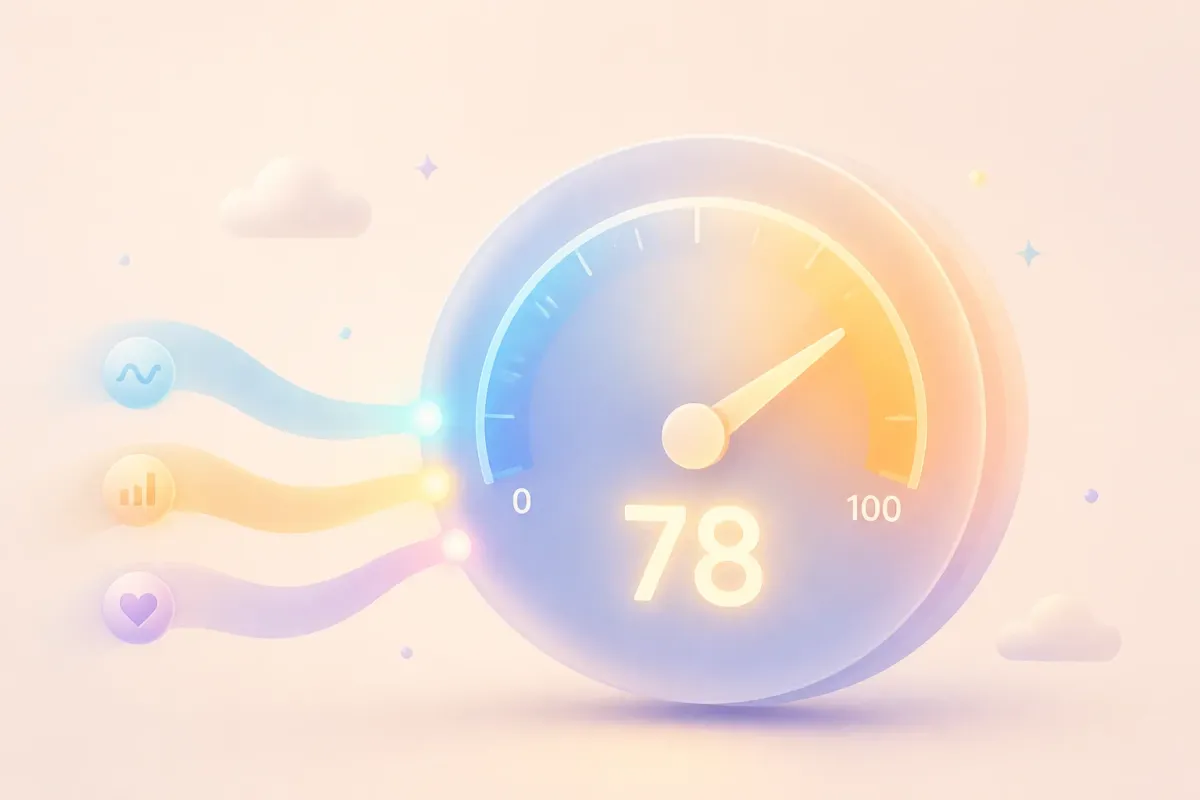
Signal two: the team intelligence model. Happily.ai's risk model reads patterns across DEBI (Dynamic Engagement Behavior Index) trajectory, recognition flow, and open-text sentiment. It surfaces a forward-looking signal each week, broken into clear bands so managers know where to spend their attention. 30 of the 62 departing colleagues had appeared on that list before they resigned: sixteen in the Medium-to-High band and fourteen in the Low band.
Together, the two signals covered a large majority of the year's departures.
| Signal | Colleagues Reached Early | Share of 62 Departures |
|---|---|---|
| Stepped back from daily participation | 20 | 32% |
| Surfaced by the team intelligence model | 30 | 48% |
| Combined early signal | 50 | 81% |
| No signal detected | 12 | 19% |
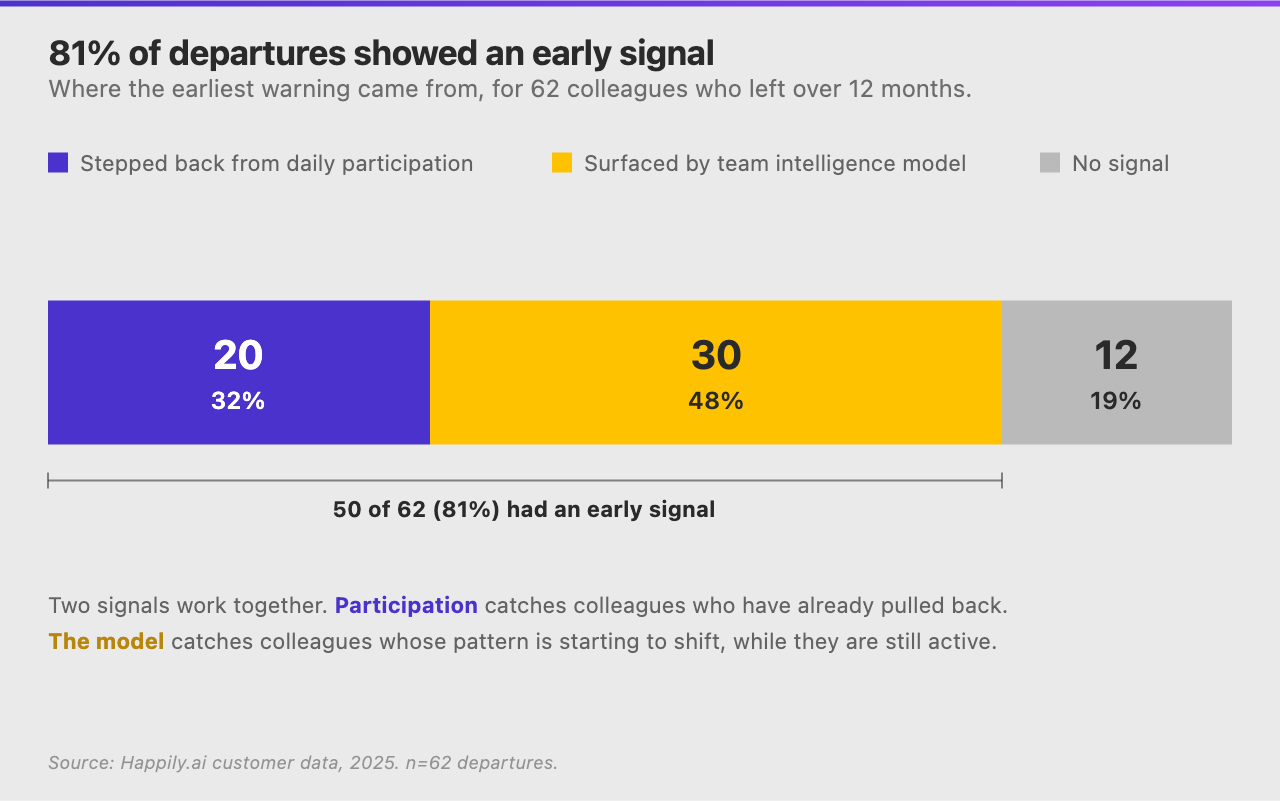
These two views complement each other. Participation tells you who has already pulled back. The model tells you who is still active, but whose pattern is starting to shift. Read together, they gave managers a clear, weekly picture of where a supportive conversation would matter most.
Why the People Still Showing Up Are the Real Story
It is easy to focus on the 32% who had visibly stepped back. The more interesting group is the 68% who were still active right up to their resignation. 42 of the 62 colleagues looked engaged on the surface. They were checking in. They were recognizing teammates. A standard engagement dashboard would have rated them as healthy.
This is exactly where real-time intelligence pays off. A quarterly survey or a static score would have missed them. The continuous model picked up small shifts in their patterns: recognition becoming less frequent, sentiment in open-text responses softening, interaction rhythm changing. None of those alone would raise a flag. The combination did.
Of those 42 still-active colleagues, 30 had been surfaced by the model in time. That is a meaningful number. It meant a manager could open a thoughtful, supportive conversation while there was still room to make things better.
How the Reduction Adds Up
The 44% drop in monthly attrition makes sense once you see how the workflow connects.
Each week, managers received a short list of names from their team that the intelligence layer had flagged or that had stepped back from daily participation. The list was small enough to act on. Usually one or two names per manager.
Each name came with context. Which patterns had shifted. Which themes were appearing in recent feedback. A suggested starting question for the conversation. Managers did not need to be analysts. They needed to be present.
When the signals reached managers early, and managers had the time and the prompt to act, retention improved. The math of the 44% reduction is simply this: a clear majority of departures had an early signal, and a meaningful share of those situations could be turned around once a supportive conversation happened in time.
What Managers Actually Did
A signal in a dashboard does nothing on its own. What made this work was the habit built around the signals.
Weekly hotspot reviews. Managers spent ten minutes each week with a team-level view of who had been surfaced and why. This was the start of the manager's planning week, not an afterthought.
Conversations with a starting point. Each name came with light context: the pattern that had shifted and a suggested first question. This made it easy to begin a check-in that felt thoughtful rather than scripted.
Gentle backup from HR. When a colleague appeared on a manager's list for two weeks in a row without a touchpoint, an HR business partner offered to help. The intent was support for the manager, not oversight.
A shared standard. The company set a simple internal expectation: if a colleague who had been surfaced by the system left without a recent development conversation, the team would look at the process, not the person. That framing made managers comfortable using the signals as a help, not a judgment.
None of this required new tools, a new performance cycle, or a culture overhaul. It required treating real-time team intelligence as part of the weekly management rhythm.
Why the Numbers Add Up
Retention math is rarely a soft win. Each role in a mid-sized company carries more capital than a salary line suggests. A senior salesperson holds long-running customer relationships. A team lead holds vendor and partner trust built over months. A long-tenured manager holds institutional knowledge that takes years to rebuild.
A few patterns make retention especially valuable for growing companies:
Replacement is slower than it looks. Senior talent in any specialized field is shared across a small number of competitors. Vacancies sit open longer than HR plans assume.
Knowledge walks with the person. Process documentation rarely captures the relationships, judgment calls, and quiet workarounds that make a role function.
Cycles run on continuity. Whether it is a sales cycle, a project, or a customer relationship, swapping people mid-way carries a real cost in delays and rework.
For a 200-person company, moving from 8.3 to 4.6 monthly departures means roughly 44 more colleagues staying each year. At a conservative replacement cost of three months of salary per role, that is a seven-figure annual difference, before you count the value of continuity and institutional knowledge.
The Intelligence You Already Have, Waiting to Be Used
Most HR teams already collect the ingredients. Recognition platforms know who is giving and receiving. Survey tools know who is responding. Performance systems know how often managers and reports are connecting. What is often missing is a way to bring those inputs together, per person, in real time, in front of the manager who can act.
Three questions to check your own setup:
- Can a manager see today which colleagues on their team have stepped back from daily participation in the past two weeks?
- Can the same manager see a forward-looking view of who would benefit from a supportive conversation soon?
- Is there a weekly habit that turns those views into a short, planned check-in?
If the answer to any of these is no, the underlying signals are likely already in your data. The opportunity is to route them to the manager and make acting on them simple.
The Takeaway
Real-time data becomes intelligence the moment a manager can act on it. That is the heart of what changed at this company.
Three things stand out:
Participation is a strong, early signal that most engagement programs do not use well. Colleagues who had stepped back from the daily rhythm were many times more concentrated among those who left than among those who stayed. That contrast alone is worth building a weekly habit around.
A continuous intelligence model adds reach where participation alone does not. It surfaces colleagues who are still showing up but whose pattern is shifting. Together, the two views gave managers a picture of where to spend ten thoughtful minutes that week.
The result, the 44% reduction, comes from the workflow, not the dashboard. Real-time signals matter because managers act on them while there is still time for the action to matter.
This is what Culture Activation was built for: a continuous loop that turns daily check-ins, DEBI, manager hotspot views, and team intelligence into a single, usable workflow. For this company, it meant more colleagues staying, more relationships preserved, and a healthier team week by week.
See your own team intelligence in action.
Book a demo and we will walk you through how Happily.ai surfaces real-time team signals and turns them into a weekly management habit. For a complementary read on what early signals look like in the data, see What Employees Complain About Predicts Turnover Better Than How Often They Complain.