



On this page
Most teams that miss their goals were not lazy. They were busy. Everyone shipped things, closed tickets, and ended the week tired. The work just never added up to what mattered.
That is the part of managing team focus that catches managers off guard. The visible signal is effort, and effort looks healthy. The hidden problem is alignment: how much of that effort actually rolls up to the goals the team is supposed to move. A team can run at full speed for a quarter and still drift, because nobody could see the gap between activity and priority until the results came in.
Team focus is the degree to which a team's day-to-day work connects to its stated goals. Managing it means watching that connection in real time, not auditing it after the quarter ends. Happily.ai is a Culture Activation platform that makes team focus visible to managers as work happens, so effort can be redirected while it still counts.
Best for managers who suspect their team is busy on the wrong things but can't yet see where the effort is going.
What Managing Team Focus Actually Means
Most "focus" advice is about the individual: block your calendar, kill notifications, single-task. That advice is fine, but it solves the wrong problem for a manager. A team of perfectly focused individuals can still be collectively unfocused if each person is focused on something different.
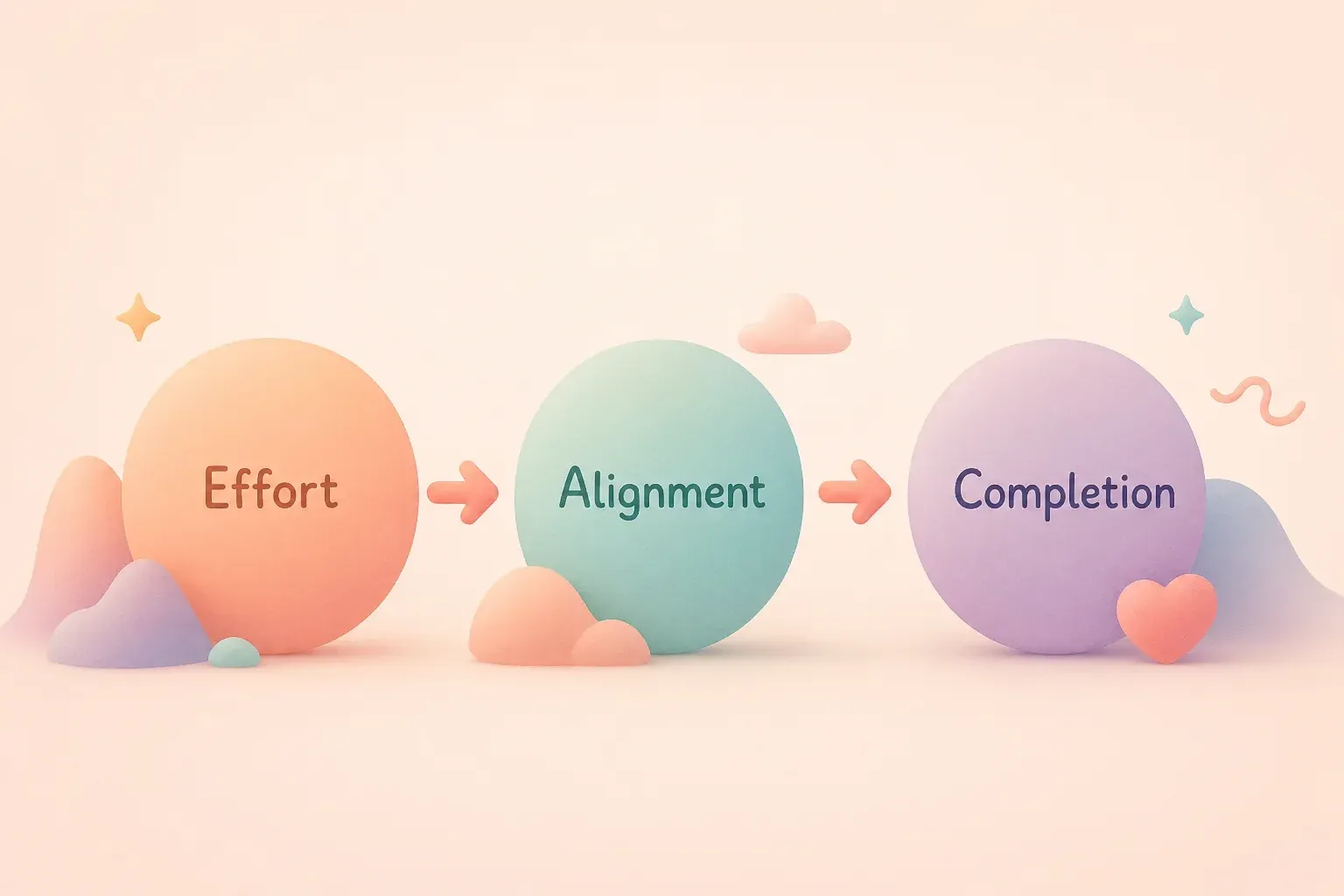
Managing team focus comes down to three questions a manager has to answer every week:
- Effort: What is the team actually spending energy on right now?
- Alignment: How much of that effort connects to a goal that matters?
- Completion: Is the work moving to done, or quietly carrying over week after week?
Notice that only the first question is about activity. The other two are about direction and progress. Managers who track activity alone (tasks closed, hours logged, standups attended) measure motion and miss drift. The job is not to generate more effort. It is to make sure the effort already happening points the same way.
Why Team Focus Slips: The Alignment Gap
Here is the mechanism. Work enters a team faster than priorities get set. A customer escalates. A teammate asks for help. A new idea sounds urgent. Each of these is a reasonable thing to spend an afternoon on. None of them arrive labeled with which goal they serve, or whether they serve one at all.
So people do the reasonable thing in the moment. They take the work. Over a few weeks, a layer of unaligned effort builds up underneath the team's real priorities. It feels productive because it is genuinely hard work. It just isn't the work that moves the goal.
This gap is well documented at the strategy level. Research by Kaplan and Norton, the creators of the Balanced Scorecard, found that 95% of a company's employees are unaware of, or do not understand, its strategy. If people can't connect their work to the goal, they default to whatever is loudest. The result is a team that is fully occupied and only partly aligned.
Four signals tell you the alignment gap is widening:
- Unaligned work. Tasks that don't map to any current goal. Not bad work, just disconnected work.
- Carried-over work. The same item shows up unfinished week after week. It survives because nobody decides whether it matters.
- Effort pooling in the wrong place. Most of the team's energy lands on a goal that isn't the priority, while the priority starves.
- Invisible focus. The manager genuinely doesn't know what the team is working on between check-ins, so the gap stays hidden until results.
Each of these compounds. An unaligned task this week becomes a carried-over task next week, which becomes a quarter of pooled effort in the wrong place. The earlier you catch it, the cheaper it is to fix.
A Framework for Managing Team Focus
You can close the alignment gap with a weekly rhythm. The point is to make focus a thing you steer, not a thing you discover in the postmortem.
1. Make focus visible before you try to manage it
You cannot redirect effort you cannot see. Start every week by getting the team's actual work in front of you in one place: what each person is focused on, in their words, not a status you inferred. Visibility is the precondition for everything else. A manager who learns what the team worked on three weeks late is doing forensics, not management. For the live version of this, see our team alignment audit guide.
2. Tie every piece of work to a goal, or leave it unaligned on purpose
Take each focus item and ask: which goal does this serve? Most should map cleanly. Some won't, and that is fine. The discipline is to make the choice consciously. Leaving an item unaligned is a legitimate decision when the work falls outside current goals (a favor, a fire, a learning project). What you want to eliminate is unaligned-by-accident: work that nobody ever decided about. Alignment is a yes or a deliberate no, never a shrug.
3. Watch effort, not just task counts
Five tiny tasks and one substantial project are not the same week, but a task counter treats them identically. Look at where the team's real effort is concentrated, then compare that against your priorities. If 70% of the week's heavy lifting landed on a secondary goal, you have a problem a task list will never show you. Effort is the unit that reveals where focus truly went.
4. Catch carried-over work in week two, not month three
When the same item lingers unfinished across multiple weeks, treat it as a signal, not a guilt trip. Carried-over work usually means one of three things: it is blocked, it is bigger than it looked, or it secretly isn't a priority. All three deserve a decision. Surface lingering items early and ask the simple question: do we finish this, resize it, or drop it? The cost of an undecided task is that it quietly consumes attention every single week.
5. Close the loop weekly
Managing focus is a rhythm, not a one-time reset. Each week: see the work, align it, check where effort went, clear the carryover, then reset for the week ahead. This matters most exactly when priorities change. When a company pivots, reorganizes, or resets goals for a new quarter, focus management is the infrastructure that lets a team re-point its effort fast instead of running for weeks on last quarter's map. A clear weekly loop is what makes a leader's new call actually land in the work.
How Happily Helps You Manage Team Focus
The framework above is doable by hand. It is also exactly the kind of weekly bookkeeping that slips when the week gets busy. Happily.ai turns the rhythm into something a manager sees at a glance.
The Focus Board lays out the team's work across three columns: Pending Alignment, Open, and Done. The columns are not arbitrary. An item only reaches Open once it is both unfinished and linked to a goal. Anything not yet connected to a goal sits in Pending Alignment, where it stays visible until someone decides where it belongs. The board makes the alignment gap impossible to ignore, because unaligned work has its own column instead of hiding inside a long task list.
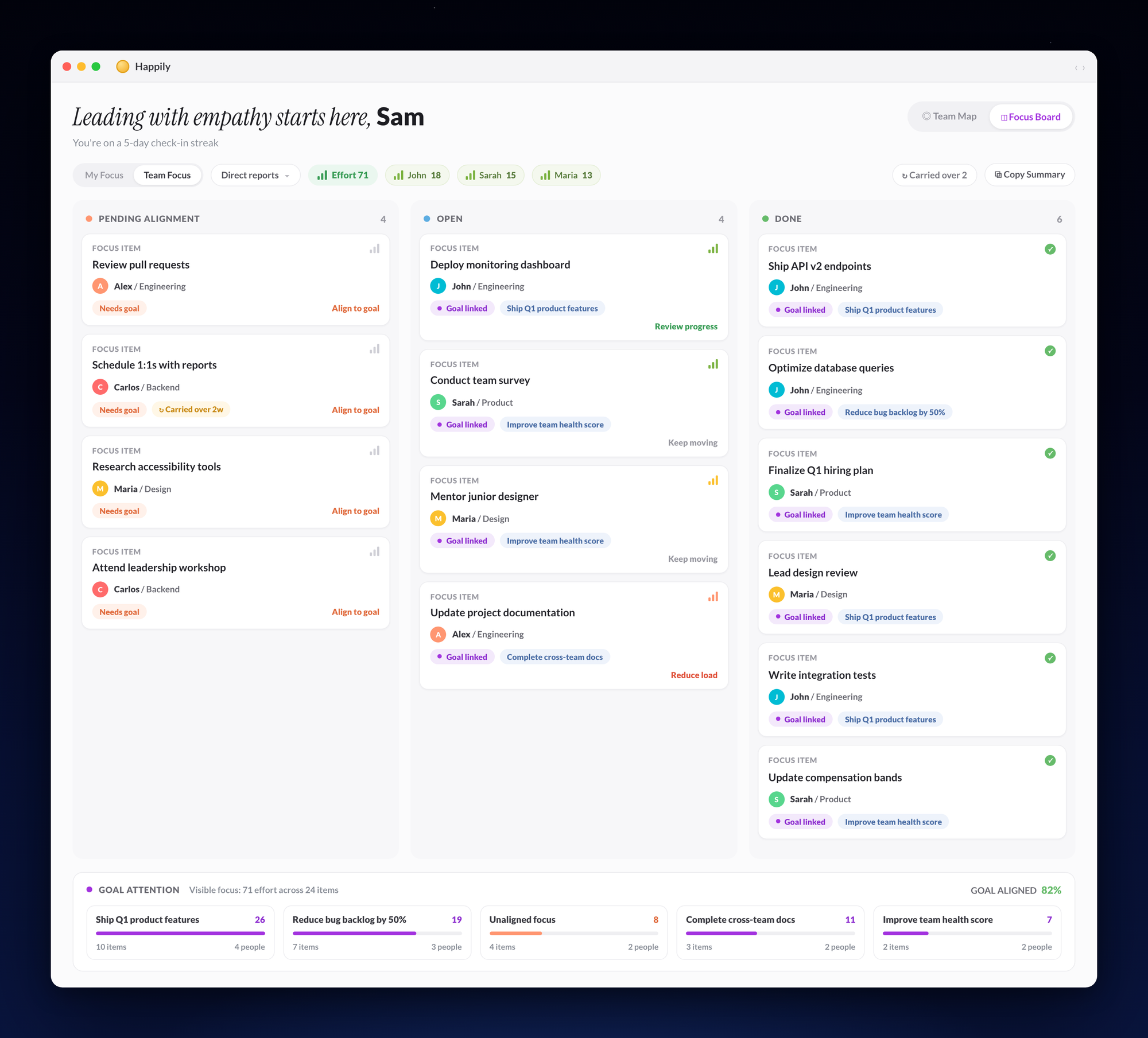
Each focus card carries the detail that makes a decision possible: who owns it, which goal it links to, an effort score, and a "carried over" flag when the same item has lingered across weeks. A card suggests the next move directly, whether that is Align to goal, Review progress, or Reduce load for someone carrying too much.
Goal Aligned % answers the alignment question with one number. It is effort-weighted, not a task count, so it tells you what share of the team's real effort actually rolls up to your goals. Goal Attention then breaks that effort down by goal, and flags the two failure modes by name: Unaligned focus and effort linked to goals outside your team's priorities. This is the difference between sensing your team is off and seeing exactly where.
The Team Map shows the same team as people rather than tasks: each person ringed by their health and check-in signal, so you can read who is thriving and who is quietly stretched. Focus and wellbeing sit side by side, because the person buried in carried-over work is usually the person about to burn out.
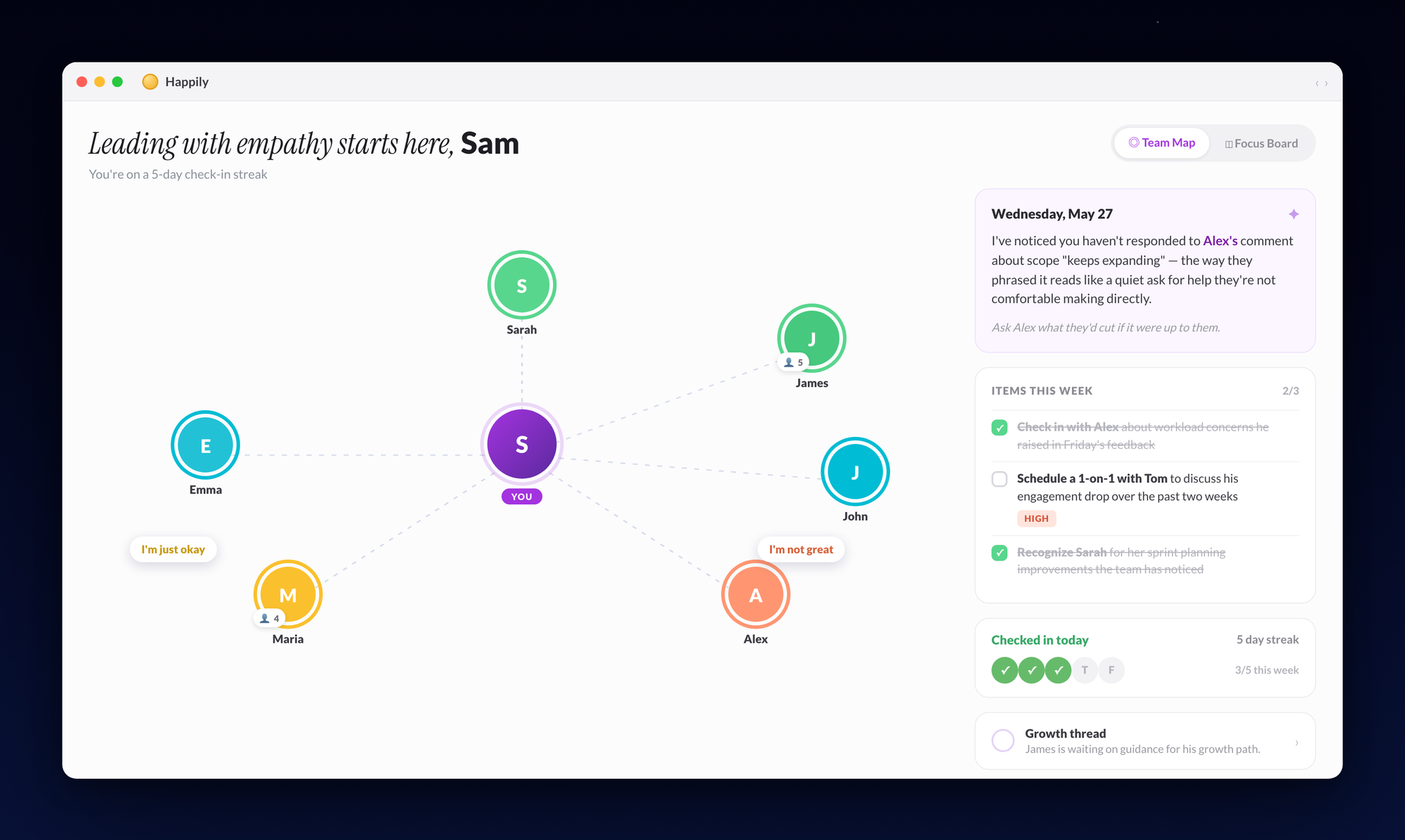
Layered on top, a daily reflection surfaces patterns a busy manager misses, like a teammate who keeps raising a concern that hasn't been answered yet, paired with one concrete next action. This is Culture Activation in practice: the platform doesn't just measure focus, it prompts the small daily moves that keep a team aligned. That is how Happily reaches 97% adoption against a 25% industry average, and why the focus view holds up week after week instead of becoming another dashboard nobody opens.
Focus Management vs. Activity Tracking
| Dimension | Activity Tracking | Focus Management |
|---|---|---|
| Core question | What got done? | What got done that mattered? |
| Unit measured | Tasks, tickets, hours | Effort weighted by goal alignment |
| Unaligned work | Invisible, blends in | Surfaced in its own column |
| Lingering work | Just an open task | Flagged as carried over, forces a decision |
| When you learn | After the quarter | While the week is still moving |
| Manager's role | Report on output | Redirect effort in real time |
When to Manage Focus More Actively
Choose lightweight focus management if your team is small, goals rarely change, and you already see everyone's work daily. A weekly conversation may be enough.
Choose structured focus management if any of these are true: the team is scaling, priorities shift often, you manage through other managers, or you keep getting surprised by where the quarter landed. The bigger the gap between what you can see and what the team is doing, the more a focus system pays for itself.
If you want the manager-effectiveness case behind this, managers account for 70% of the variance in team engagement. A manager who can see and steer focus is operating on the single highest-leverage surface they have.
Frequently Asked Questions
What is team focus management? Team focus management is the practice of keeping a team's day-to-day work connected to its goals. It watches three things: where effort is going, how much of it aligns to priorities, and whether work is moving to done or carrying over.
How is managing team focus different from project management? Project management tracks whether tasks get completed. Focus management asks whether the right tasks are being worked on in the first place. A team can be excellent at finishing work and still finish the wrong work.
Why do busy teams still miss their goals? Because effort and alignment are different things. Work enters a team faster than priorities get set, so a layer of unaligned-but-reasonable work builds up. The team stays fully occupied while only part of its effort moves the goal.
What is the alignment gap? The alignment gap is the distance between how hard a team is working and how much of that work connects to its goals. It widens quietly through unaligned tasks and carried-over work, and usually only shows up in the results.
Is Happily.ai worth it for a 150-person company? Happily.ai fits growing companies where managers are scaling past the point of seeing every person's work directly. If your managers are getting surprised by where the quarter landed, the Focus Board and Goal Aligned % give them back the visibility they lose as the team grows.
The One Thing to Remember
Your team's problem is rarely effort. It is almost always alignment. Make the work visible, connect each piece to a goal or consciously leave it out, watch where effort actually pools, and clear the lingering items before they calcify. Do that weekly, and focus stops being something you discover in the postmortem and becomes something you steer.
Ready to see where your team's effort is actually going? Book a demo and watch the Focus Board map your team's real focus in minutes.