

On this page
Give two people the same AI tools. Six months later, one produces more output: more documents, more code, more decks. The other has learned several times faster and is now solving problems the first one cannot see. Same tools. Different use.
The difference is a rhythm. The learning loop is the practice of oscillating between action, which creates information, and deep work, which converts that information into judgment and better next moves. Neither mode produces learning on its own. The learning happens across the cycle, and the rate of switching sets the rate of learning.
This article explains the mechanism, the two failure modes that masquerade as productivity, and why AI is widening the gap between people who run this loop deliberately and people who don't.
Action Creates Information. Deep Work Converts It
Every real act produces information that thinking alone cannot. Ship the feature and watch what users actually do. Talk to the customer who might say no. Run the experiment that might kill your favorite idea. Reality grades the work, and the grade is data.
Deep work is where that data becomes something valuable. It is the mode of critical thinking and creation: sitting with what came back, finding the pattern, and producing the next hypothesis, the next design, the next decision. Cal Newport's research popularized deep work as the skill of focusing without distraction on a cognitively demanding task (Newport, 2016). The learning loop adds the other half: what you focus on should be the freshest information your actions produced.
This cycle has a long research lineage. David Kolb's experiential learning model describes learning as a repeating cycle of concrete experience, reflection, and active experimentation (Kolb, 1984). The learning loop is that cycle, run at the speed of modern work.
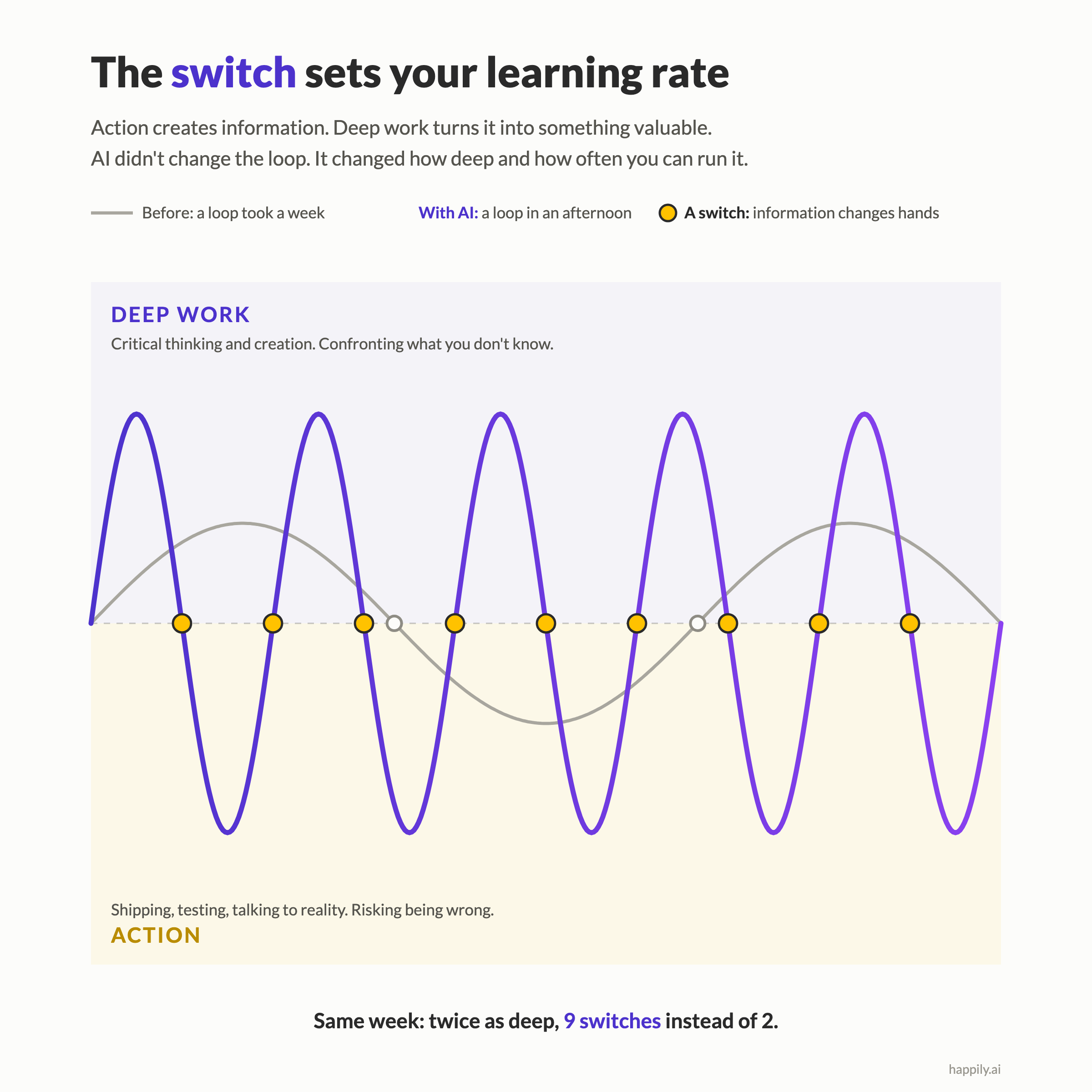
The two modes have to stay in phase. Too long in deep work and you disconnect from the reality of the problem. The problem moves while you polish your model of it. Too long in action and you ship shallow solutions that don't hold, because nothing you learned made it into the next attempt.
The Two Failure Modes That Look Like Productivity
Both modes draw on the same reserve of cognitive effort. And both are uncomfortable in their own way.
Deep work is messy. You confront how much you don't know and have to do something about it. For much of a session, you feel as though you're not getting anywhere. Action carries a different discomfort: shipping before you feel ready and letting reality grade you. Deep work risks discovering you're ignorant. Action risks proving you're wrong.
Under fatigue, most of us retreat to whichever mode feels easier. That retreat produces two recognizable failure patterns:
- Endless polishing that masquerades as rigor. The work looks thoughtful. Nothing has touched reality in weeks.
- Busy shipping that masquerades as progress. The work looks energetic. Nothing learned from the last three shipped things made it into the fourth.
Neither produces learning, even when both look productive. Teams have the same failure modes at scale. Our data shows that in a typical week, team focus is only 70-80% aligned with stated goals, and the gap is usually invisible until misalignment compounds into rework and missed quarters.
Four Profiles, One Multiplier
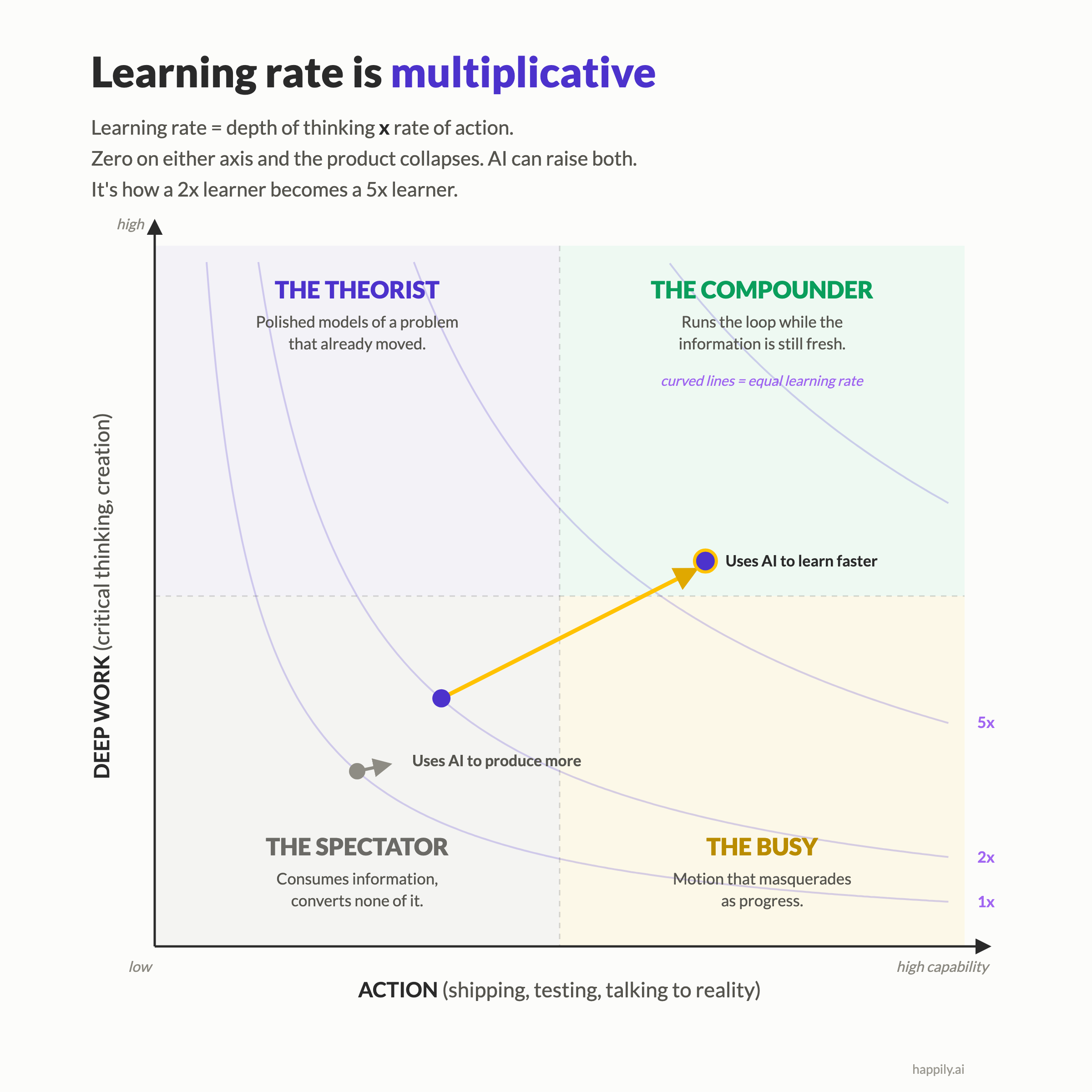
Mapping the two capabilities against each other makes the landscape visible:
| Profile | Deep work | Action | What it looks like | Learning rate |
|---|---|---|---|---|
| The Spectator | Low | Low | Consumes information, converts none of it | Near zero |
| The Theorist | High | Low | Polished models of a problem that already moved | Low |
| The Busy | Low | High | Motion that masquerades as progress | Low |
| The Compounder | High | High | Runs the loop while information is still fresh | Multiplying |
The key property of this matrix: learning rate is multiplicative, not additive. Depth of thinking times rate of action. Zero on either axis and the product collapses. A brilliant thinker who never ships learns slowly. A relentless shipper who never reflects learns slowly. The compounder beats both, often on less total effort.
What AI Changes About the Learning Loop
AI raises both factors at once. Synthesis is cheaper, so you can think deeper. Execution is cheaper, so you can act sooner. A loop that used to take a week now fits in an afternoon.
That compression is why learning rates are diverging. The person who used to learn 2x faster than their peers might now be at 5x. Not because they got smarter, but because they run more cycles while the information is still fresh, and they tolerate the discomfort of each one. The same dynamic shows up in how AI coaching changes manager development: the value comes from acting on signals quickly, not from accumulating more reports.
Two honest caveats. First, this rate of learning is mentally taxing. When we audited six weeks of our own AI usage at Happily.ai, the review load alone (reading what AI tools report back, in order to stay responsible for the output) ran to thousands of textbook-page equivalents per day. Faster loops consume attention, and attention does not scale with the tooling. Second, not every task deserves the full loop. Routine, well-understood work can run on habit. Reserve the loop for problems where the answer is uncertain and the cost of being wrong compounds.
It's also worth separating the loop from context switching. Context switching is involuntary fragmentation across unrelated tasks, and the research is clear that it is expensive: refocusing after an interruption takes roughly 23 minutes (Mark, 2023). The learning loop is a deliberate phase shift within the same problem. One scatters attention. The other concentrates it on what reality just told you.
How to Run the Loop Deliberately
The skill is noticing when the mode you're in has stopped producing, and switching. Two diagnostic rules:
- If your last three working sessions produced no new decisions, you're polishing. Switch to action: ship the smallest version that lets reality respond.
- If you can't say what your last three shipped things taught you, you're thrashing. Switch to deep work: block a session whose only output is what the evidence says and what changes next.
For leaders, the harder problem is that you can't see which mode your team is in. Activity metrics make the theorist and the busy look identical to the compounder. This is the same visibility gap we wrote about in peripheral focus: teams rarely look unfocused, they look busy in slightly wrong directions.
Making the loop visible is an operational practice. Weekly priorities surface what each person is about to act on. Lightweight check-ins surface what came back. Tools like Happily.ai's daily check-ins and focus tracking exist to close exactly this gap: they map where attention actually goes against what the team decided matters, so the switch back to deep work happens on evidence instead of anecdote.
Choose your structure by failure mode. If your team over-polishes, set demo days that force contact with reality. If your team over-ships, set review sessions where the only agenda is what the last cycle taught you. If you don't know which one you have, measure focus first and decide from data.
FAQ
What is the learning loop in knowledge work? The learning loop is the cycle of alternating between action and deep work: act, absorb what reality tells you, adjust, act again. Action creates information. Deep work converts it into judgment and the next move. The rate of completed cycles sets the rate of learning.
Is the learning loop the same as deep work? No. Deep work is one half of the loop: focused, cognitively demanding thinking. Without regular contact with reality through action, deep work drifts into polishing models of a problem that has already moved. The loop pairs the two.
Why does AI make some people learn faster than others? AI lowers the cost of both thinking and acting, so loop frequency can multiply. People who use AI only to produce more output capture little of this. People who use it to run more learning cycles compound. Because learning rate is multiplicative (depth of thinking times rate of action), small differences in how the loop is run produce large differences in outcome.
Is switching between deep work and action just context switching? No. Context switching is involuntary fragmentation across unrelated tasks, and it costs roughly 23 minutes of refocusing per interruption (Mark, 2023). The learning loop is a deliberate mode change within the same problem, timed to when the current mode stops producing.
How do I know if my team is stuck in one mode? Look at decisions and lessons, not activity. No new decisions in weeks signals over-polishing. No articulated lessons from recent shipments signals over-shipping. Weekly focus data makes this visible earlier than quarterly reviews.
The Takeaway
The fastest learners aren't the smartest. They're the best at switching, and they switch while the information is still fresh.
Want to see where your team's attention actually goes each week? Take the product tour or book a demo.
Sources:
- Deep Work: Rules for Focused Success in a Distracted World - Cal Newport (2016)
- Experiential Learning: Experience as the Source of Learning and Development - David Kolb (1984)
- Attention Span: A Groundbreaking Way to Restore Balance, Happiness and Productivity - Gloria Mark (2023)