


The statistic is so familiar it's almost lost meaning: 70% of organizational change initiatives fail.
We've heard this number for decades. We've invested in change management frameworks, communication campaigns, and stakeholder alignment. We've addressed the "soft stuff"—culture, buy-in, leadership commitment.
And still, the failure rate persists.
Here's the uncomfortable truth: Most change initiatives fail not because of strategy, communication, or even resistance. They fail because they're designed for how we think people should behave, not how people actually behave.
The Fundamental Attribution Error in Change Management
When change initiatives don't land, leaders typically look for explanations:
- "People are resistant to change"
- "The culture doesn't support innovation"
- "Middle management isn't bought in"
- "We didn't communicate enough"
Notice what these explanations have in common: they locate the problem in people's attitudes, beliefs, or character.
Behavioral science calls this the fundamental attribution error—overweighting personality and underweighting situation. When we see behavior we don't like, we assume it reflects who people are rather than the context they're in.
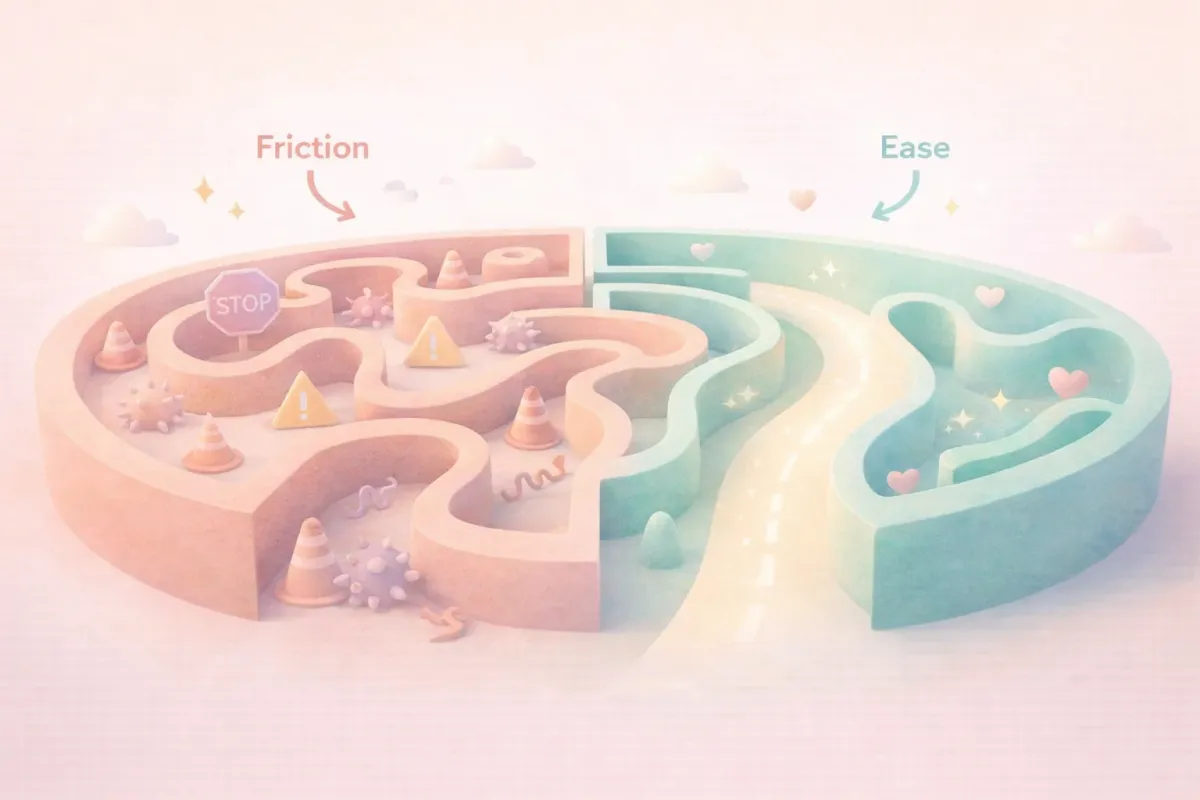
The implications for change management are profound. If you think failure happens because people are resistant, you design interventions targeting attitude: training, town halls, messaging. If you recognize failure happens because context makes the old behavior easier than the new behavior, you design different interventions: environment changes, friction reduction, choice architecture.
Most organizations are doing the former when they need to be doing the latter.
The Behavior Equation
Stanford behavioral scientist BJ Fogg offers a simple model: Behavior = Motivation + Ability + Prompt.
For a behavior to occur, all three elements must be present:
- Motivation: The person wants to do it (or wants the outcome)
- Ability: The person can do it (it's easy enough)
- Prompt: Something triggers the behavior at the right moment
Most change initiatives focus exclusively on motivation. They explain why the change matters, paint a vision of the future, create urgency, get leadership endorsement.
But motivation is the most unreliable element. It fluctuates with mood, energy, competing priorities. It requires constant replenishment through communication and events. It's expensive to maintain and quick to decay.
The more effective lever is ability—making the new behavior easier than the old behavior. No amount of motivation can overcome a behavior that's too difficult to execute consistently.
Why "Easy" Is the Real Change Lever
Consider a common change initiative: improving cross-functional collaboration.
The motivation approach looks like this:
- Launch a company-wide message about collaboration as a core value
- Train people on collaboration skills
- Recognize collaborative behavior publicly
- Hold managers accountable for team cooperation
This can work—if maintained indefinitely. But the moment attention shifts, the moment a new priority emerges, behavior reverts.
The ability approach asks different questions:
- What makes cross-functional work hard right now?
- Where does friction exist in current processes?
- What tools or systems make isolation easier than collaboration?
- How can we redesign workflows so collaboration is the path of least resistance?
Maybe the issue is that booking a room for a cross-functional meeting takes 15 steps. Maybe information lives in siloed systems that require permission requests to access. Maybe the org chart creates reporting structures where cross-functional work feels like going "outside your lane."
Fix these friction points, and collaboration increases without constant motivational investment.
The Habit Problem
Most organizational behavior isn't conscious decision-making. It's habit.
Neuroscientists estimate that 40-45% of daily actions are habits—behaviors that happen automatically in response to contextual cues, without deliberate thought. In organizations, the number is likely higher. How you start your day, how you handle email, how you run meetings, how you respond to requests—these become patterned responses that repeat without conscious consideration.
Change initiatives disrupt these patterns. They ask people to override automatic behavior with deliberate behavior. This is cognitively expensive. It requires attention, working memory, willpower—resources that deplete throughout the day.
This is why change often starts strong and fades fast. People have motivation in week one. By week eight, the cognitive cost of maintaining new behavior exceeds the motivational benefit. The old habit wins.
The behavioral solution isn't more motivation. It's habit design—creating contextual triggers for new behaviors and disrupting the triggers for old ones.
Three Behavioral Design Principles for Organizational Change
1. Make the new behavior the default
Defaults are powerful. They take advantage of status quo bias and decision fatigue. People stick with the default option at remarkably high rates, even when alternatives are easy and obvious.
In organizational change, this means asking: "How do we make the desired behavior what happens if people do nothing special?"
Example: If you want more peer recognition, don't launch a campaign asking people to recognize more. Instead, integrate recognition prompts into existing workflows—a nudge after successful project completion, a prompt when someone marks a task done. The recognition becomes the default path, not a conscious addition.
Example: If you want more one-on-ones, don't train managers and hope they comply. Auto-schedule recurring meetings in calendars. Make the manager's task "show up to scheduled meeting" rather than "remember to schedule meeting."
2. Reduce friction for the new behavior, add friction to the old
Every step in a process is a point of potential drop-off. Every form field, approval requirement, or system login adds friction. Behavioral economists call this the "mere inconvenience" effect—small frictions have disproportionate impact on behavior.
Audit both sides of the change equation:
- What friction exists in doing the new thing?
- What makes the old thing easy?
Then flip them. Add steps to the old behavior. Remove steps from the new behavior.
Example: If you want people to use a new communication channel instead of email, make the new channel faster to access. But also add friction to email—require subject line formats, implement approval workflows for certain recipients, make "reply all" require confirmation.
Example: If you want people to enter data into a new system, don't just train them. Make the old spreadsheet read-only. Remove the friction from new system entry (auto-populate what you can, eliminate unnecessary fields).
3. Leverage social proof and commitment devices
Humans are social animals. We look to others to determine appropriate behavior, especially in ambiguous situations. We also maintain consistency with our public commitments.
These tendencies can be designed for:
Social proof: Make the new behavior visible. Share who's doing it, how many people have adopted, what percentage of teams have transitioned. People will conform toward the visible norm.
Commitment devices: Get public commitments from individuals and teams. Not private agreements—public ones. The discomfort of breaking a visible commitment is a powerful motivator that doesn't require constant reinforcement.
Example: Display a dashboard showing adoption rates by team. Nobody wants their team at the bottom. The social comparison creates motivational pressure without constant communication campaigns.
The 97% Adoption Finding
At Happily.ai, we've observed a consistent pattern: platforms designed around behavioral science achieve 97% adoption rates compared to the industry average of 25%.
This isn't about better features or more training. It's about making the desired behavior (regular engagement with the platform) easy enough that it happens without deliberate effort.
The techniques are precisely those described above:
- The platform integrates with existing tools (reduces friction)
- Engagement activities are brief and fit into natural workflow breaks (ability)
- Personalized prompts arrive at moments when engagement is most likely (prompt timing)
- Social visibility creates comparison effects (social proof)
- The default is participation; opting out requires active choice (default behavior)
The 70% change failure rate isn't inevitable. It's a design failure—designing for how we wish people would behave rather than how behavioral science shows they actually behave.
From Initiative to Infrastructure
The deepest insight from behavioral science isn't about specific techniques. It's about the nature of behavior itself: environments shape behavior more than intentions do.
This reframes the entire concept of organizational change. Instead of launching "initiatives"—time-bounded efforts to shift mindsets—organizations should build behavioral infrastructure: environments designed to make desired behaviors the natural, easy choice.
The difference is sustainability. Initiatives require ongoing energy, attention, and maintenance. Infrastructure works in the background, shaping behavior without constant intervention.
Culture itself can be understood this way. Culture isn't a set of values posted on walls. It's the accumulated behavioral infrastructure—the defaults, the friction points, the social signals, the physical and digital environments—that make certain behaviors likely and others unlikely.
Change the infrastructure, change the behavior. Change the behavior, change the culture.
No motivation campaign required.