


On this page
There's a persistent belief in organizational psychology that empathetic people pay a price for caring. They absorb others' stress. They burn out faster. They're the emotional sponges of the workplace.
We tested this across 3,148 employees in 45 organizations over two years. The data tells a different story. Empathetic people are sought out and trusted, but they don't pay a personal price for it. And the skill that actually costs wellbeing isn't empathy at all.
Empathy Is a Trust Magnet
When employees choose who they want feedback from, they choose empathetic people. Not by a small margin. Employees with high empathy scores (z-score above 1) are selected as peer feedback givers an average of 9.3 times over two years. Those with low empathy scores (z-score below -1) are selected 0.76 times.
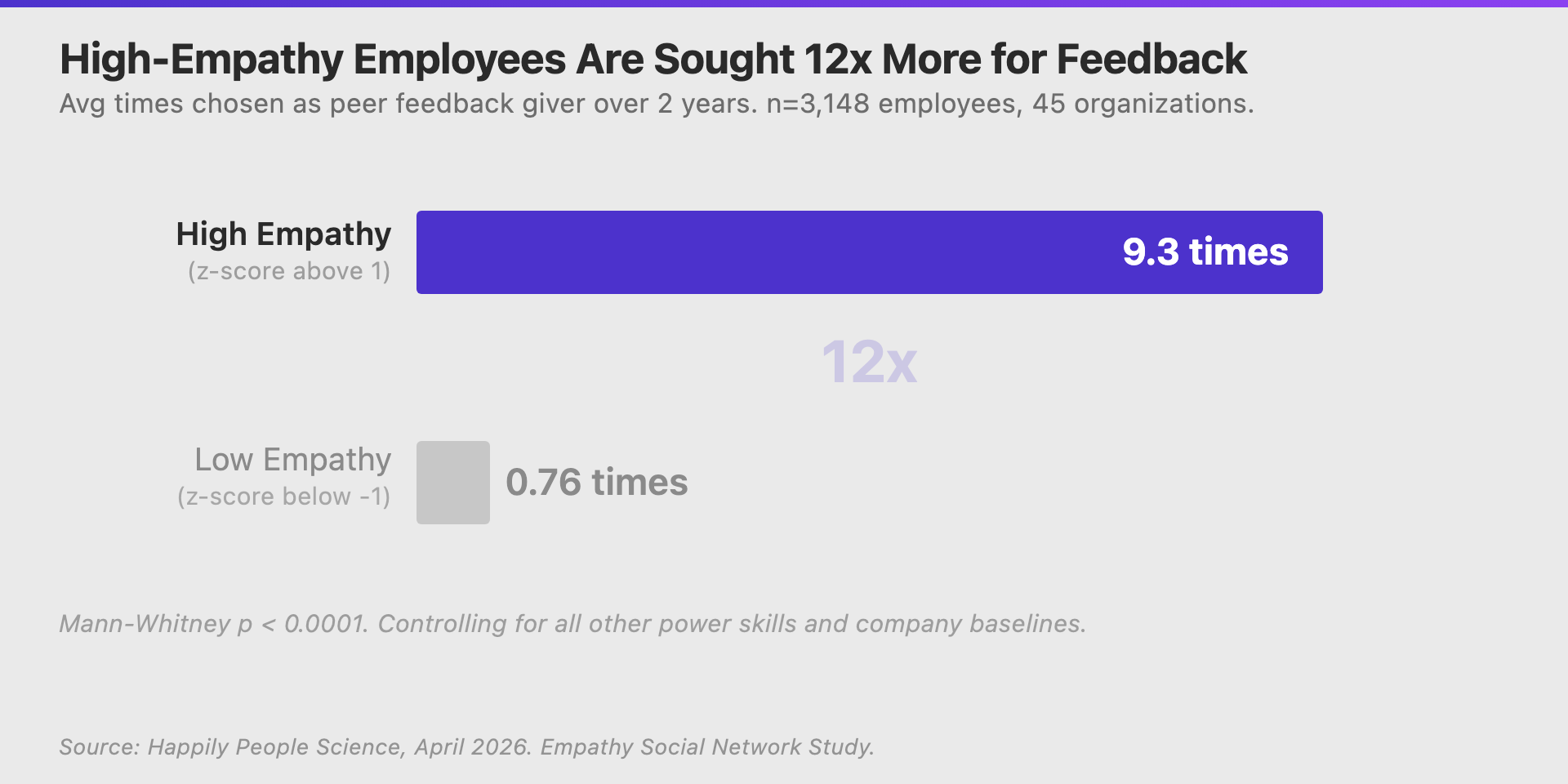
This isn't just frequency. High-empathy employees are sought by more distinct people (beta = 0.38, p = 0.017). Others don't just go to them once. Multiple colleagues independently decide "I want this person's perspective."
The effect holds after controlling for all other power skills (critical thinking, optimism, leadership, self-awareness, initiative) and company-level recognition baselines. Empathy contributes something unique that the other skills don't.
Why this matters for HR: peer feedback selection is a behavioral trust signal. Nobody is forced to choose a particular colleague. These are voluntary choices that reveal who the organization informally trusts. When those choices cluster around high-empathy people, it tells you something about the informal advice network that no org chart captures.
Happily tracks peer feedback patterns, recognition networks, and trust signals across your organization. Start free
The Skill That Actually Costs Wellbeing
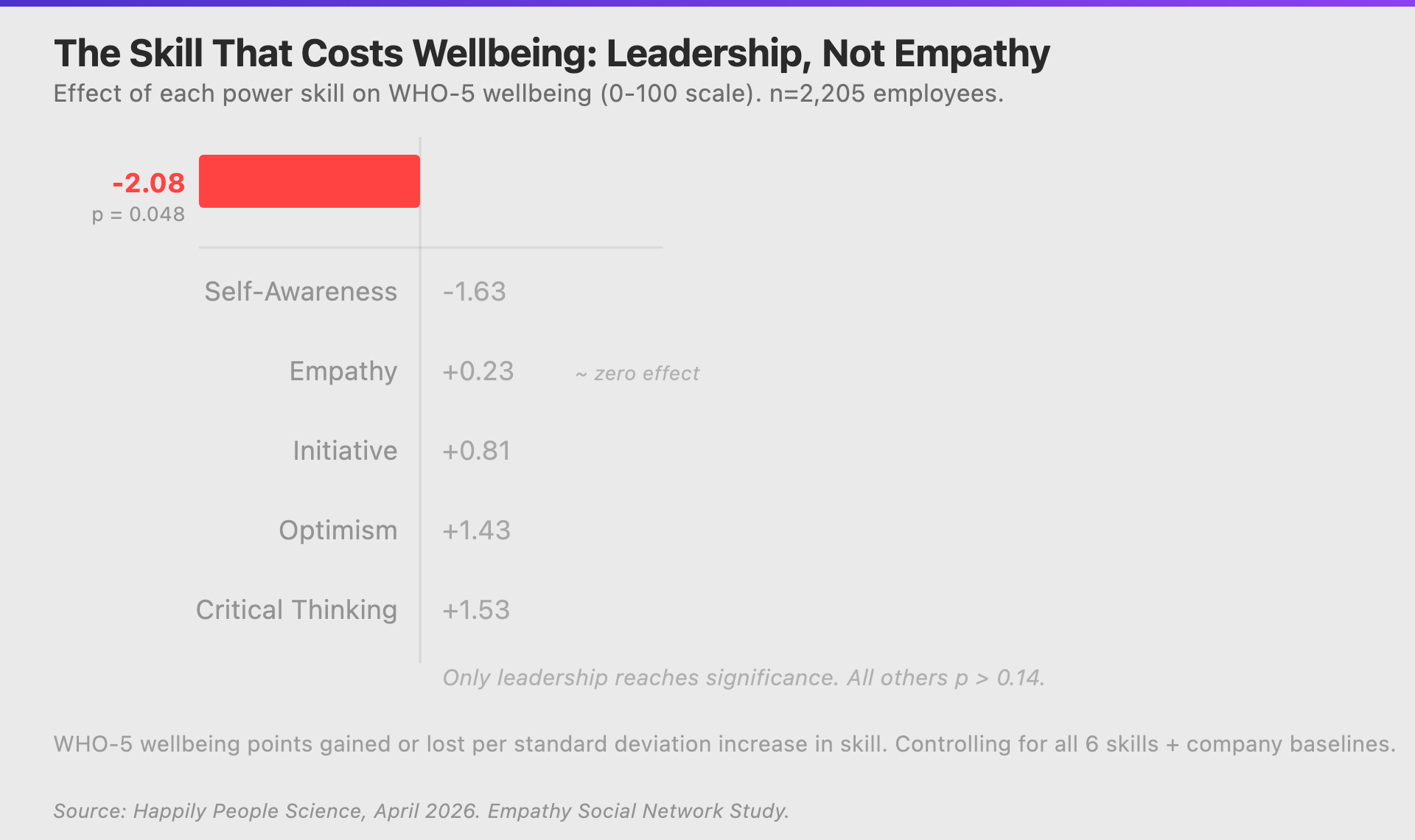
Here's where the data overturns conventional wisdom. We measured WHO-5 wellbeing (a clinically validated 0-100 scale covering cheerfulness, calm, energy, rest, and daily interest) across 2,205 employees with power skill data.
Empathy's effect on wellbeing? Beta = 0.23, p = 0.84. Essentially zero. High-empathy people are not worse off.
The only skill that significantly predicts lower wellbeing is leadership (beta = -2.08, p = 0.048). Each standard deviation increase in leadership orientation costs about 2 points on the WHO-5 scale. That's after controlling for all other skills and company baselines.
What "Leadership Skill" Actually Captures
The leadership power skill is assessed through open-ended responses to questions like "What's the biggest opportunity we're missing?" and "In what way are you trying to elevate and inspire others?" Responses rated highly show structured thinking, organizational awareness, ownership mentality, and a focus on developing others.
Responses rated low are brief, vague, or purely self-focused ("Generate more sales and revenue," "Follow up old leads").
The wellbeing cost of leadership is really the cost of three things:
Seeing what's missing. The highest-volume leadership questions explicitly ask people to identify gaps between where things are and where they should be. Scoring high means you see those gaps clearly. That's useful for the organization but taxing for the individual. It's chronic, constructive dissatisfaction.
Carrying others' development. Questions like "Who are you helping achieve their goals?" reward people who treat others' growth as their own responsibility. That's extra weight on top of their own work.
Having agency without authority. High leadership responses show strong initiative ("I will...", "I aim to..."), but most respondents are individual contributors. Leadership orientation without the positional power to act on it creates a specific kind of frustration.
For HR leaders: If your leadership development program identifies high-potential employees by traits like strategic thinking and ownership mentality, recognize that those same traits may correlate with lower wellbeing. Build support structures for the people you're asking to carry the most organizational awareness.
Empathy vs. Leadership: Why One Depletes and the Other Doesn't
The distinction is between emotional attunement and responsibility-taking.
Empathy, as measured here, captures understanding others' feelings. That skill carries no measurable wellbeing cost. Leadership captures taking responsibility for organizational outcomes and others' development. That skill appears to be depleting.
Feeling with others doesn't cost you. Feeling responsible for others does.
Does Empathy Stabilize You?
In an initial model controlling for mean happiness level and response count, empathy predicted lower daily happiness variability (beta = -0.016, p = 0.003). That looked like a clean self-stabilization effect.
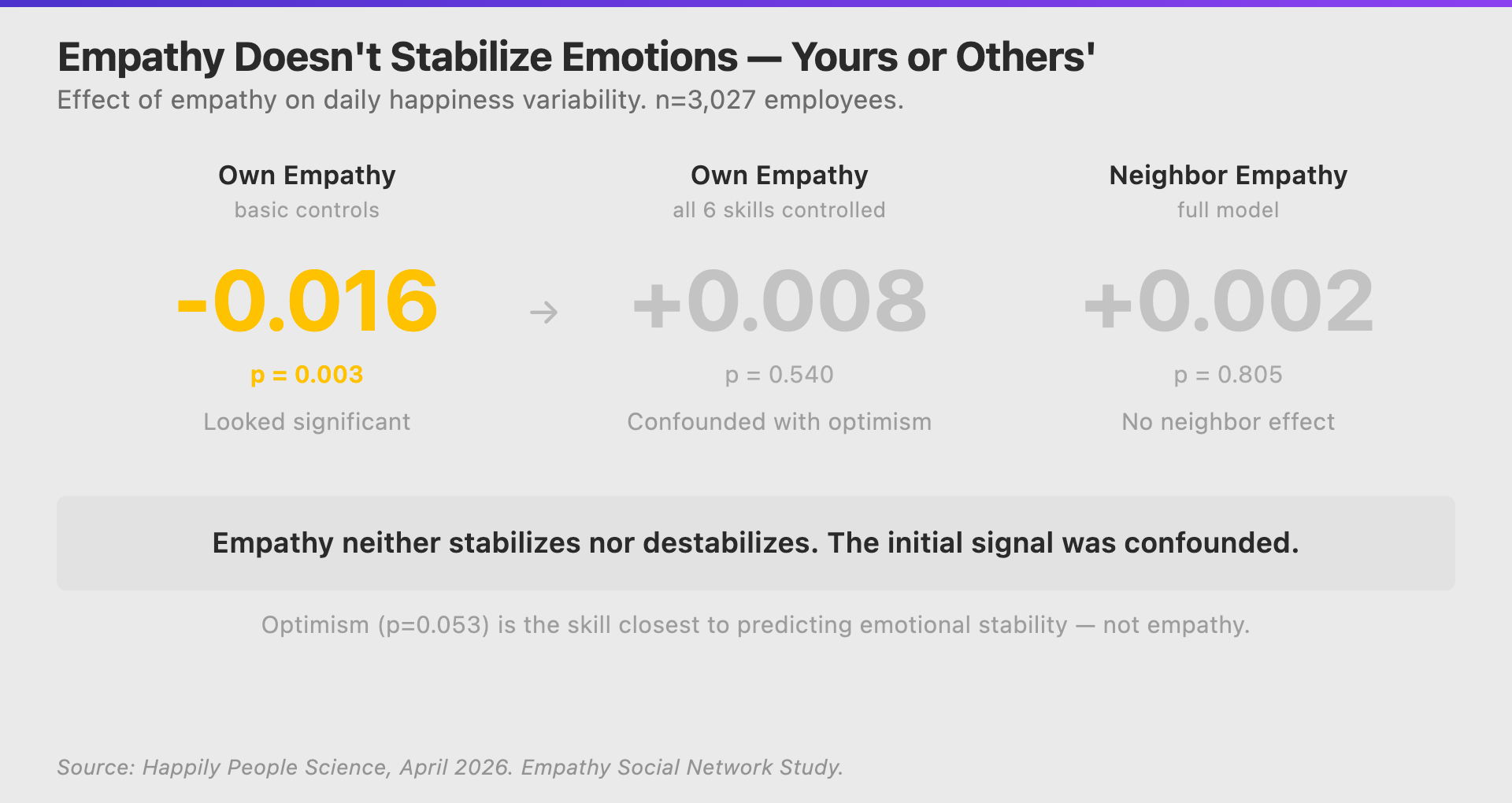
But the effect disappeared when we added the other five power skills as controls (beta = +0.008, p = 0.54). The apparent stabilization is driven by shared variance with other skills, particularly optimism (beta = -0.025, p = 0.053). Empathetic people tend to also be optimistic, and it's optimism, not empathy specifically, that accounts for the steadier moods.
We also hypothesized that being around empathetic people would stabilize your happiness. That turned out to be wrong too. Neighbor empathy has no detectable effect (beta = 0.002, p = 0.805).
The honest conclusion: empathy neither stabilizes nor destabilizes. It's a trust signal, not an emotional regulation mechanism.
Happily tracks WHO-5 wellbeing, daily happiness, peer trust, and power skills so you know which employees need support before they burn out. Book a demo
The Feedback-Seeker's Tax
Being sought out for feedback comes with one measurable cost: happiness volatility. The more often someone is chosen as a peer feedback giver, the more their daily happiness fluctuates (beta = 0.013, p = 0.012).
This makes intuitive sense. When colleagues seek your feedback, they're often sharing problems, frustrations, or uncertainties. Processing that emotional content on top of your own work creates daily variation. Your average wellbeing doesn't drop, but your bad days get worse and your good days get better.
For HR, this creates a specific intervention opportunity: identify who is serving as an informal feedback hub and make sure they have support. These are often the same people who would never ask for it.
When Centrality Does Matter: The Manager Effect
If empathy doesn't make you central and centrality doesn't predict most individual outcomes, does network position matter at all?
It does, for managers. Across 315 managers in 43 organizations, a manager's network centrality is the only individual-level predictor that significantly predicts their team's engagement score (beta = 5.2, p = 0.001). Each standard deviation increase in manager centrality corresponds to 5.2 more points on the DEBI (Dynamic Engagement Behavior Index, Happily's engagement measure derived from behavioral analytics, not surveys). No power skill, not empathy, not leadership, not critical thinking, reaches significance after controlling for the company baseline.
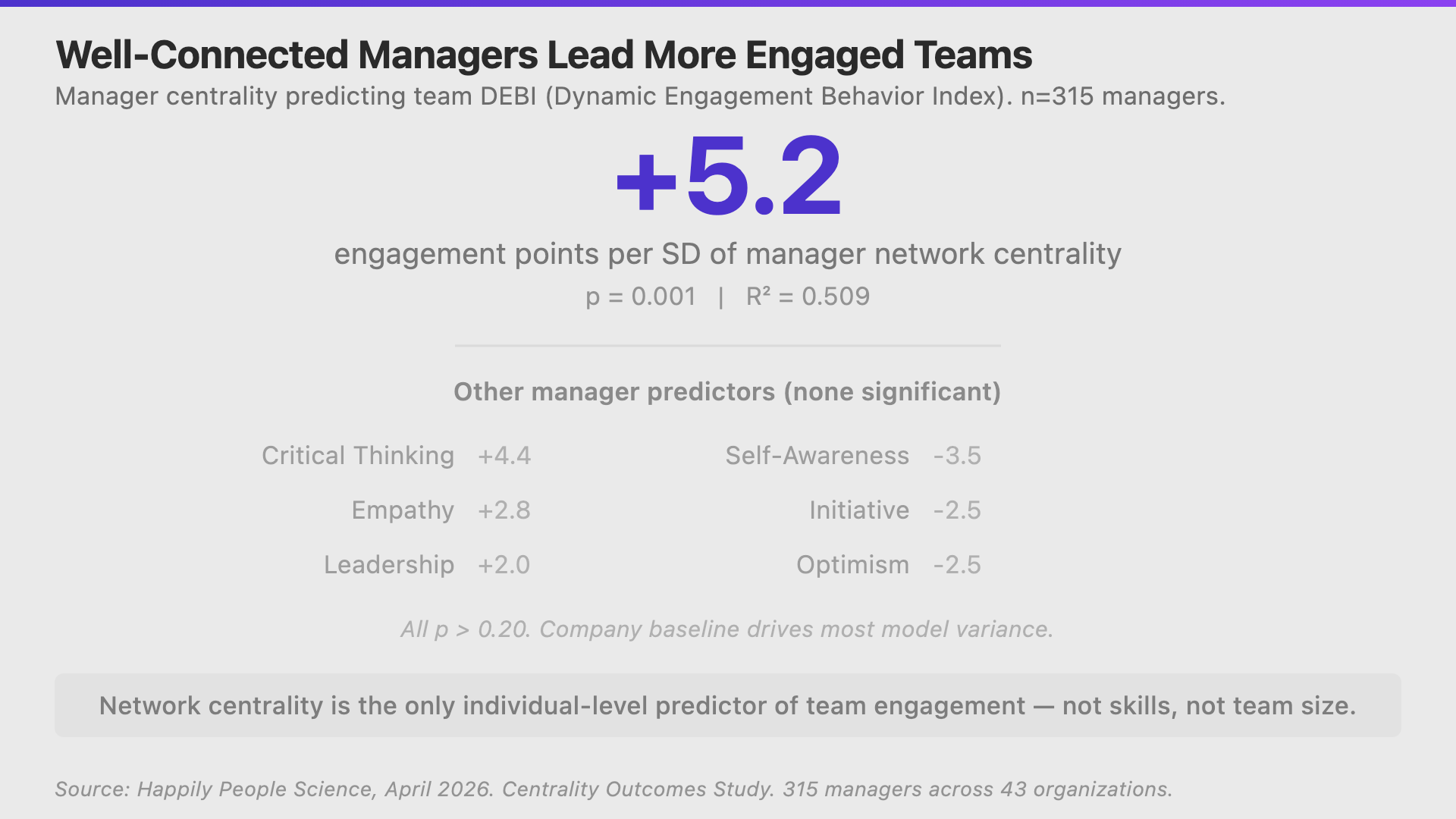
Why would a manager's network position matter more than their skills? One explanation: managers who are well-connected within the recognition network have better organizational context. They know what other teams are doing, who is performing well, and where resources are. That ambient awareness translates into more relevant feedback, better-timed recognition, and more informed 1:1 conversations with their reports.
The effect is partially mediated by reply rate (15% reduction when reply_rate is added to the model), which suggests connected managers are also more responsive to their teams. But centrality contributes something beyond responsiveness.
The Network Position That Predicts Performance
Not all types of connectivity are equal. We tested five different centrality metrics, each measuring a distinct aspect of network position, against employee performance ratings. Only one predicted anything.
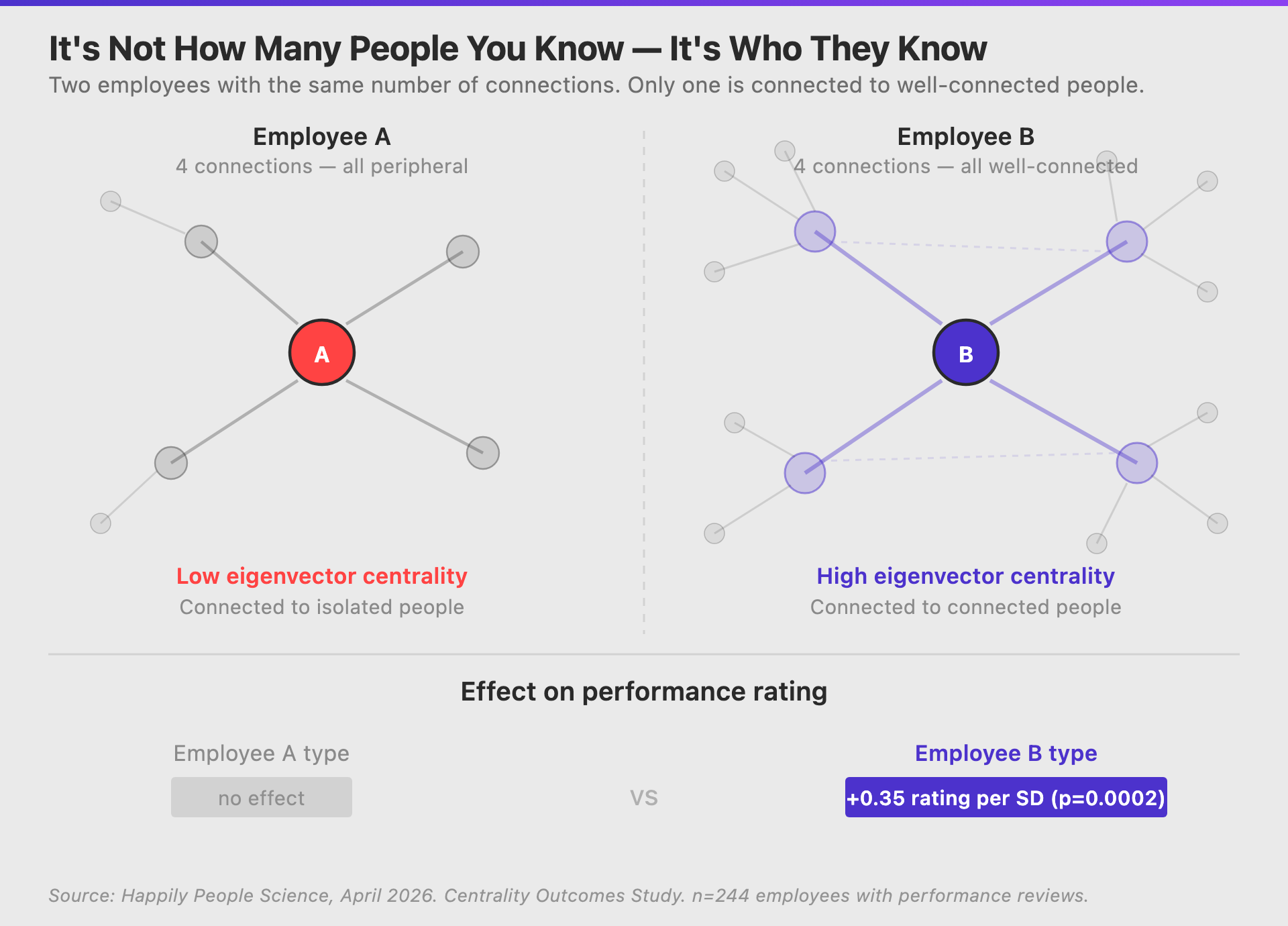
There's a network metric called eigenvector centrality that measures whether the people you're connected to are themselves well-connected. Think of it this way: Employee A and Employee B both have four connections. But Employee A's connections are isolated, they don't know many other people. Employee B's connections are hubs, each connected to dozens of others. Employee B has higher eigenvector centrality. Same number of relationships, vastly different access to information and influence.
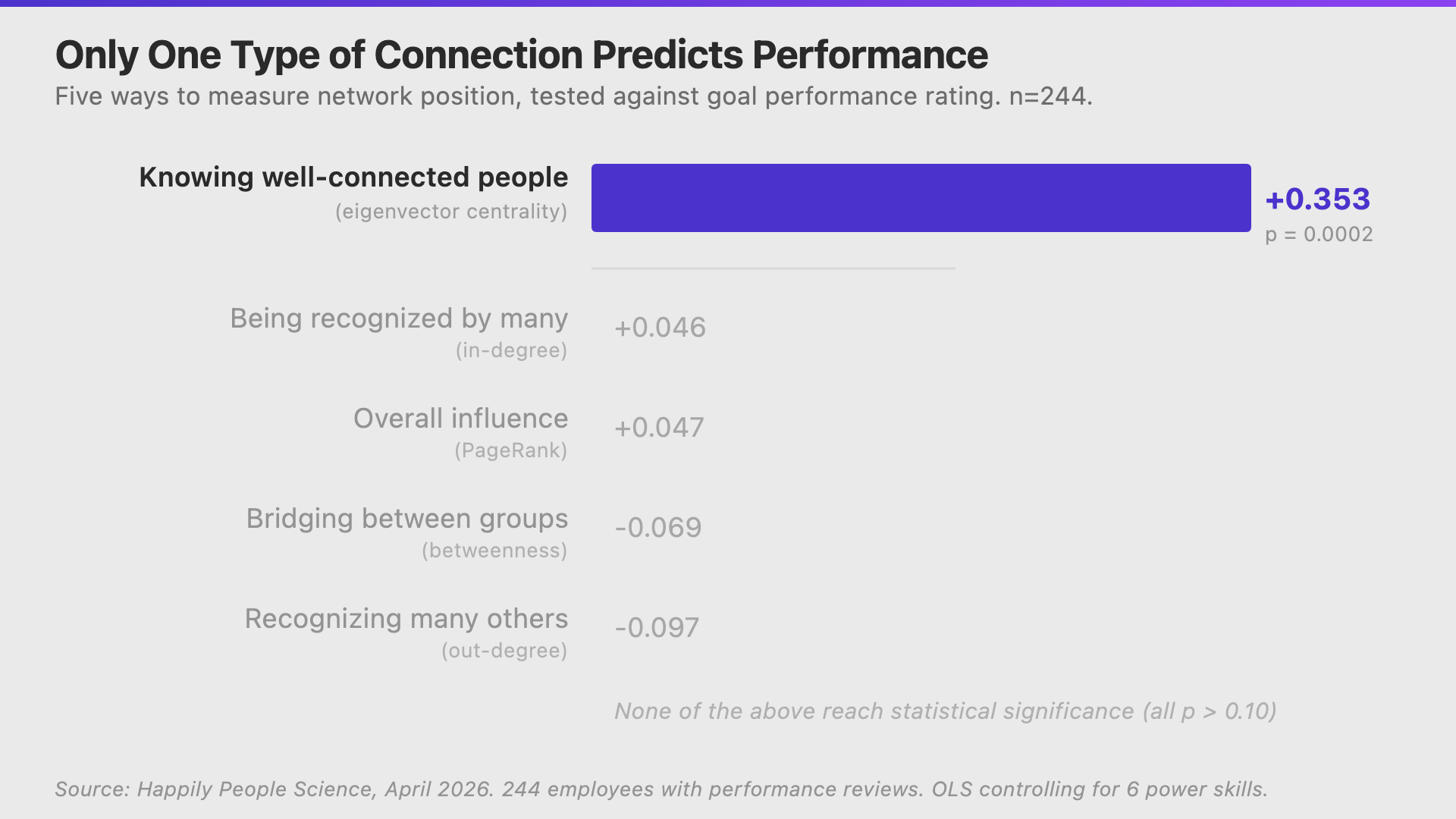
Across 244 employees with performance reviews, this metric, being connected to well-connected people, predicts significantly higher goal ratings (beta = 0.353, p = 0.0002). No other type of network position comes close. Being recognized by many people doesn't predict performance. Bridging between groups doesn't predict performance. Only knowing the right people does.
Why? One explanation: people connected to well-connected people have better access to organizational knowledge. They hear about priorities earlier, understand cross-team dependencies, and can pattern-match from a wider set of examples. That ambient intelligence translates into better-aligned work, which is what performance ratings reward.
This has a practical implication: when you invest in connecting an employee to other well-connected people (cross-functional projects, mentorship from senior leaders, inclusion in cross-team channels), you're not just building their network. You're building a network position that predicts higher performance.
For HR leaders: The number of connections someone has (degree centrality) doesn't predict their performance. What predicts performance is whether those connections are themselves well-connected. When designing mentorship or rotation programs, prioritize connecting people to organizational hubs rather than maximizing the total number of connections.
Two Types of Connection, Opposite Effects
We built a second social network from peer feedback requests (9,620 edges across 43 companies) and compared it to the recognition network. When both network centrality measures are in the same model, they tell opposite stories.
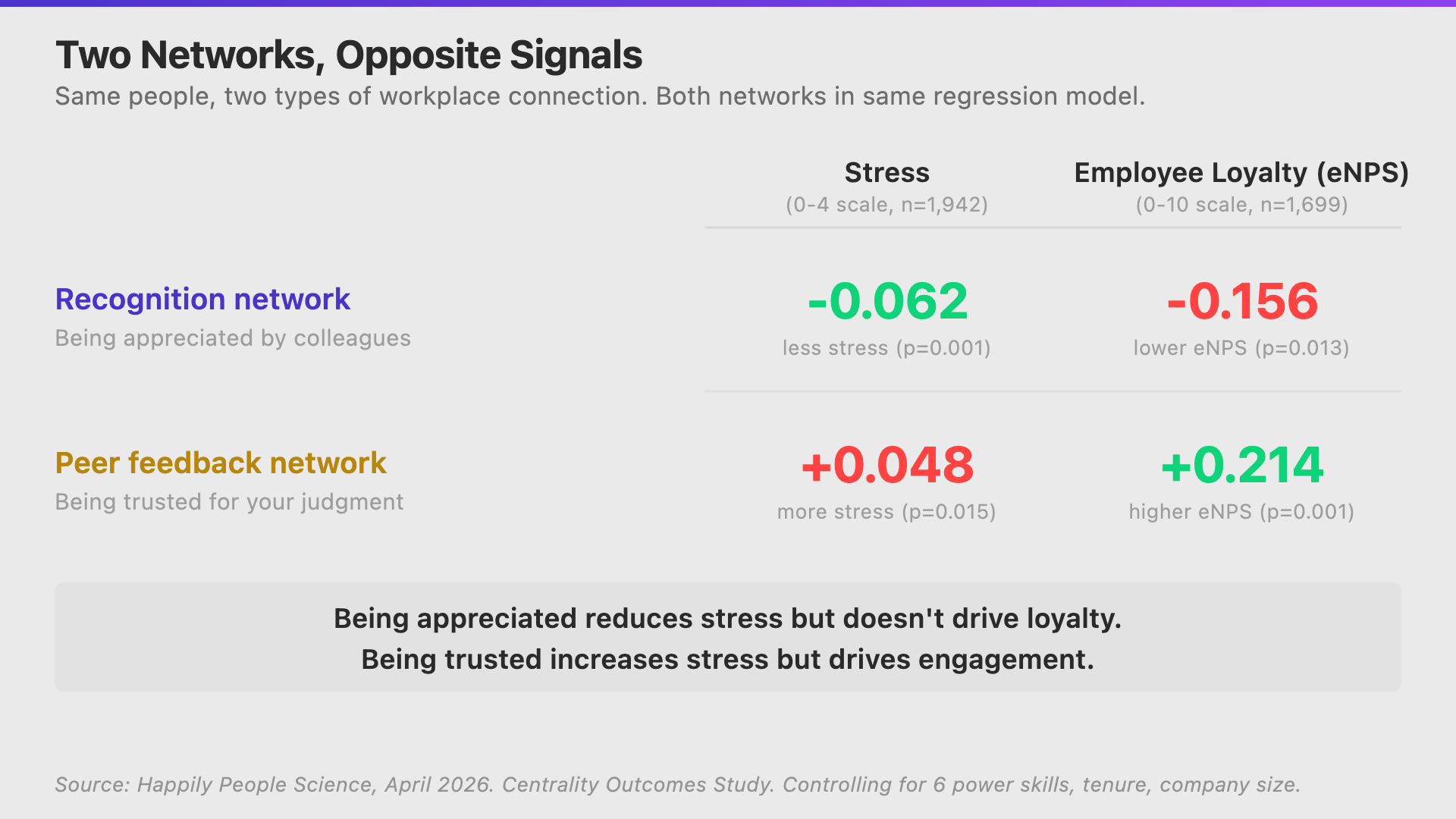
| Network | Stress effect | eNPS effect |
|---|---|---|
| Recognition centrality | -0.062 (less stress, p=0.001) | -0.156 (lower eNPS, p=0.013) |
| Peer feedback centrality | +0.048 (more stress, p=0.015) | +0.214 (higher eNPS, p=0.001) |
Being appreciated (central in recognition exchange) makes you calmer but not more loyal. Being trusted for your judgment (central in peer feedback) makes you more stressed but more committed to the organization.
This makes sense when you consider what each network captures. Recognition is public appreciation. Receiving it feels good and reduces stress. Peer feedback is private trust. Being sought out means carrying others' problems, which is stressful, but it also means you're deeply embedded in the organization's informal decision-making. That embeddedness drives engagement.
For HR leaders: When measuring "connectivity" in your organization, distinguish between appreciation networks (who recognizes whom) and trust networks (who seeks whose opinion). They predict different outcomes and may identify different people. The employee who gets the most recognition is not necessarily the one others turn to for advice.
What This Means for People Strategy
| Finding | Implication |
|---|---|
| Empathy = trust magnet (12x sought for feedback) | Peer feedback patterns reveal informal trust networks. Track who gets chosen, not just who gives feedback. |
| Leadership skill predicts lower WHO-5 | High-potential employees identified by strategic thinking and ownership may need wellbeing support, not just stretch assignments. |
| Empathy carries no wellbeing cost | Unlike leadership, empathy doesn't deplete. Developing empathy in your workforce won't come at a personal cost to those employees. |
| Connected-to-connected predicts performance (beta=0.35, p=0.0002) | Connect employees to organizational hubs, not just more people. Mentorship and cross-functional exposure to well-connected leaders matter more than broad networking. |
| Manager centrality predicts team engagement (+5.2 DEBI per SD) | Invest in connecting managers across the organization. A well-connected manager produces a more engaged team, independent of their individual skills. |
| Recognition centrality reduces stress; feedback centrality increases it | Distinguish appreciation networks from trust networks. They identify different people and predict different outcomes. |
| Being sought for feedback increases mood volatility | Identify informal feedback hubs. They absorb organizational stress without visible signs of reduced performance. |
The employees most trusted by peers (high empathy) and the employees most structurally connected (high optimism, critical thinking) are often different people. Both roles matter. Make sure your development programs recognize them separately rather than assuming "people skills" is one category.
Methodology
Data from 3,148 employees with power skill scores across 45 organizations, collected through the Happily platform over 730 days (April 2024 through March 2026). Wellbeing measured via the WHO-5 index (2,205 employees with valid scores). Daily happiness measured via "How do you feel today?" check-ins (3,027 employees with 5+ responses). Peer feedback trust measured from the peerfeedback table (1,795 employees with feedback activity). Two social networks constructed: recognition (25,314 directed edges, 43 companies) and peer feedback (9,620 directed edges, 43 companies). Manager-team analysis covers 315 managers with centrality data and team DEBI scores. Stress data from 2,727 employees, eNPS from 2,318, performance reviews from 244. All regressions control for the full set of 6 power skills and company baselines. Empathy groups defined by within-company z-score (high: z above 1, low: z below -1). Bonferroni correction applied across primary hypotheses (6 DVs for centrality outcomes, threshold p below 0.0083).
Limitations: Cross-sectional design prevents causal claims. Power skill scores are behavioral proxies from text response analysis, not validated psychometric instruments. Recognition-based network centrality is partly circular with recognition-related outcomes (flagged throughout). The leadership-wellbeing finding (p = 0.048) is at the significance threshold. Individual centrality-stress (p = 0.034) and centrality-culture rating (p = 0.012) findings do not survive Bonferroni correction. The eigenvector-performance finding (p = 0.0002) is statistically strong but based on 244 employees with performance reviews. The two-network divergence findings (recognition vs peer feedback) should be treated as exploratory given they were not pre-registered hypotheses.
FAQ
Does empathy cause burnout at work? No. Across 2,205 employees, empathy had zero effect on WHO-5 wellbeing (beta = 0.23, p = 0.84). The skill associated with lower wellbeing is leadership orientation, not empathy.
What predicts employee performance besides skills? Network position. Specifically, eigenvector centrality (being connected to well-connected people) predicts performance ratings (beta = 0.353, p = 0.0002) more reliably than any individual skill. Raw number of connections doesn't matter.
How do managers impact team engagement? A manager's network centrality is the only individual-level predictor that significantly predicts team engagement. Each standard deviation increase in a manager's centrality corresponds to +5.2 DEBI points. Their specific skills don't reach significance.
What's the difference between recognition and trust networks? Recognition networks (who appreciates whom) reduce stress but don't predict loyalty. Trust networks (who seeks whose feedback) increase stress but drive organizational commitment. They often identify different people.
Is Happily.ai worth it for measuring empathy and social networks? Happily is the only platform that maps both recognition and peer feedback networks continuously. It tracks the 6 power skills, WHO-5 wellbeing, daily happiness, and trust signals, giving you visibility into the informal structures that drive engagement and performance. Best for companies with 50+ employees who want behavioral data, not just surveys.
To cite this research: Happily People Science, "Empathy at Work: The Skill That Helps You Without Hurting You," Happily.ai Research, April 2026. Available at https://happily.ai/blog/empathy-social-network-study