



On this page
Gallup's research shows that managers account for 70% of the variance in team engagement. Communication is where most of that variance gets created, because talking to people is what a manager does all day.
Communication training for managers is structured skill development that teaches people leaders to give specific feedback, ask before answering, translate strategy into this week's work, and surface conflict early, delivered with enough spaced practice that the behavior survives a normal week back at the desk.
Best for: companies between roughly 50 and 1,000 employees where a layer of newly promoted managers now sits between the founders and most of the workforce, and where nobody has ever taught those managers the job.
This guide is for the person who has to choose or build the program: the seven skills worth training, the formats you can buy, what each one costs and fails at, how to tell whether it worked, and when training is the wrong purchase entirely.
What Poor Manager Communication Costs

Grammarly and The Harris Poll estimated in their 2022 State of Business Communication report that ineffective communication costs US businesses $12,506 per knowledge worker per year, or up to $1.2 trillion annually. Treat that as modeled rather than measured: it multiplies self-reported wasted hours by an assumed salary. Even discounted heavily, at 200 employees it is a seven-figure line item nobody has a budget code for.
The engagement data is firmer. Gallup's State of the Global Workplace: 2026 Report found global engagement fell to 20% in 2025, and that managers fell furthest, from 27% engaged to 22%. Gallup puts the annual cost of low engagement to the world economy at roughly $10 trillion, about 9% of global GDP.
The mechanism is not mysterious. The UKG Workforce Institute's 2023 study of 3,400 people across ten countries found 69% said their manager affects their mental health, the same share who said their spouse or partner does, and more than said their doctor (51%) or therapist (41%). That influence travels through ordinary conversations: how a priority gets explained, whether a concern gets a reply, what happens after someone raises a problem.
None of this means your managers are failing. Most were promoted for being excellent at the individual job, then handed responsibilities requiring a different skill, with no instruction. Training is the correction, and a cheaper one than replacing the people who leave.
What a Manager Communication Training Program Should Contain

A curriculum is not a topic list. Each module below has three parts: the skill, the drill, and the signal that tells you it transferred. If a proposal cannot produce that third part for every module, you are buying a lecture series.
1. Feedback Inside 24 Hours
Specific, observation-based feedback, delivered close enough to the event that the person still remembers what they did. Managers learn the SBI structure: Situation ("in the client call this morning"), Behavior ("you reframed their objection by walking through the implementation timeline phase by phase"), Impact ("which moved them from skeptical to asking about next steps"). Three sentences, under a minute.
The drill: each manager writes and sends three SBI messages during the session, about real people, that day.
The signal: feedback volume per manager per week, and the ratio of reinforcing to redirecting feedback. Roughly three to one gives enough safety that corrective feedback lands as help.
2. Ask Before You Answer
When someone brings a problem, the fast move is to solve it. It feels like competence. Done every time, it routes every decision through the manager, and the team's speed gets capped by one person's calendar.
The drill: three questions before any answer. "What have you tried?" "What do you think is causing it?" "If you had to decide right now, what would you do?" Then, if input is still needed, offer it as one option rather than the answer.
The signal: talk ratio. In a working one-to-one, the manager talks less than a third of the time.
3. Translate Strategy Into This Week's Work
Executives speak in quarters. Individual contributors live in weeks. The manager is the translation layer, and when that layer is thin, people work hard on things that do not matter.
The drill: after every leadership meeting, write three sentences. What changed. Why it matters to this team. What we do differently starting Monday. A manager who cannot answer all three has a question to send back up, not a gap to paper over.
The signal: ask direct reports to name the team's top three priorities in order, then compare to the manager's list. The overlap is your alignment score.
4. Name the Tension in the Room
Every team carries unresolved friction: overlapping ownership, conflicting priorities, one person who keeps getting talked over. It exists whether or not anyone says it out loud. Naming it is what makes resolution possible.
The drill: practice the structural framing. "We do not have a clear decision rule for when customer requests conflict with the roadmap" works. "You two keep disagreeing" does not. Every naming conversation closes with a decision, or an owner and a date.
The signal: time between an issue first appearing in team chatter and a decision being recorded.
5. Close the Loop
Few things erode trust faster than raising a concern and never hearing about it again. The implied message is that it was not worth remembering.
The drill: managers keep a running list of every commitment made in a one-to-one and open the next one by reporting back, including on items with no progress. "I have not fixed this yet, here is where it stands" holds more trust than silence.
The signal: median response time to employee input. Happily.ai research on manager response times found that how quickly a manager replies predicts whether people keep speaking up at all.
6. Recognition as a Communication Behavior
Recognition usually gets filed under rewards. It belongs in the communication curriculum, because it is a specific act of noticing and naming what someone did.
The drill: one written recognition per manager per day, naming the behavior rather than the person. "You are great" builds nothing. "Leading that update with risks before status made the review twice as fast" tells someone exactly what to repeat.
The signal: Happily.ai's analysis of more than 10 million workplace interactions found that people who give recognition are trusted 9x more than those who stay silent. The trust multiplier attaches to the giver, which is why this is a manager skill rather than a program.
7. Communicating Change and Difficult News
Restructures, new targets, return-to-office decisions, budget cuts. Managers deliver decisions they did not make to people who will hold them responsible for the outcome.
The drill: state the decision, the reason, and the part that is genuinely unresolved, in that order, without softening the decision into ambiguity. Then take questions without defending. Managers who avoid this reach the performance conversation months too late, which is a communication failure wearing a process costume.
The signal: after any announcement, the share of people who can correctly state what changed and why.
Seven modules is a quarter of spaced sessions, not one sitting. Which brings us to format.
Workshop Formats: Half-Day, Cohort, or Embedded Practice
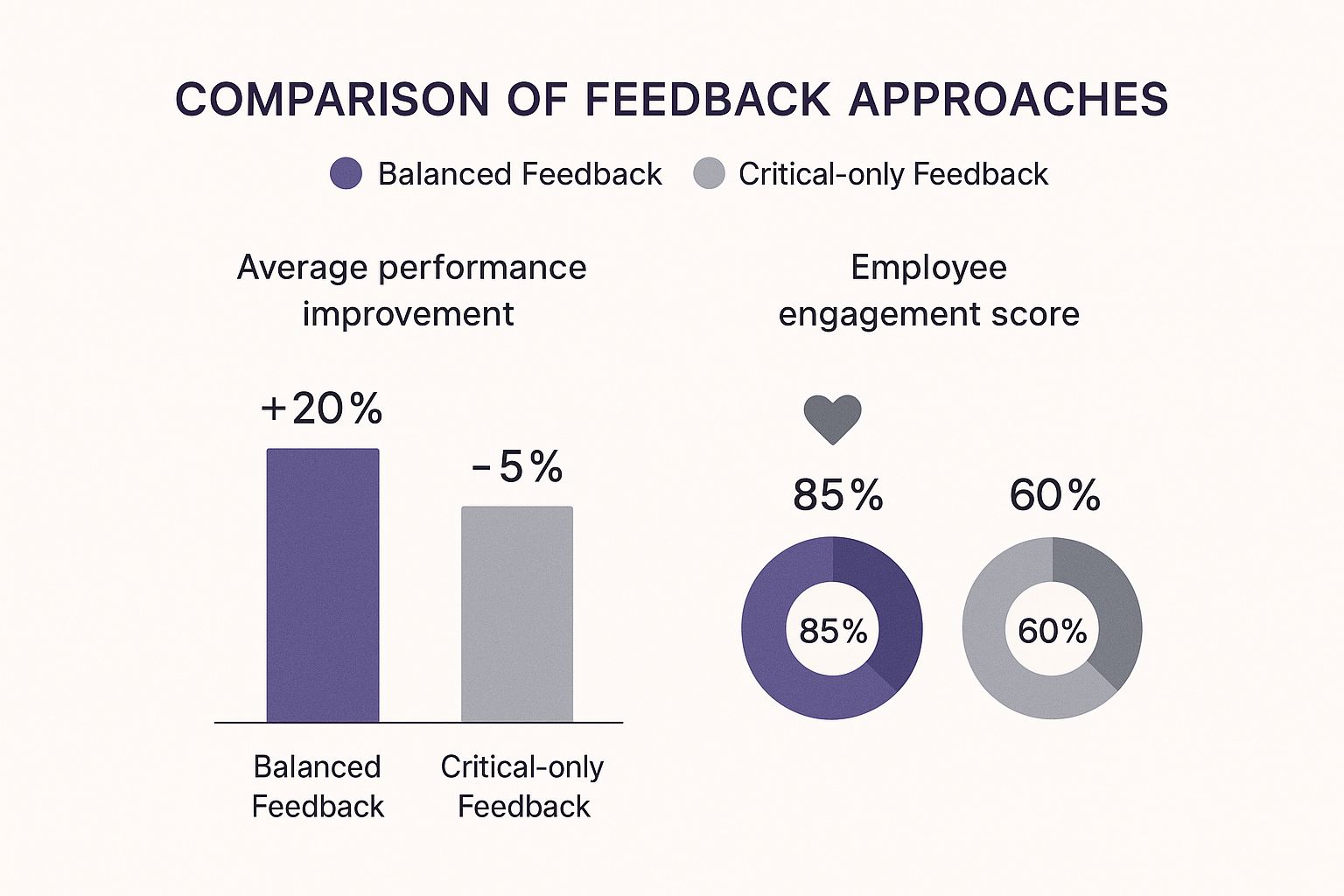
The largest meta-analysis of leadership training, Lacerenza and colleagues in the Journal of Applied Psychology (2017), pooled 335 independent samples and found leadership training substantially more effective than earlier reviews suggested, with large effects on learning and on transfer to the job. The same analysis found the design choices matter: needs analysis beforehand, feedback during, multiple delivery methods with real practice, and sessions spaced over time rather than compressed into one sitting.
Read that as a warning about format, not a licence to buy anything.
The Half-Day Workshop
Four hours, one room, one facilitator, everyone at once. Its real strength is shared vocabulary. After a half-day, "let's SBI that" means something to all thirty managers, and that is worth more than most people credit.
Cost profile: the lowest per-head instructor-led option, and the easiest to approve because it is one line and one date.
What it fails at: transfer. Four hours is enough to introduce seven skills and practice one. The Lacerenza analysis found spaced sessions outperform single sittings, and a half-day is the definition of unspaced. Buy it when you need common language fast, not when you need behavior change.
The Multi-Week Cohort
Six to twelve managers, one session a week or fortnight for a quarter, with practice assigned between sessions and the group troubleshooting real cases.
Cost profile: the most expensive per head, several times a half-day, because you pay for facilitator hours across a quarter plus manager time away from their teams.
What it fails at: scale and timing. Twelve managers per cohort means a 60-manager organization is looking at a year. It concentrates learning in a room rather than in the work, so a cohort that ends without a measurement system still decays, just more slowly. And it punishes companies in genuine turbulence, because managers mid-restructure miss sessions.
Embedded Daily Practice
No block on the calendar. Prompts arrive in the flow of work: a question before a one-to-one, a nudge to close a loop, a flag that three people on this team have not been recognized in a month. Practice happens on live cases with real people.
Cost profile: platform pricing, typically per employee per month, so it scales down cleanly for small manager populations and up cleanly for large ones.
What it fails at: the hard stuff. A prompt cannot teach a manager to run a layoff conversation. Embedded practice is very good at keeping a skill alive and weak as first exposure to a difficult one. It also assumes managers have enough autonomy to act on the prompt. If your managers cannot make decisions, nudging them to communicate better is noise.
Self-Paced E-Learning
Worth naming because it is where most budgets default, and it is genuinely useful for foundational knowledge. The Lacerenza analysis found self-administered delivery underperforms facilitated delivery, so treat a video library as prework, not as the program.
| Format | Duration | Cost profile | Best for | Main weakness |
|---|---|---|---|---|
| Half-day workshop | 3 to 4 hours, one sitting | Low per head, single line item | Building shared vocabulary across a manager group fast | Almost no transfer; unspaced by design |
| Multi-week cohort | 6 to 12 weeks, weekly or fortnightly | Highest per head, plus manager time off-team | Deep practice on hard conversations, small manager groups | Slow to scale; decays without a measurement system |
| Embedded daily practice | Continuous | Per employee per month, scales both ways | Keeping skills alive after initial exposure | Weak as first exposure to difficult skills |
| Self-paced e-learning | Self-directed | Lowest per head | Foundational concepts, prework before a live session | Underperforms facilitated delivery on transfer |
If Your Situation Looks Like This, Choose This
If you have fewer than 15 managers and the problem is one or two specific people, then skip the program and buy individual coaching. Group training to fix two managers is expensive theater.
If you have 20 or more managers using different words for the same things, then start with a half-day workshop to install shared vocabulary and follow it with embedded practice. The workshop alone will not hold.
If the recurring failure is hard conversations, performance issues, or conflict left unaddressed for months, then you need a multi-week cohort. Those skills require rehearsal with a facilitator watching, and no prompt or video substitutes for that.
If your managers already know what good looks like but do it inconsistently, then the gap is reinforcement, not knowledge. Buy embedded practice and measurement, not another workshop.
If you ran training in the last 18 months and nothing changed, then do not rebuy the same format. Run a needs analysis and a 360 first, because the meta-analytic evidence puts needs analysis among the strongest predictors of whether training works.
If your managers each carry more than 12 direct reports, then fix span of control before training. More on that below.
How to Tell Whether the Training Worked
Satisfaction sheets measure whether the facilitator was likeable. Useful for choosing facilitators, useless for deciding whether to renew.
Measurement has one prerequisite: baseline before the training, not after. Without pre-training numbers you cannot attribute anything, and every result becomes a story rather than a finding.
| Horizon | Indicator | How to measure |
|---|---|---|
| 0 to 30 days | Feedback frequency per manager | Count of feedback or recognition instances given per manager per week |
| 0 to 30 days | Manager talk ratio in one-to-ones | Self-report plus spot observation by an HR partner |
| 30 to 90 days | Response time to employee input | Median hours from an employee raising something to a manager reply |
| 30 to 90 days | Priority-recall alignment | Ask reports to name the top three priorities; compare to the manager's |
| 30 to 90 days | Team engagement movement | Continuous engagement score by team, against that team's own pre-training baseline |
| 2 to 4 quarters | Voluntary turnover on trained teams | Compare trained-manager teams to untrained, controlling for function |
| 2 to 4 quarters | Promotion readiness | Share of teams producing a promotable successor |
Two cautions. Compare each team to its own baseline rather than to other teams, because a team that started at the bottom has more room to move and will flatter the program. And expect leading indicators to move within a month while lagging ones take two or three quarters. Judging a program on turnover at 60 days will kill something that was working.
For a standing view rather than a one-off study, a manager effectiveness scorecard turns these indicators into a repeatable per-manager readout, which is also how you discover that the average hides a wide spread.
When Communication Training Is the Wrong Purchase

Training fixes a skill gap. It is a bad answer to four problems that look like skill gaps and are not.
Span of control. A manager with 18 direct reports cannot run weekly one-to-ones. There are not enough hours. Sending that person to a workshop on better one-to-ones teaches a skill they are structurally prevented from using, and the shortfall gets recorded as their failure. Fix the org design first.
No feedback loop. With no data on how their team actually experiences them, managers get technique without calibration, and they will apply it in the direction of their existing blind spots. A 360 or a continuous signal has to exist first, or the training has nothing to correct against.
Unclear decision rights. When two leaders hand a team conflicting priorities, the manager in the middle is not communicating badly. They are accurately transmitting an unresolved disagreement. No amount of framing practice fixes that.
A manager who does not want the job. Some of your strongest individual contributors took management because it was the only promotion track available. Training will not create appetite. A senior IC track will, and it costs less than the turnover their team will otherwise produce.
A fifth, harder one: if senior leaders do not model the behavior, managers read the training as compliance and revert within weeks. No vendor can solve that for you.
The Part a Workshop Cannot Do
Here is the honest position, from a company that sells the alternative.
Workshops work. The meta-analytic evidence is clear, and anyone telling you training is theater is selling something. What workshops cannot do is survive the return to a full inbox. A skill practiced for four hours in March and never prompted again is gone by May, and the reason is not manager laziness. Nothing in the working week asks for it.
Happily.ai is a Culture Activation platform, which means it works on daily behavior rather than periodic measurement. For a manager development program that means four things. Gems make recognition a daily currency people spend and redeem, so module six stops depending on willpower. DEBI, our Dynamic Engagement Behavior Index, gives each team a 0 to 100 engagement score that updates continuously, so you can watch a trained manager's team move against its own baseline instead of waiting for the next engagement survey cycle. Manager scorecards show each manager their own feedback frequency, response time, and recognition patterns, which is the calibration layer training normally lacks. The hotspot map shows leaders which teams are drifting, so coaching goes where the problem is rather than everywhere at once. That combination reaches 97% adoption against roughly 25% for the category, and customers see an average 40% reduction in turnover, worth about $480,000 a year for a mid-sized organization.
The sequence that works: run the workshop or cohort to install the skill, then use daily practice and measurement to keep it. Buy only the second half and managers never get the hard conversation skills. Buy only the first half and you get a good memory and no change. See how manager development works day to day for the mechanics.
Frequently Asked Questions
How long should manager communication training be? Spaced beats compressed. The Lacerenza meta-analysis found training delivered across multiple sessions outperforms the same content in one sitting. A defensible shape is a half-day or full-day opening to install vocabulary, then shorter sessions every two weeks for a quarter, then continuous reinforcement in the flow of work. Total facilitated time of 12 to 20 hours spread across three months will outperform 20 hours delivered in three days.
Does communication training for managers actually work? Yes, with conditions. Pooling 335 independent samples, Lacerenza and colleagues found leadership training produced large improvements in learning and in transfer to the job. The conditions matter as much as the finding: run a needs analysis first, include feedback, use real practice rather than lecture, space the sessions, and prefer facilitated delivery over self-administered. Programs that skip those get the reputation the whole category carries.
How much does communication training for managers cost? No credible published benchmark exists for per-participant workshop pricing, so treat any vendor number as a negotiating position rather than a market rate. What is published is total learning spend. Training magazine's 2025 Training Industry Report put average US expenditure at $874 per learner per year across 40 training hours, and ATD's 2026 State of the Industry put direct learning expenditure at $846 per employee. Use those as your sanity check, and ask every vendor for the fully loaded number including manager time away from their team, because that is usually the largest component and the one nobody quotes.
Should we run communication workshops for managers in person or virtually? In person, if the content includes conflict, performance conversations, or anything where people have to be seen struggling. The meta-analytic evidence favors face-to-face, on-site, facilitated delivery. Virtual instructor-led is a fair trade for distributed teams and foundational content, but it needs facilitators genuinely skilled at remote engagement, not a slide deck on a webcam. Our guide to communication in virtual teams covers what else changes at distance.
How do we know the training worked and not something else? Baseline before you start, then compare each trained manager's team to its own prior numbers. Track behavioral indicators at 30 days and business indicators at two to four quarters. If you can stagger the rollout, train half your managers first and use the other half as a comparison group. That single design choice will do more for your credibility with the CFO than any vendor's ROI calculator.
Sources:
- Lacerenza, C. N., Reyes, D. L., Marlow, S. L., Joseph, D. L., & Salas, E., "Leadership Training Design, Delivery, and Implementation: A Meta-Analysis" - Journal of Applied Psychology, 102(12), 1686-1718 (2017)
- Gallup: Manager Development Strategy (70% of variance in team-level engagement) - Gallup (2026)
- Gallup: Global Employee Engagement Continues to Decline, State of the Global Workplace 2026 - Gallup (2026)
- Grammarly and The Harris Poll: The State of Business Communication - Grammarly / The Harris Poll (2022)
- UKG Workforce Institute: Managers Impact Our Mental Health More Than Doctors and Therapists - The Workforce Institute at UKG (2023)
- Training Magazine: 2025 Training Industry Report - Training magazine (2025)
- ATD: Highlights From the 2026 State of the Industry Report - Association for Talent Development (2026)
Internal Links Used:
- 1-on-1 Meeting Template for Managers
- The Recognition Trust Multiplier
- Manager Effectiveness Scorecard
- 5 Practices for Improving Communication in Virtual Teams
- Manager Development Platform
Word Count: 3,237