


Gallup's research is clear: managers account for 70% of the variance in team engagement. That makes manager effectiveness software the highest-leverage investment a CEO can make in organizational performance.
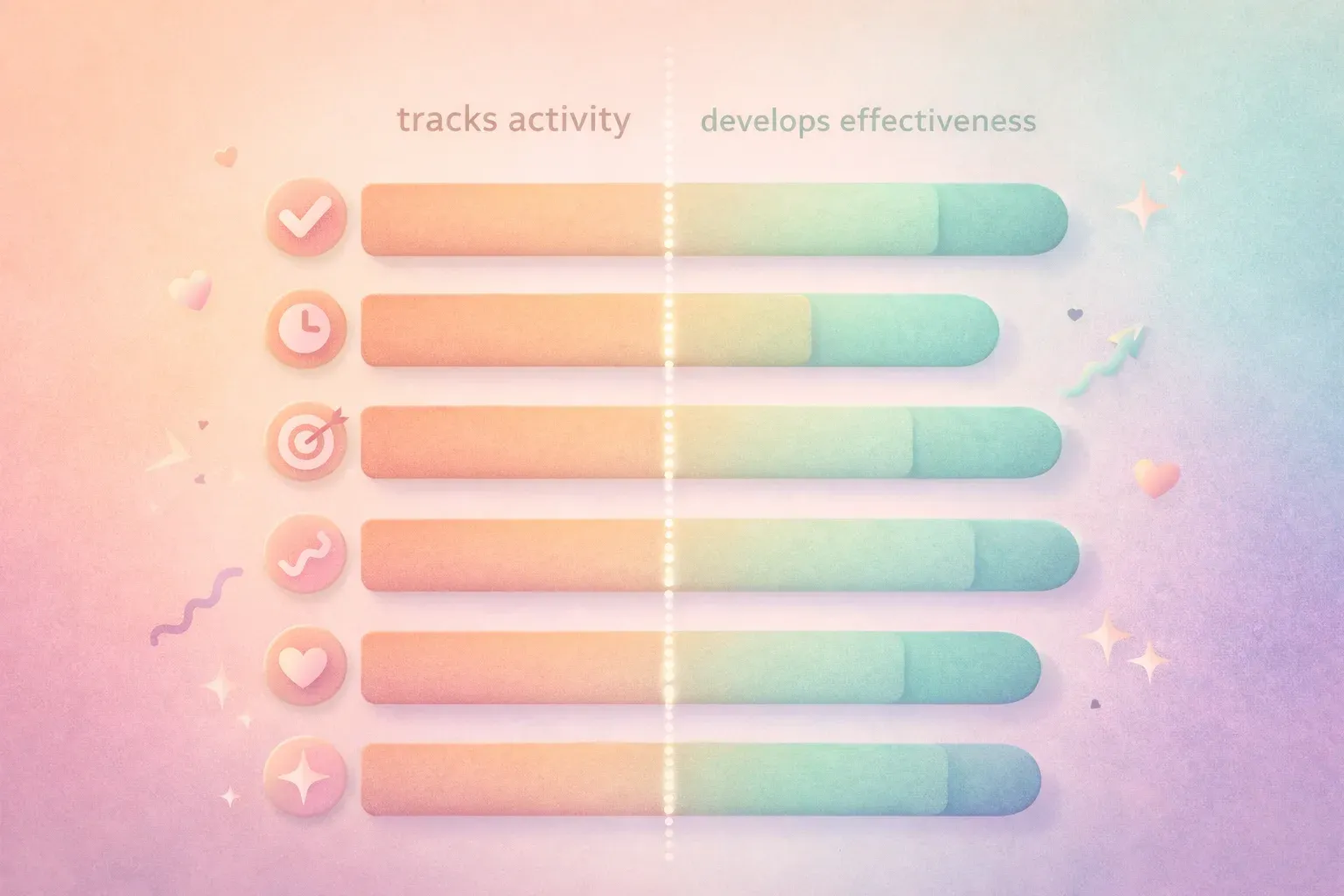
But here's the problem most buyers miss. The majority of manager effectiveness software tracks manager activity (did they complete the check-in, submit the review, log the 1:1) rather than manager effectiveness (are their teams healthier, more aligned, and making progress).
That distinction shapes everything. The tool you choose determines whether you're building a documentation system or a development system. Whether you get reports about what happened last quarter or signals about what's happening right now. Whether managers spend their time filling out forms or building better teams.
This guide compares 8 manager effectiveness platforms on the criteria that actually predict outcomes. Not feature counts. Not integration lists. The factors that determine whether your investment changes manager behavior or produces compliance paperwork.
How to Evaluate Manager Effectiveness Software
Most evaluation frameworks focus on features: survey types, review templates, integration count. These criteria miss what matters.
Manager effectiveness software should be evaluated on six dimensions that predict real-world outcomes.
| Criteria | What to Ask | Why It Matters |
|---|---|---|
| Leading vs. lagging indicators | Does this tool surface problems before they become resignations, or confirm them after? | Quarterly surveys are autopsies. Daily signals are checkups. |
| Adoption rate | What percentage of managers and employees actually use this weekly? | A tool with 25% adoption generates 25% of the insight you paid for. |
| Manager time investment | How many minutes per week does this require from each manager? | Managers already spend 35% of their time on administrative tasks (Gartner, 2024). Every minute matters. |
| Coaching vs. documentation | Does this tool help managers get better, or just track what they did? | Documentation without development is expensive record-keeping. |
| Behavioral science foundation | Is the behavior change approach evidence-based, or is it "just send reminders"? | The difference between 97% and 25% adoption is design, not discipline. |
| Scalability | Does this work for 50 people and 500 people without reinvention? | Growing companies change tools when they shouldn't have to. |
The tools below are evaluated against these six criteria. The differences are significant.
Manager Effectiveness Software: Head-to-Head Comparison
| Platform | Best For | Approach | Adoption Model | Data Speed | Coaching Depth | Growth-Stage Fit |
|---|---|---|---|---|---|---|
| Happily.ai | Daily behavioral change + AI coaching | Behavioral science, gamification | 97% daily (voluntary) | Real-time, continuous | AI coaching for every employee | Strong |
| 15Five | Structured check-ins + OKR tracking | Weekly workflows, templates | Manager-dependent | Weekly (if completed) | Manager training content | Moderate |
| Lattice | All-in-one performance suite | Reviews + surveys + goals | Review-cycle dependent | Quarterly surveys + periodic reviews | Review frameworks | Moderate |
| Culture Amp | Enterprise survey analytics | Periodic surveys + benchmarks | Survey-cycle driven | Quarterly | Manager effectiveness surveys | Moderate |
| BetterUp | 1:1 executive and manager coaching | Human coaching + AI support | Session-based | Per coaching session | Deep (human coaches) | Niche |
| Humu | Behavioral nudges for managers | Nudge-based interventions | Nudge-dependent | Periodic | Nudge recommendations | Moderate |
| Leapsome | Combined reviews + learning | Reviews, goals, surveys, learning | Module-dependent | Varies by module | Learning paths | Moderate |
| Reflektive (Achievers) | Real-time feedback and recognition | Feedback-driven performance | Feedback-dependent | Near real-time | Limited | Moderate |
8 Manager Effectiveness Platforms Compared
1. Happily.ai: Best for Companies That Need Manager Behavior Change, Not More Checklists
Happily.ai is a Culture Activation platform that develops manager effectiveness through daily behavioral habits, AI coaching, and continuous team health signals rather than periodic reviews and check-ins.
Most manager effectiveness tools give managers more to do. Happily takes the opposite approach: it makes effective management behaviors automatic through behavioral science and gamification. Managers don't fill out weekly check-in forms. They build daily habits that generate real-time data about their teams as a byproduct of use.
The adoption difference is measurable. Happily.ai achieves 97% voluntary daily adoption compared to the 25% industry average for HR technology. That gap is the result of designing for habit formation (Fogg Behavior Model: Behavior = Motivation x Ability x Prompt) rather than compliance. When workload pressure builds and managers start skipping optional processes, habit-driven tools maintain usage while process-driven tools lose data exactly when it matters most.
For a CEO evaluating manager effectiveness software, the practical value is threefold. First, you see which managers need support through real-time signals, not through quarterly reviews that arrive too late. Second, every manager gets AI coaching personalized to their team's dynamics, not generic training content. Third, the manager effectiveness scorecard measures what actually predicts team outcomes: response patterns, feedback quality, and recognition habits.
Strengths:
- 97% adoption means your investment generates continuous data, not quarterly snapshots
- AI coaching at scale provides personalized manager development without adding headcount
- Leading indicators surface manager effectiveness signals before they become team health problems
- Behavioral science foundation built on proven models for lasting behavior change
- Three-dimensional visibility: team feeling, focus, and progress in one view
Limitations:
- Smaller brand recognition in the US market compared to Lattice or Culture Amp
- The gamification approach requires organizational openness to that model
- Smaller benchmark database than enterprise platforms with 6,000+ company datasets
Best for companies that need managers to actually change behavior, not complete more workflows. Organizations where previous tools saw low adoption. CEOs who want real-time visibility into how managers affect team mental health and performance.
2. 15Five: Best for Companies Wanting Structured Performance Workflows
15Five is a performance management platform that structures the weekly check-in, review, and OKR tracking process for managers and their direct reports.
15Five's core value is digitizing management routines. The weekly 15-minute check-in format gives managers a repeatable structure. Their "Best-Self Review" framework is well-designed and growth-oriented. The OKR tracking provides clear goal visibility from company level to individual level.
For teams where the primary gap is process consistency (managers aren't doing regular 1:1s, reviews happen ad hoc, goals aren't tracked), 15Five adds structure that drives accountability.
The tradeoff is that structure doesn't guarantee behavior change. 15Five captures what managers report, but it doesn't independently signal whether a team is struggling. If a manager asks "How are you doing?" and an employee says "Fine," 15Five records that faithfully. It doesn't tell you the employee is three weeks from quitting.
Strengths:
- Clean weekly check-in workflow that creates management consistency
- Strong OKR tracking with company-to-individual goal cascading
- Transform coaching program provides structured manager training
- "Best-Self Review" framework emphasizes development over evaluation
Limitations:
- Adoption depends on manager discipline to complete weekly check-ins
- Limited team health signals beyond what employees self-report
- Tracks manager activity (check-in completion) more than manager effectiveness (team outcomes)
Best for companies that need to professionalize ad hoc management processes. Organizations where managers have strong discipline but lack structure. Teams that run on formal OKR methodology.
For a detailed breakdown, see: Happily vs 15Five for Manager Effectiveness

3. Lattice: Best for Companies Wanting Performance, Engagement, and Compensation in One System
Lattice is a comprehensive people management platform combining performance reviews, engagement surveys, compensation management, and goal tracking.
Lattice's value proposition is consolidation. Instead of buying separate tools for reviews, surveys, compensation, and goals, you get a unified platform. For companies where tool sprawl is creating data silos and admin overhead, the integration value is real.
Their manager effectiveness capabilities live primarily within the performance review and 1:1 modules. Managers get structured frameworks for performance conversations, goal alignment views, and growing AI-assisted review writing.
The tradeoff with breadth is depth. No single Lattice module leads its category. The engagement surveys aren't as sophisticated as Culture Amp's. The check-in workflow isn't as focused as 15Five's. And for manager development specifically, the platform is stronger at tracking performance conversations than at changing how managers lead.
Strengths:
- True all-in-one platform reduces tool sprawl and data silos
- Compensation benchmarking fills a genuine gap for growing companies
- Good HRIS integrations for data consistency
- Growing AI features for review assistance
Limitations:
- Breadth over depth: no single feature is category-leading
- Manager development is embedded in performance review workflows, not daily habits
- Enterprise-oriented complexity can overwhelm lean HR teams at 50-150 employees
- Engagement component relies on periodic surveys with quarterly visibility gaps
Best for companies that need one platform for performance reviews, engagement, compensation, and goals. Organizations large enough (200+) to benefit from the full suite. Teams where tool consolidation is a higher priority than deep manager development.
4. Culture Amp: Best for Enterprise Organizations Needing Manager Effectiveness Surveys
Culture Amp is an enterprise employee experience platform built around periodic surveys, analytics, and a benchmark database of 6,000+ companies.
Culture Amp's manager effectiveness capabilities center on their manager effectiveness survey. This structured assessment collects upward feedback from direct reports on specific management competencies. The results feed into analytics dashboards where HR teams can identify patterns, compare against benchmarks, and target development programs.
The analytics are genuinely deep. You can slice manager effectiveness data by department, tenure, team size, and other dimensions. For a company with 1,000+ employees and dedicated people analytics staff, this granularity drives real insight.
The limitation for growing companies is the survey-dependent model. Manager effectiveness data arrives quarterly at best. Between surveys, there's no signal. A manager whose team is struggling in January won't show up as a concern until the March survey results land in April.
Strengths:
- Industry-leading benchmark database (6,000+ companies) for contextualizing manager scores
- Deep analytics and segmentation for identifying patterns
- Structured manager effectiveness survey framework
- Strong integration ecosystem with major HRIS platforms
Limitations:
- Survey-based model creates quarterly data gaps in manager effectiveness visibility
- Measures manager reputation (how reports rate them) more than manager behavior (what they do daily)
- Enterprise pricing and implementation timeline designed for larger organizations
- The survey tells you which managers need help but doesn't provide the help
Best for companies that are 500+ employees with dedicated people analytics teams. Organizations that need enterprise-grade benchmarks for board reporting. Companies where manager effectiveness data feeds into structured L&D programs.
5. BetterUp: Best for Organizations Investing in 1:1 Executive and Manager Coaching
BetterUp is a coaching platform that pairs managers and executives with certified coaches for structured development programs, supplemented by AI coaching and content.
BetterUp's approach is fundamentally different from software-driven platforms. Instead of giving managers tools and hoping they improve, BetterUp provides each manager with a dedicated human coach. The coaching sessions are structured, evidence-based, and personalized to each manager's specific development needs.
The depth of impact per manager is potentially the highest of any platform on this list. A skilled coach working with a manager over months can address specific behaviors, build self-awareness, and create lasting change in ways that software alone cannot.
The constraint is economics. Human coaching is expensive. BetterUp works at scale for executive teams and high-potential managers, but providing a dedicated coach to every people manager in a 200-person company is a significant investment. Their AI coaching features extend reach, though they don't replicate the depth of human coaching.
Strengths:
- Deep, personalized development through certified human coaches
- Evidence-based coaching methodology with measurable outcomes
- Addresses root causes of manager behavior, not surface-level process gaps
- AI coaching extends reach beyond 1:1 sessions
Limitations:
- Significantly higher cost per manager than software-only platforms
- Coaching capacity creates a natural ceiling on how many managers can be served
- No continuous team health signals between coaching sessions
- Better suited for targeted development than organization-wide manager uplift
Best for companies that are investing in executive and high-potential manager development. Organizations with budget for deep, individualized coaching. CEOs who want to develop their leadership team specifically (not all managers equally).
6. Humu: Best for Organizations Wanting Behavioral Science Nudges for Managers
Humu is a behavioral nudge platform (spun out of Google's People Operations) that sends targeted, personalized nudges to managers based on survey data and organizational science.
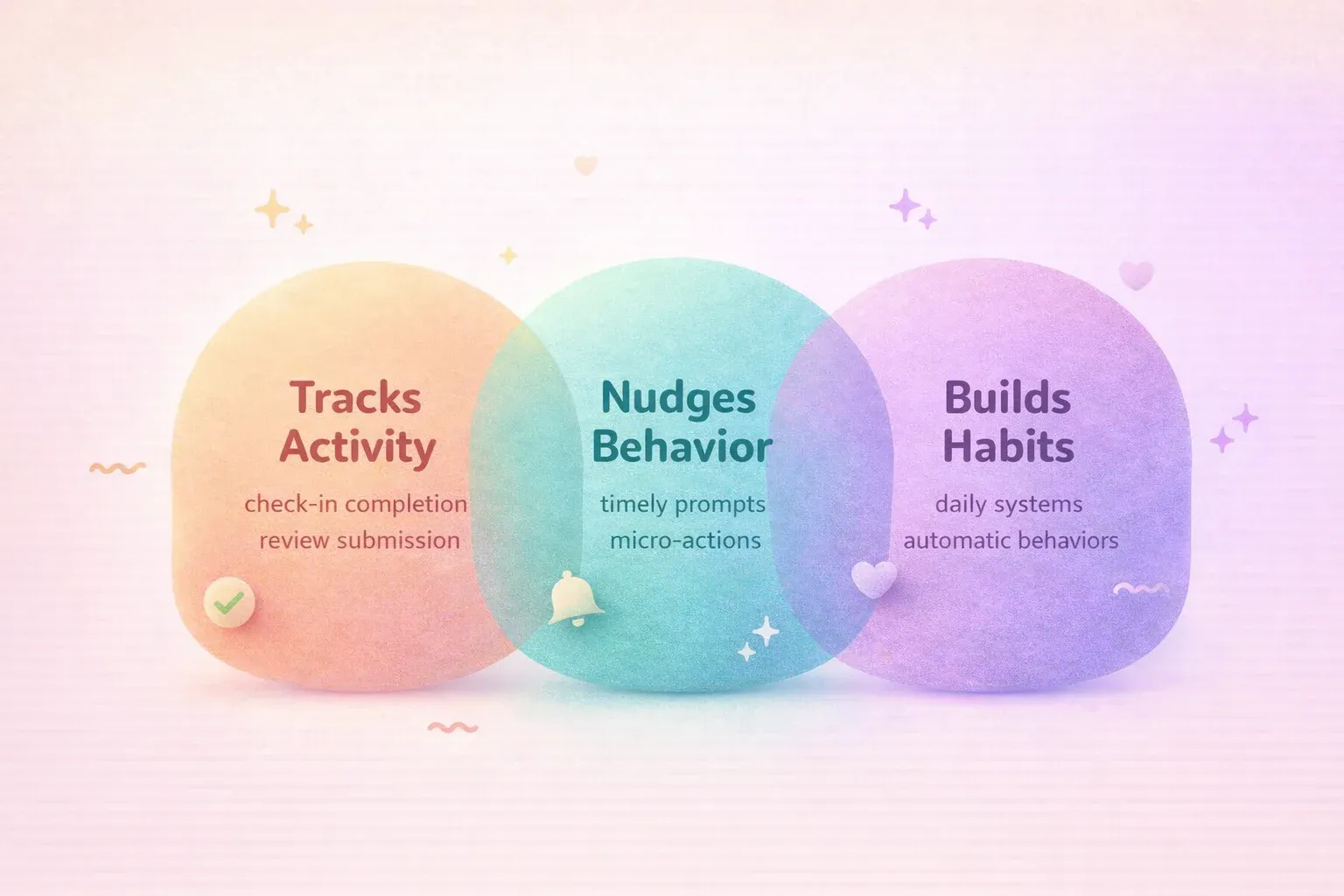
Humu's core insight is sound: telling managers to "be better" doesn't work, but sending specific, timely, science-backed nudges can shift behavior incrementally. Their approach uses machine learning to identify which nudges will have the highest impact for each manager, based on their team's survey data.
The model is grounded in legitimate behavioral science. Small, well-timed prompts outperform large training programs for sustained behavior change. Humu applies this principle to manager development at organizational scale.
The limitation is the feedback loop. Humu's nudges are informed by periodic survey data, which means the nudge targeting updates quarterly or semi-annually, not in real time. A manager whose team dynamics shifted last week may still receive nudges based on last quarter's data.
Strengths:
- Genuine behavioral science approach backed by Google People Operations research
- Personalized nudge targeting using machine learning
- Low time burden on managers (nudges take seconds to read)
- Scales behavioral science interventions across the organization
Limitations:
- Nudge effectiveness depends on the quality and freshness of underlying survey data
- Limited visibility into whether nudges actually change behavior (measurement gap)
- Less comprehensive than full manager development platforms
- Nudges address micro-behaviors but may not solve systemic management issues
Best for companies that already run engagement surveys and want to activate the data through behavioral nudges. Organizations interested in behavioral science approaches but not ready for a full platform change. Teams where managers are generally competent but need consistent behavioral reminders.
7. Leapsome: Best for Companies Wanting Reviews, Goals, Surveys, and Learning Combined
Leapsome is a people enablement platform combining performance reviews, goal management, engagement surveys, and learning paths in one integrated system.
Leapsome's manager effectiveness capabilities span multiple modules: performance reviews with customizable frameworks, 1:1 meeting support, goal alignment, engagement surveys, and a learning management component. The integration between these modules is the differentiator. When a manager's effectiveness survey reveals a feedback gap, the platform can recommend a specific learning path.
The learning module sets Leapsome apart from pure performance management tools. Manager development isn't limited to feedback from reviews. It connects to structured learning content, creating a closed loop between identifying development needs and addressing them.
The tradeoff is familiar for all-in-one platforms: breadth comes at the expense of depth. Each module competes with dedicated best-of-breed tools. And the learning content, while useful, is standardized rather than personalized to each manager's specific team dynamics.
Strengths:
- Closed loop between identifying manager development needs and providing learning content
- Strong European market presence with GDPR-native design
- Customizable review frameworks adaptable to different management philosophies
- Goal alignment from company level to individual level
Limitations:
- Each module competes with stronger best-of-breed alternatives
- Learning content is standardized, not personalized to each manager's team context
- Manager effectiveness insights depend on periodic survey and review cycles
- Full platform requires significant configuration and adoption across multiple modules
Best for companies that want integrated performance management and learning in one platform. Organizations in the European market where GDPR compliance matters. Teams that value structured learning paths connected to performance data.
8. Reflektive (Achievers): Best for Companies Focused on Real-Time Feedback and Recognition
Reflektive (now part of the Achievers platform) is a real-time performance management tool focused on continuous feedback, recognition, and goal tracking.
Reflektive's original value proposition was removing the friction from feedback. Instead of waiting for quarterly reviews, managers and employees can share feedback in the moment through lightweight tools integrated into daily workflows (email, Slack, Teams). The recognition component reinforces positive behaviors in real time.
The acquisition by Achievers brought Reflektive into a broader employee engagement ecosystem. This adds recognition program capabilities, rewards, and broader engagement features. For companies that want real-time feedback as part of a larger recognition and engagement strategy, the combined platform offers breadth.
The limitation for manager effectiveness specifically is that real-time feedback tools depend on people actually giving feedback. Without behavioral design to make feedback habitual, usage tends to spike at launch and decline over months. The tool enables feedback but doesn't build the habit of giving it.
Strengths:
- Low-friction feedback tools integrated into daily communication platforms
- Real-time recognition that reinforces positive manager behaviors
- Part of broader Achievers engagement and recognition ecosystem
- Removes the formal process barrier from feedback
Limitations:
- Feedback volume depends on voluntary adoption, which typically declines over time
- Recognition features are stronger than manager development capabilities
- Manager effectiveness insights are limited to feedback and recognition patterns
- Post-acquisition platform integration is still evolving
Best for companies that prioritize real-time feedback and recognition as their primary manager effectiveness lever. Organizations already using or evaluating Achievers for broader engagement. Teams where the biggest gap is feedback frequency, not management skill development.
The Measurement Gap: Manager Activity vs. Manager Effectiveness
Most manager effectiveness software measures the wrong thing.
They track whether managers completed their check-ins. Whether they submitted reviews on time. Whether they logged their 1:1 notes. This is manager activity. It tells you whether managers are using the tool. It tells you nothing about whether their teams are better for it.
Manager effectiveness is different. It shows up in team health signals: declining wellbeing, shifting engagement patterns, growing misalignment between daily work and stated goals. It shows up in leading indicators that predict turnover 90 days before a resignation, not in exit interview data that confirms what you already suspected.
Research from Happily.ai's analysis of 10 million+ workplace interactions found that the managers who complete every check-in form aren't necessarily the managers whose teams thrive. The managers whose teams thrive are the ones who respond to feedback quickly, recognize contributions consistently, and notice when something shifts in team dynamics.
This gap between tracking activity and measuring effectiveness is the single most important distinction when evaluating manager effectiveness software. A platform that tells you "92% of managers completed their weekly check-in" gives you compliance data. A platform that tells you "Team 7's wellbeing signals have declined 15% over three weeks and their manager's feedback response time has increased" gives you actionable intelligence.
The question to ask every vendor: Do you measure what managers do with your tool, or what happens to their teams?
How to Choose: A Decision Framework by Company Stage
The right manager effectiveness software depends on where your organization is today and what kind of change you need.
If you're 50-200 employees and losing visibility as you scale, choose Happily.ai. The combination of 97% adoption, continuous signals, and AI coaching is designed for the scaling challenge. You get manager effectiveness data as a byproduct of daily use, not as a quarterly project. Most managers at this stage aren't ineffective by choice. They're unprepared. Happily builds the habits they need.
If your managers need structured workflows and you run on OKRs, choose 15Five. Their check-in templates and goal tracking are well-built. The value is highest when manager discipline is already strong and the gap is process consistency.
If you need one platform for performance, engagement, compensation, and goals, choose Lattice. The consolidation value is real at 200+ employees where tool sprawl creates administrative overhead.
If you need enterprise-grade benchmarks and deep survey analytics, choose Culture Amp. Their 6,000+ company database is unmatched for contextualizing your manager effectiveness data.
If you're investing in deep, individualized coaching for senior leaders, choose BetterUp. Nothing replaces a skilled human coach for targeted executive development.
If you want science-backed behavioral nudges layered onto existing survey data, choose Humu. The approach is sound for organizations that already have measurement in place.
If you need integrated performance management and learning with European compliance, choose Leapsome. The closed loop between reviews and learning paths is distinctive.
If real-time feedback and recognition are your primary levers, choose Reflektive (Achievers). Low-friction feedback tools remove the process barrier.
One principle holds across all eight: the tool that gets used is the tool that works. Manager effectiveness software with 25% adoption generates 25% of the insight you paid for. Before comparing features, compare real-world adoption rates.
Frequently Asked Questions
What is manager effectiveness software?
Manager effectiveness software is a category of platforms designed to improve how people managers lead their teams. These tools range from structured check-in and review systems (15Five, Lattice) to behavioral change platforms (Happily.ai, Humu) to human coaching services (BetterUp). The core purpose is the same: since managers account for 70% of team engagement variance, improving manager effectiveness is the highest-leverage investment in organizational performance. The best manager development tools go beyond tracking activity (did the manager complete the review) to measuring effectiveness (is their team healthier, more aligned, and making progress).
How much does manager effectiveness software cost?
Manager effectiveness software pricing varies significantly by approach. Software-only platforms (15Five, Lattice, Leapsome, Reflektive) typically range from $6 to $14 per employee per month. Survey-focused platforms (Culture Amp) often start higher with enterprise pricing. Behavioral change platforms (Happily.ai, Humu) fall in a similar range to software platforms. Coaching-first platforms (BetterUp) are significantly more expensive due to human coach involvement. For a 200-person company, expect to budget $14,400 to $33,600 annually for software platforms. The real cost calculation should factor in adoption: a $10/employee tool with 25% adoption effectively costs $40 per engaged employee.
Which manager effectiveness platform has the highest adoption rate?
Happily.ai reports 97% voluntary daily adoption, achieved through behavioral design (gamification, micro-interactions, personalized prompts) rather than mandates. The industry average for HR technology adoption is approximately 25% (Gartner). Most manager effectiveness platforms don't publicly report adoption rates because the numbers depend heavily on organizational enforcement. Process-dependent tools (15Five, Lattice) see adoption fluctuate based on manager discipline. Platforms with higher time demands per session tend to see lower sustained adoption. When evaluating, ask vendors for real-world adoption data, not account creation or login metrics.
Can manager effectiveness software replace executive coaching?
Manager effectiveness software and executive coaching serve different needs and work best together. Software platforms (Happily.ai, 15Five, Lattice) scale across all managers and provide continuous data. Executive coaching (BetterUp) goes deeper with fewer people. The research suggests that for organization-wide manager development, daily behavioral systems outperform periodic training programs. For targeted executive development addressing specific leadership challenges, human coaching remains the most effective intervention. Most growing companies benefit from a scaled platform for all managers combined with coaching for senior leadership.
How long does it take to see results from manager effectiveness software?
Timeline depends on the platform's approach. Continuous behavioral platforms (Happily.ai) generate usable data within 2-4 weeks because daily habits create data volume quickly. Organizations using Happily.ai report a 48-point eNPS improvement and 40% turnover reduction as benchmark outcomes. Structured workflow tools (15Five, Lattice) show process improvements within 4-8 weeks as managers adopt check-in cadences. Survey-based platforms (Culture Amp) require 1-2 survey cycles (3-6 months) to establish baselines. Coaching platforms (BetterUp) show individual behavior change within 2-3 months. The critical variable across all platforms is adoption speed: the faster your team actually uses the tool, the faster you get reliable signals.