


Traditional goal-setting frameworks like OKRs have served organizations well for decades. But there's a fundamental problem that even the most sophisticated quarterly planning can't solve: the gap between setting goals and knowing whether daily work actually moves the needle.
Research from Asana reveals that only 26% of employees clearly understand how their individual work contributes to company goals. Most organizations set objectives at the beginning of a quarter, then don't revisit them until the review period, by which point the opportunity to course-correct has long passed.
What if there were a way to bridge this gap in real time, turning the static snapshot of quarterly goals into a continuous signal of organizational direction? This is precisely where behavioral science, people analytics, and artificial intelligence converge to create something genuinely new.
The Hidden Cost of Quarterly Blindness
The OKR framework, pioneered at Intel and popularized by John Doerr at Google, revolutionized how companies think about strategic alignment. The core premise remains sound: set ambitious objectives, define measurable key results, and align teams toward common outcomes (Doerr, 2018).
But here's what the framework's architects didn't anticipate: the modern workplace operates at a velocity that makes quarterly cycles feel almost geological in comparison.
Consider what happens in a typical OKR cycle. Leadership convenes to establish company objectives. Teams translate these into departmental goals. Individual contributors craft their personal OKRs. The process takes weeks. Then everyone gets to work, and for the next 60 to 90 days, there's remarkably little visibility into whether daily activities actually connect to those carefully crafted objectives.
As one analysis from Xodiac puts it, quarterly cycles are "deceptively short when you set strategic goals—but painfully long when you need feedback." The static quarterly OKR becomes a "distant checkbox rather than a living guide" for daily decision-making (Xodiac, 2025).
The research supports this concern. Locke and Latham's foundational goal-setting theory demonstrates that specific, challenging goals improve performance, but only when accompanied by regular feedback (Locke & Latham, 2002). Without feedback, even well-designed goals lose their motivational power.
Goal-setting without continuous feedback is like navigating with a compass you can only check once per quarter. You might eventually reach your destination, but you'll waste enormous energy on unnecessary detours.
Why Traditional Performance Management Falls Short
The annual performance review represents an extreme case of this feedback gap. Data from ClearCompany shows that 82% of companies used annual reviews in 2016, but that number dropped to just 54% by 2019 as organizations recognized the limitations of infrequent assessment (ClearCompany, 2023).
The problems are well-documented. A PwC survey found that 60% of employees prefer ongoing feedback to annual reviews. Gallup's research indicates that only 47% of employees actually know what they're supposed to accomplish at work, while organizations with highly engaged teams see a 21% increase in profitability (Gallup, 2024).
The disconnect between goal-setting and daily work creates several cascading problems:
Misallocated effort. Employees spend significant time on activities that feel productive but don't advance strategic priorities. Without real-time visibility, neither they nor their managers can identify this drift until the quarter ends.
Delayed recognition. Small wins that demonstrate values alignment or goal progress go unnoticed for months. The motivational window closes long before any acknowledgment arrives.
Reactive rather than proactive management. Managers discover misalignment only during retrospective reviews, when the opportunity to guide and coach has already passed.
Strategic blindness. Leadership lacks visibility into whether the organization is actually moving in the intended direction until lagging indicators appear in quarterly results.
Research from McKinsey confirms that companies focusing on people's performance are 4.2 times more likely to outperform their peers, with 30% higher revenue growth and 5 percentage points lower attrition (McKinsey, 2024). Yet most organizations' performance management systems fail to deliver this advantage because they operate in batch mode rather than continuous flow.
The Science of Continuous Feedback
Locke and Latham's research, spanning four decades and involving over 40,000 participants across multiple countries, establishes five core principles for effective goal-setting: clarity, challenge, commitment, feedback, and task complexity (Locke & Latham, 1990).
Notice that feedback isn't optional—it's structural to the entire framework.
The researchers found that feedback serves two critical functions. First, it helps people determine how well they're doing against their goals. Second, it helps them understand what adjustments their performance requires. Without both functions operating continuously, goal-setting loses much of its power (Latham, 2003).
This explains why organizations embracing continuous feedback mechanisms report compelling results. Research indicates 40% higher employee engagement and 26% improvement in performance compared to traditional approaches (Pop.work, 2023). Adobe reportedly saved over 80,000 hours of manager time annually by replacing annual reviews with continuous feedback systems (Zenger/Folkman, 2024).
The evidence is clear: more frequent feedback loops create better outcomes. But implementation has traditionally been the barrier. How do you capture meaningful signals about daily work without creating administrative burden?
A New Paradigm: Continuous Questions That Reveal Real-Time Direction
At Happily.ai, we've developed an approach that transforms this challenge into an opportunity. Rather than adding work to capture alignment signals, we've discovered that asking the right questions at the right moments naturally surfaces the information needed to understand organizational direction.
The approach centers on simple, reflective prompts delivered through normal work rhythms:
What are your top priorities this week?
What have you gotten done this week?
What are some of your small wins at the moment?
These questions accomplish something powerful beyond data collection. They prompt active reflection that helps employees themselves clarify their focus. When someone takes a moment to articulate their priorities, they naturally engage in the cognitive work of aligning their daily activities with broader objectives.
This aligns with what behavioral science tells us about the relationship between intention and action. The Fogg Behavior Model demonstrates that behavior change requires motivation, ability, and a prompt (Fogg, 2019). The weekly reflection questions serve as prompts that increase both motivation and ability by making goals salient and actionable.
The responses to these questions create a continuous stream of information about what people are actually focusing on and accomplishing. Aggregated across an organization, this reveals something traditional performance management systems never could: real-time visibility into organizational direction.
AI-Powered Alignment Analysis
Here's where the convergence of behavioral science and artificial intelligence creates genuine innovation.
Using AI, we can analyze how employees' daily movements align with company values and team-level goals. The system automatically matches what people report they're working on against the strategic objectives the organization has established.

The Goal Alignment dashboard above illustrates this in action. In this example, 87% of focus items over the last 30 days are aligned with organizational goals—392 aligned versus 61 unaligned. More importantly, the Goal Focus Trends visualization shows how alignment evolves week over week across different strategic objectives like "Enhance product functionality" and "Grow recurring revenue."
Notice the gray area at the bottom of the trend chart representing "Unmatched (No Goal)" items. This is precisely the visibility traditional OKR systems lack—the ability to see, in real time, when employee effort drifts toward activities that don't connect to any defined objective. Rather than discovering this misalignment at quarter's end, managers can address it immediately.
When current activity doesn't match any defined goals, the system surfaces this in real time. This isn't about catching people doing the wrong thing—it's about helping everyone stay focused on the right things.
Consider how this changes the manager's role. Traditional management requires constant vigilance to monitor whether team members are aligned with priorities. It's exhausting, imprecise, and often fails. Research shows that managers account for 70% of the variance in team employee engagement, yet managers themselves face more negative daily experiences than their teams (Gallup, 2024).
The AI alignment analysis provides managers with exactly the visibility they need without requiring them to micromanage. When someone's focus drifts from team objectives, the manager knows immediately and can have a brief, timely conversation rather than waiting for a quarterly review to discover the misalignment.
Research from Information Systems Research confirms that real-time feedback applications fundamentally change performance dynamics, with positive feedback having stronger effects on future performance than negative feedback (Information Systems Research, 2021). The key is timeliness—the closer feedback follows the relevant behavior, the more effectively it shapes future action.
Seeing the Full Picture: Culture and Goals Together
Traditional performance systems force a false choice: measure goal achievement OR measure cultural contribution. But the highest-performing organizations understand that both matter—and that the intersection is where real value creation happens.
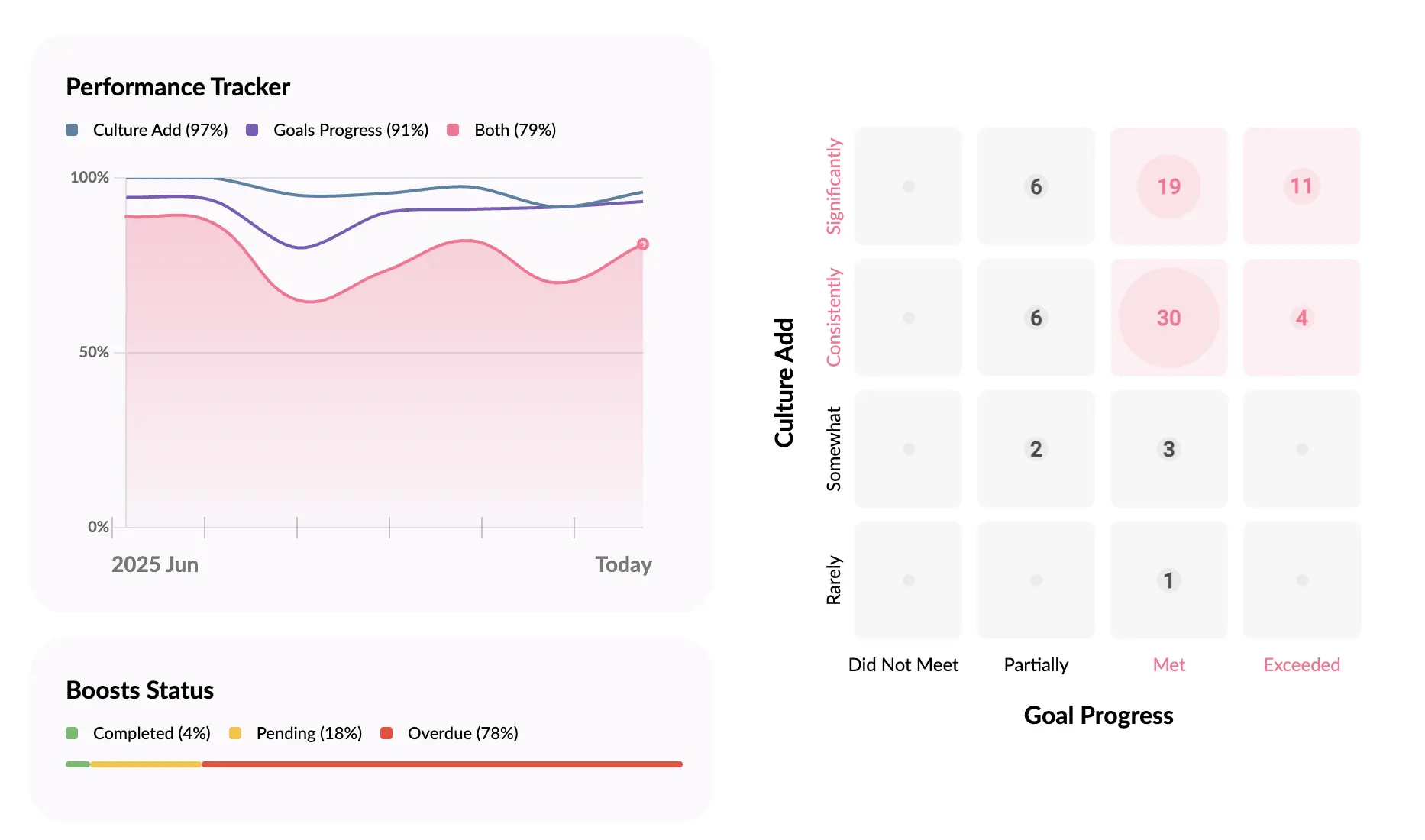
The Performance Tracker above demonstrates how continuous measurement reveals this intersection. Three metrics track simultaneously: Culture Add (how well employees embody organizational values), Goals Progress (advancement toward objectives), and Both (the crucial overlap where values-aligned work drives goal achievement).
In this example, 97% of the team demonstrates strong Culture Add, 91% shows Goals Progress, and 79% achieves both—the "sweet spot" where employees are both living the values and advancing strategic priorities. The matrix on the right reveals exactly where each team member falls across these dimensions, enabling targeted coaching conversations.
The trend line tells an equally important story. Notice how the "Both" metric (shown in pink) fluctuated over time, dipping in the middle of the period before recovering. Traditional quarterly reviews would miss this entirely—they'd only capture the endpoint. Continuous tracking allows managers to investigate what caused the dip and address it in real time.
This dual-axis view transforms how organizations think about performance. An employee who crushes their goals but undermines company values creates a different kind of problem than one who embodies values but struggles with execution. Seeing both dimensions simultaneously enables nuanced, appropriate responses.
Seven Transformative Benefits
This approach to real-time goal alignment delivers benefits that traditional OKR processes simply cannot match:
1. Continuous course correction. Rather than discovering misalignment at quarter's end, managers and employees can adjust focus weekly. Small corrections prevent large deviations. The Goal Focus Trends visualization makes drift visible immediately.
2. Amplified human relationships. The system doesn't replace manager-employee conversations—it enhances them by providing rich context for coaching and recognition. When a manager knows exactly what someone accomplished that week and how it connects to team goals, feedback becomes far more meaningful.
3. Active prioritization. The act of articulating priorities each week creates clarity of focus. Employees who regularly reflect on their priorities make better decisions about where to direct their attention.
4. Values visibility. Beyond goal alignment, the Performance Tracker reveals whether daily activities reflect organizational values. This addresses the common challenge where values exist on paper but don't guide actual behavior.
5. Recognition at the speed of accomplishment. When someone achieves a win, it can be acknowledged immediately rather than months later. Research on recognition demonstrates that timely acknowledgment has dramatically greater impact than delayed praise.
6. Reduced manager burden. AI handles the analysis work, giving managers insight without requiring them to track everything manually. This addresses the finding that 2 in 3 managers need more support to effectively manage performance (Betterworks, 2024).
7. Organizational learning. Aggregated patterns reveal whether the entire organization is moving in the intended direction. Leadership gains early warning when strategic objectives aren't translating into daily focus—like seeing that 61 focus items aren't aligned to any goal and investigating why.
What This Means for Performance and Productivity
The traditional view of performance management centers on measurement—tracking outputs, evaluating against benchmarks, assigning ratings. This continuous alignment approach inverts that paradigm.
Performance and productivity, properly understood, aren't really about measurement at all. They're about direction and momentum.
Direction comes from goals and values. When everyone in an organization understands the strategic objectives and how their work connects to them, direction is clear. The alignment problem most organizations face isn't that they lack goals—it's that goals don't effectively guide daily decisions.
Momentum comes from daily reinforcement. The weekly reflection questions, the small wins recognition, the alignment feedback—all of these create consistent forward motion. Gallup's research shows that employees receiving meaningful weekly feedback report being fully engaged at a rate 80% higher than those receiving less frequent feedback (ThriveSparrow, 2024).
This represents what we believe people analytics should ultimately enable: not surveillance, but genuine insight into organizational health and direction. The signals captured through continuous feedback reveal whether an organization is healthy, whether teams are aligned, whether people feel connected to purpose.
Making the Transition
Organizations considering this evolution from traditional OKRs to continuous alignment should understand that the shift is as much cultural as technological.
The technology piece is increasingly straightforward. AI tools for performance management have matured rapidly, with 52% of managers already using AI tools in their roles (PeopleFluent, 2024). The challenge isn't capability—it's adoption and integration.
The cultural piece requires deliberate attention. Employees accustomed to being left alone until annual review time may initially resist regular reflection prompts. Managers comfortable with batch-mode assessment need coaching on continuous feedback skills. Leadership must commit to actually using the real-time alignment data to inform decisions.
Several practices support successful transition:
Start with the "why." Connect continuous feedback to outcomes employees care about: recognition, clarity, reduced anxiety about performance reviews, and better support from managers.
Keep questions simple. The weekly prompts work because they're easy to answer. Complex surveys create burden; simple questions prompt genuine reflection.
Close the loop. When someone shares a win, ensure acknowledgment follows. When alignment gaps appear, ensure supportive conversations happen. The system's value depends on visible response to the signals it surfaces.
Train managers. The data is only valuable if managers know how to use it. Invest in building manager capability for continuous coaching conversations.
Trust the process. Initial patterns may be noisy as people learn to use the system. Over weeks and months, the signals become clearer and more valuable.
The Future of Organizational Alignment
We're at an inflection point in how organizations think about performance, goals, and alignment. The annual review is clearly declining. Quarterly OKRs, while better, still leave too much to chance in the spaces between cycles.
What's emerging is something more fluid and more human: continuous attention to direction and momentum, supported by technology that makes the invisible visible.
The organizations that thrive in 2026 and beyond will be those that master this new paradigm. They'll know, in real time, whether their people are focused on what matters. They'll spot misalignment early and correct it quickly. They'll recognize achievements as they happen rather than months later. They'll build cultures where strategic alignment isn't an annual exercise but a daily reality.
This is where behavioral science, people analytics, and organizational psychology converge. Where we amplify human relationships through conversations that should be happening anyway. Where validation, recognition, and feedback flow continuously rather than pooling in quarterly dams.
The technology now exists to capture the signals that reveal organizational direction. The science tells us these signals matter enormously. The question for every organization is whether they're ready to see what continuous alignment reveals—and act on what they learn.
Ready to move beyond quarterly goal-setting? Discover how continuous feedback and AI-powered alignment can transform your organization's performance. Learn more at Happily.ai.
References
Betterworks. (2024). State of Performance Enablement Report.
ClearCompany. (2023). Performance Management Statistics Report.
Doerr, J. (2018). Measure What Matters: How Google, Bono, and the Gates Foundation Rock the World with OKRs. Portfolio.
Fogg, B.J. (2019). Tiny Habits: The Small Changes That Change Everything. Houghton Mifflin Harcourt.
Gallup. (2024). State of the Global Workplace Report.
Latham, G.P. (2003). Goal setting: A five-step approach to behavior change. Organizational Dynamics, 32(3), 309-318.
Locke, E.A., & Latham, G.P. (1990). A Theory of Goal Setting and Task Performance. Prentice-Hall.
Locke, E.A., & Latham, G.P. (2002). Building a practically useful theory of goal setting and task motivation. American Psychologist, 57(9), 705-717.
McKinsey. (2024). In the Spotlight: Performance Management That Puts People First.
Pop.work. (2023). Continuous Performance Management Research Report.
PeopleFluent. (2024). AI in HR Survey Report.
ThriveSparrow. (2024). Performance Management Statistics.
Xodiac. (2025). Quarterly OKRs Are Broken: What to Do Instead.
Information Systems Research. (2021). Are Traditional Performance Reviews Outdated? An Empirical Analysis on Continuous, Real-Time Feedback in the Workplace.
Zenger/Folkman. (2024). The Future of Performance Reviews Study.