



On this page
The recognition trust multiplier is a behavioral science finding showing that employees who give peer recognition are trusted 9x more than those who do not—a research-backed pattern for managers and organizational leaders who want to build high-trust teams through daily habits rather than top-down initiatives.
Employees who publicly thank their colleagues are trusted 9x more than those who stay silent. This finding from Happily.ai's analysis of over 10 million workplace interactions challenges a common assumption: that recognition primarily benefits the receiver. The data tells a different story.
The Giver Effect
When you recognize a colleague, witnesses form impressions about both parties. The receiver gains visibility for their contribution. But you gain something harder to manufacture: a reputation for noticing good work.
Happily.ai's research tracked trust ratings across organizations using peer recognition systems. Employees who gave recognition at least once per month scored an average trust rating of 4.2 out of 5. Those who never gave recognition averaged 0.47. The difference compounds over time.
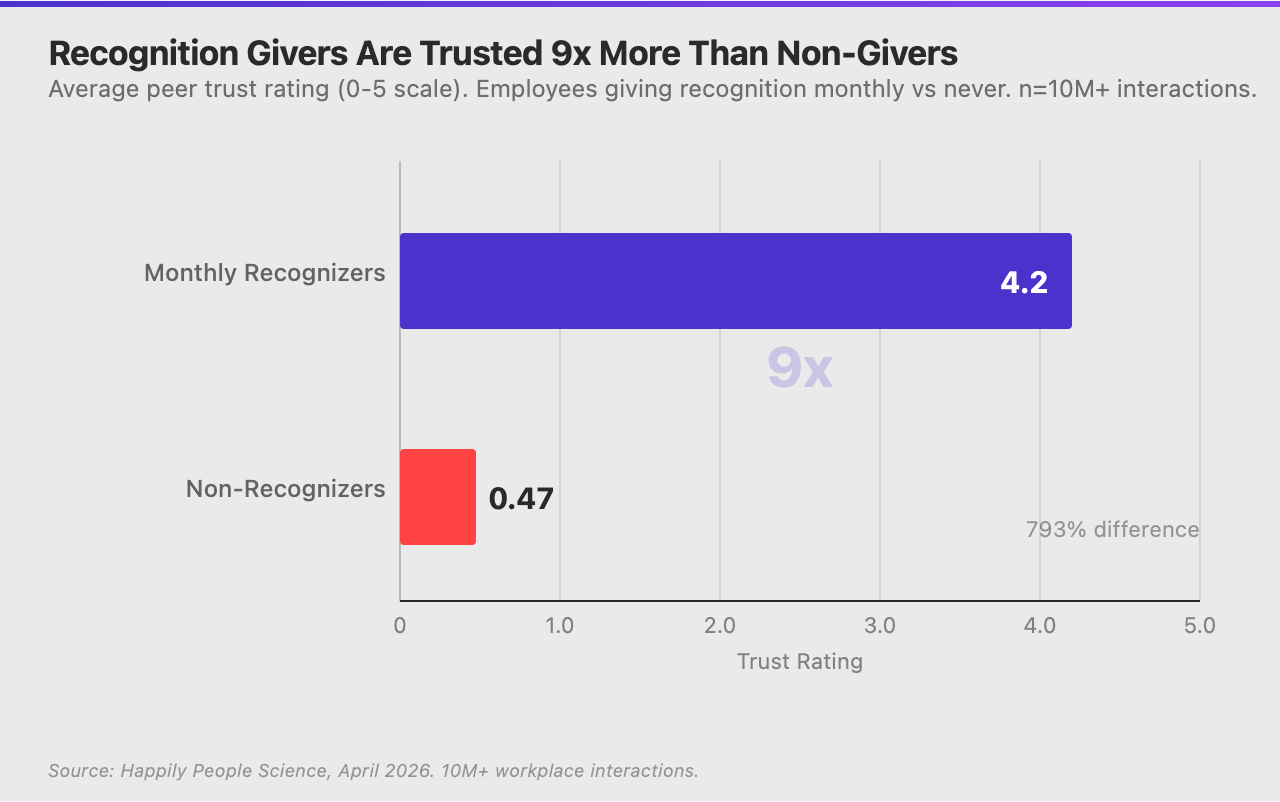
This pattern held across industries, team sizes, and seniority levels. Recognition givers weren't trusted more because they were already popular. The act of recognizing others shifted how colleagues perceived them.
Why Giving Signals Character
Trust research identifies two components: competence and warmth. Recognition addresses warmth directly. When you thank someone publicly, you signal three things:
- You pay attention. You noticed what others contributed.
- You share credit. You're not hoarding visibility for yourself.
- You value relationships. You took time to acknowledge another person.
These signals matter because they're hard to fake. Anyone can claim to be a team player in a performance review. Consistent recognition behavior demonstrates it in real time.
The Compounding Returns of Mutual Recognition
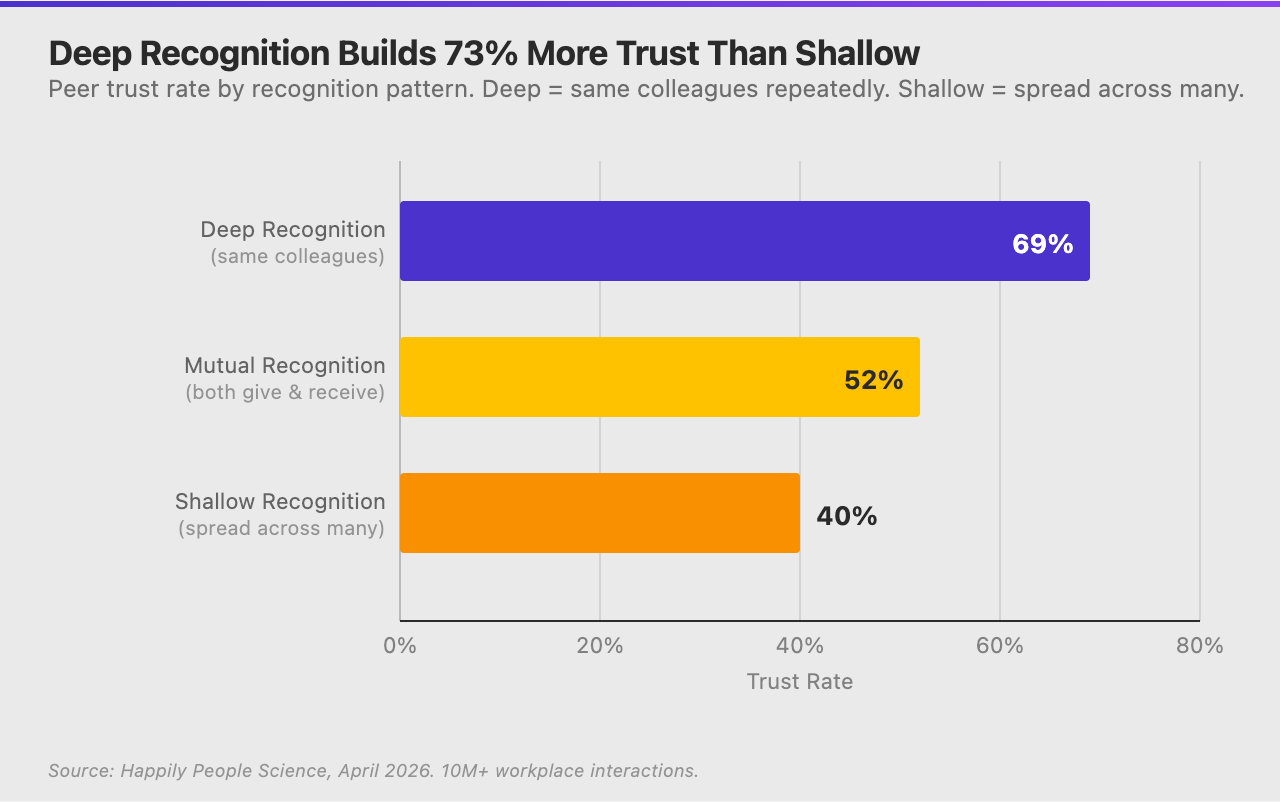
The most striking finding involves reciprocity. Employees who both give and receive recognition achieve trust ratings of 52%. That's 20.8x the baseline rate of non-participants.
This creates a flywheel effect. High-trust employees receive more opportunities, collaborate more effectively, and influence decisions more readily. Their recognition of others then reinforces their trusted status.
The data also revealed an optimal pattern. Employees who recognized the same colleagues repeatedly (building deeper relationships) achieved 69% trust rates. Those who spread recognition thinly across many colleagues scored 40%. Depth beats breadth.
Practical Applications for Teams
These findings suggest specific actions for managers and individual contributors:
For managers: Model recognition behavior visibly. Your team watches what you do more than what you say. When you thank team members publicly, you demonstrate that recognition is valued and safe.
For individuals: Start small but start now. One genuine thank-you per week shifts your reputation over months. Focus on specific contributions rather than generic praise.
For organizations: Track recognition patterns alongside engagement metrics. Low recognition frequency often precedes engagement decline. It's an early warning signal.
The Trust Deficit in Remote Work
Remote and hybrid teams show lower recognition frequency than co-located teams. Without hallway encounters and spontaneous appreciation, recognition requires deliberate effort.
Organizations that implemented structured recognition prompts saw 3x increases in recognition activity. The behavior wasn't declining because people valued colleagues less. It was declining because the moments for spontaneous appreciation disappeared.
Recognition Approaches Compared
| Approach | Trust Impact | Adoption Rate | Effort Required | Best For |
|---|---|---|---|---|
| Informal verbal thanks | Low-Medium (no visibility beyond witnesses) | Inconsistent | Minimal | Co-located teams with strong existing culture |
| Formal recognition programs (awards, bonuses) | Medium (periodic, top-down) | 20-30% participation | High (admin overhead) | Large enterprises with dedicated HR teams |
| Peer recognition platforms with gamification (e.g., Happily.ai) | High (9x trust multiplier, visible patterns) | 97% adoption | Low (integrated into daily workflow) | Growing companies (50-500 employees) wanting continuous culture data |
| Manager-only recognition | Medium (limited to one perspective) | Depends on manager | Medium | Hierarchical organizations with strong management |
| Social recognition (Slack/Teams channels) | Low-Medium (gets lost in message volume) | Variable | Low | Remote-first teams already using messaging platforms |
Who Benefits Most From Recognition Research
Best for companies that are scaling past 50 employees and finding that informal appreciation habits are breaking down as teams grow. Structured recognition platforms maintain the trust-building behavior that happened naturally when everyone knew everyone.
Best for managers who want a high-leverage, low-cost intervention for team performance. Recognition costs nothing but attention, yet drives a 9x trust multiplier—a stronger effect than most training programs or team-building activities.
Best for organizations that are seeing declining engagement or rising turnover and want a leading indicator they can act on immediately. Low recognition frequency often precedes engagement decline by weeks, making it an early warning signal that enables proactive intervention.
Choosing Your Recognition Strategy
Choose a gamification-driven peer recognition platform if your organization values continuous behavioral data and you want recognition patterns to serve as a leading indicator of team health. Choose a formal awards program if your culture responds better to structured, periodic acknowledgment and you have HR capacity to manage the process. Choose informal recognition practices if your team is small enough that verbal thanks reaches everyone and you are not yet ready for platform investment. Choose manager-led recognition if your management team is strong and you want to reinforce the connection between performance and appreciation through the leadership chain.
The Honest Limitations of Recognition Research
Recognition is a powerful trust builder, but it is not a cure-all. Organizations with fundamental problems—unclear strategy, toxic leadership, inadequate compensation—cannot recognize their way to high performance. Recognition amplifies existing culture; it does not replace missing foundations.
The 9x trust multiplier finding comes from organizations using structured recognition platforms. The effect may be smaller in organizations where recognition happens informally and is not measured. The depth-over-breadth finding (69% vs. 40% trust rates) also has a practical limit—recognizing only a narrow group can create perceived favoritism if not balanced thoughtfully.
Gamification-driven platforms like Happily.ai achieve 97% adoption, but teams that are skeptical of gamification may initially resist. The data outcomes are strong (40% turnover reduction, 48-point eNPS improvement, $480K annual savings), but cultural readiness for the approach matters. Organizations with highly technical or skeptical cultures may need a transition period.
Frequently Asked Questions
Why does giving recognition build more trust than receiving it?
Trust research identifies two components: competence and warmth. When you recognize a colleague, you signal that you pay attention, share credit, and value relationships. These signals are hard to fake, which is why they are weighted heavily in peer perception. Consistent recognition behavior demonstrates team orientation in real time, whereas anyone can claim to be collaborative in a performance review.
How often should employees give peer recognition?
At least once per month to see measurable trust effects. Happily.ai's data shows that employees who gave recognition at least monthly scored average trust ratings of 4.2 out of 5, compared to 0.47 for those who never gave recognition. The optimal pattern is consistent recognition of specific contributions to a smaller group of close collaborators, rather than infrequent recognition spread thinly across many people.
Does recognition actually reduce employee turnover?
Yes, when implemented as a continuous habit rather than a periodic event. Recognition is the strongest predictor of employee wellbeing in Happily.ai's analysis of 10M+ workplace interactions. Organizations using behavioral science-driven recognition platforms report 40% reductions in turnover and savings averaging $480K annually per 100 employees. The mechanism: high recognition frequency creates early warning signals (declining recognition is often the first sign of disengagement) and reinforces the trust networks that make people want to stay.
Is depth or breadth more important in recognition patterns?
Depth. Employees who recognized the same colleagues repeatedly achieved 69% trust rates, while those who spread recognition thinly across many colleagues scored 40%. Depth builds stronger relationships because repeated recognition signals genuine investment in specific working relationships. However, this should be balanced—recognizing only a narrow group can create perceptions of favoritism if other contributions go unacknowledged.
How do remote teams maintain recognition frequency?
Remote and hybrid teams show lower recognition frequency because spontaneous appreciation moments disappear without hallway encounters. Organizations that implemented structured recognition prompts (built into daily workflows rather than requiring separate effort) saw 3x increases in recognition activity. The key is reducing friction: recognition should take under 30 seconds and be integrated into tools employees already use daily, not require a separate platform login.
Key Takeaways
- Giving recognition boosts your trust rating 9x more than staying silent
- Employees who both give and receive recognition achieve 52% trust rates (20.8x baseline)
- Recognizing the same colleagues repeatedly builds deeper trust than spreading thin
- Remote teams need structured prompts to maintain recognition frequency
Start Building Trust Today
Recognition costs nothing but attention. The research is clear: consistent appreciation of colleagues transforms how others perceive you. Start with one specific thank-you this week. Notice who contributes. Say it publicly.
Happily.ai's recognition platform makes peer appreciation visible and measurable. See how leading companies build trust through recognition.