



On this page
Managers whose boss replies to feedback are 2.4x more likely to reply to their own team's feedback. Some of the most important management behaviors spread this way: person-to-person, link by link.
When we talk about "company culture," we imagine something that flows from the top. The CEO sets the tone. HR designs the programs. And somehow, that culture reaches everyone.
That's not how it works.
We analyzed 588 managers across 39 organizations to understand how management behaviors actually spread. The finding that stopped us: your direct manager's behavior predicts your behavior more than anything else we measured.
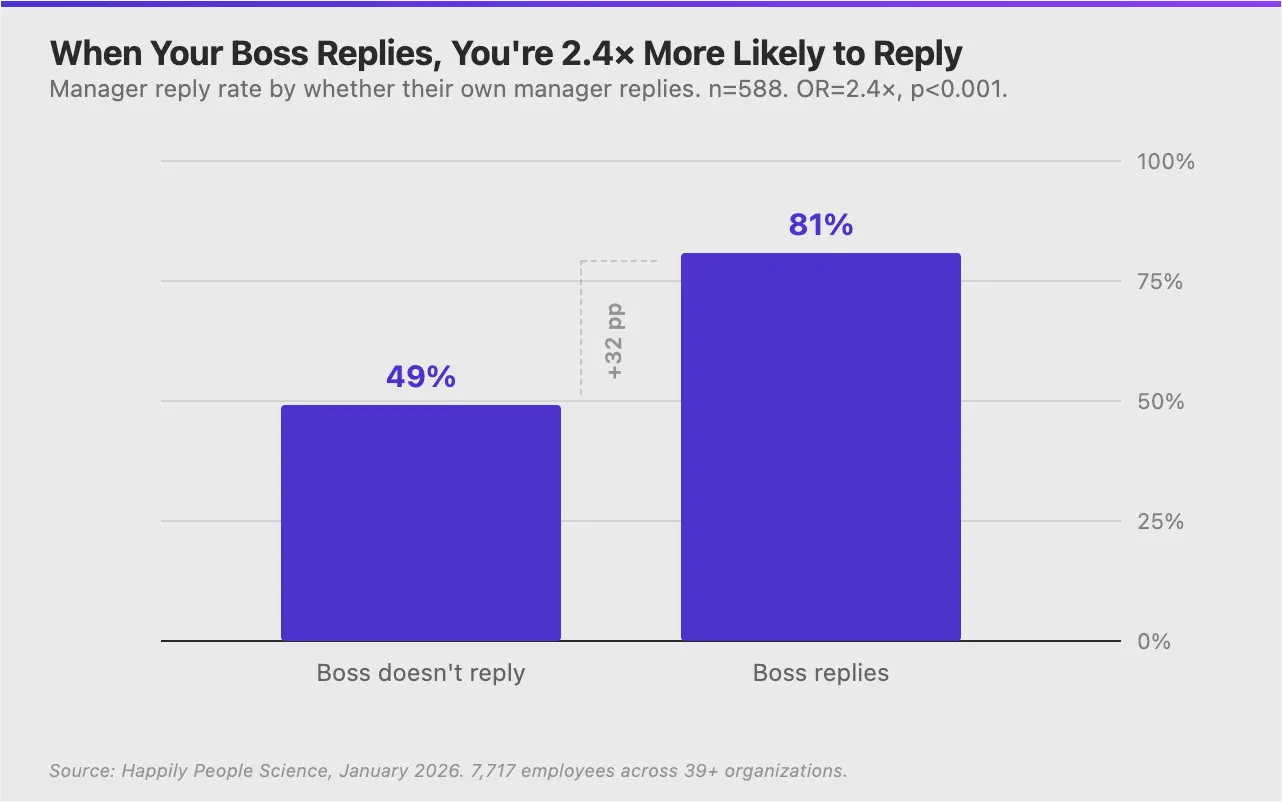
Specifically, managers whose own manager responds to employee feedback are 2.4x more likely to respond to their own team's feedback. The probability jumps from 49% to 81%.
Replying to feedback is what we call a high-impact, low-visibility behavior. It matters enormously to the person receiving the reply. But no one else sees it happen. There's no announcement, no recognition, no public record. It's invisible work.
And invisible work, it turns out, spreads invisibly too.
The Direct Manager Effect
We tested whether influence extends beyond your immediate boss by tracing management chains up to four levels deep. The results were unambiguous:
| Level | Who This Is | Statistically Significant? |
|---|---|---|
| L1 | Your direct manager | Yes (p < 0.001) |
| L2 | Your skip-level | No (p = 0.24) |
| L3 | Two levels up | No |
| L4+ | Further up | No |
Your direct manager is the dominant influence. Skip-levels and higher add nothing once you account for your immediate boss. This echoes Gallup's research showing that managers account for 70% of the variance in team engagement.
This isn't bad news. It's clarifying. The cascade works through direct transmission: your boss models behavior for you, you model it for your reports, they model it for theirs. Each link in the chain matters, but influence is local.
Think of it like a game of telephone, except each person only hears from the person directly above them. If any link breaks, everyone below is cut off from the message.
88% vs 0%: Branch Divergence in the Same Company
Even though influence is local, it compounds across levels to create dramatic divergence.
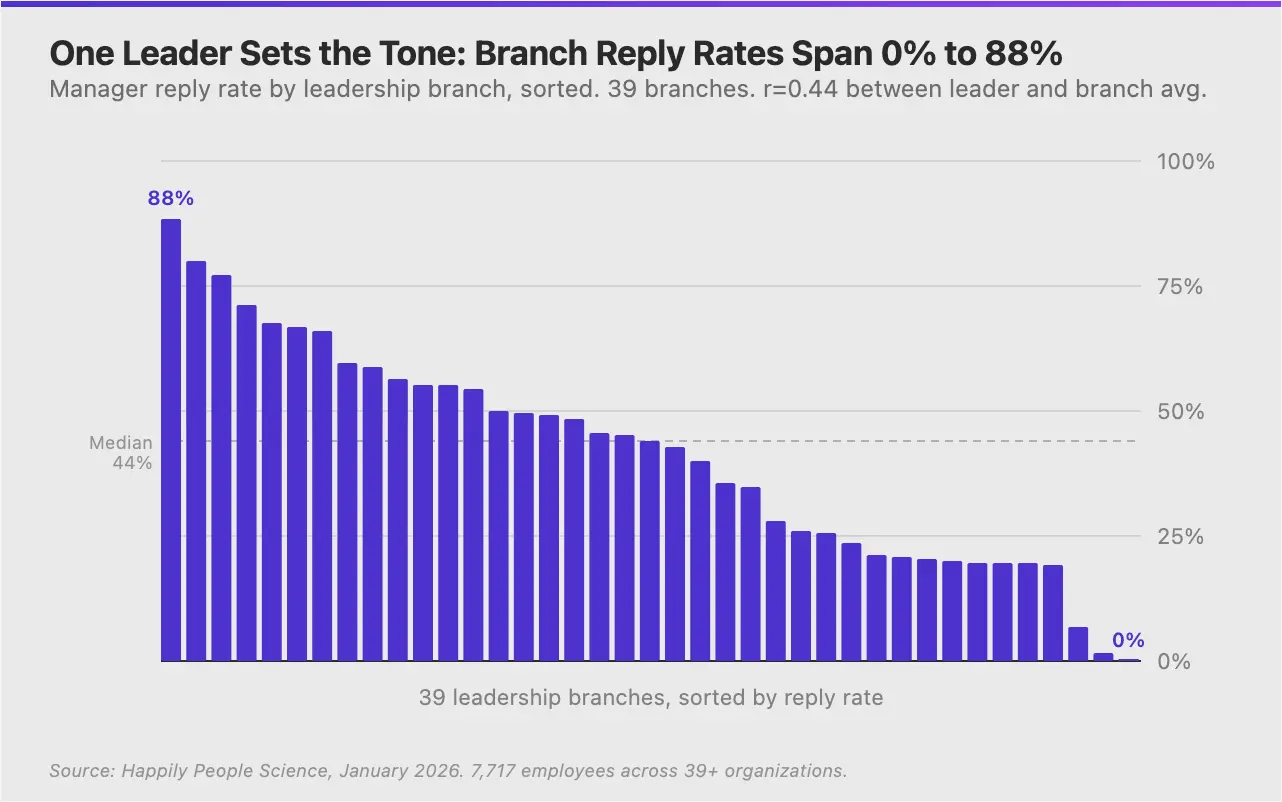
When we grouped managers by their top-level leader, reply rates varied enormously within the same organization:
- Highest branch: 88% reply rate
- Lowest branch: 0% reply rate
- Median branch: ~45% reply rate
That's not a typo. Some branches reply to nearly everything. Others reply to nothing. Same company. Same platform. Same job levels.
The correlation between a top leader's personal reply rate and their entire branch's average? r = 0.44.
The fish rots from the head. But it also thrives from the head.
Why Manager Standardization Is So Hard
This local transmission pattern explains something organizations have struggled with for decades: why is it so hard to standardize manager behaviors across a company?
The answer: there's no broadcast mechanism.
A CEO can't directly influence frontline managers. Neither can a Chief People Officer. The signal has to pass through every intermediate layer. If any link breaks, transmission stops there.
This creates culture dead zones. One non-replying manager in the middle of an org chart insulates everyone below them from the behavior. Their reports never see feedback replies modeled, so they don't adopt the practice. Neither do their reports. A single broken link affects dozens or hundreds of people downstream. (This is one reason why continuous pulse surveys matter: they reveal where the signal is getting lost.)
The 0%-88% branch variance we found isn't random. It's the predictable result of different chains having different break points. High-performing branches likely have unbroken chains from top to bottom. Low-performing branches have a break somewhere, and everyone below is cut off.
Why This Happens: Two Mechanisms
1. Role Modeling
Managers learn by example. When your boss responds thoughtfully to your feedback, you internalize that behavior as "what managers do." When they ignore it, you learn that too. This aligns with Bandura's social learning theory, which shows that people acquire behaviors by observing others, especially those with authority or status.
This isn't conscious. Most managers don't think "my boss replies, so I should too." It's absorbed through hundreds of small observations: the reply notification that pops up, the follow-up conversation that happens, the sense that feedback matters here.
High-impact, low-visibility behaviors are especially susceptible to this modeling effect. Unlike public behaviors (how you run meetings, how you present to executives), these private habits have no external enforcement. No one audits whether you replied to feedback. The only signal you get is what your own manager does to you.
2. Cultural Reinforcement
Beyond individual modeling, branches develop norms. When everyone around you replies, not replying feels conspicuously wrong. When no one does, replying feels like wasted effort.
These norms compound over time. New managers joining a high-reply branch adopt the behavior within weeks. Those joining silent branches never start. The employee feedback environment they enter shapes their habits more than any onboarding program.
What This Means for CEOs
If you're running an organization, this research suggests three things:
1. Audit Your Leadership Chains
The behaviors that matter most are often the ones you can't see: whether managers reply to feedback, how they handle difficult 1:1 conversations, whether they follow up on concerns. These high-impact, low-visibility behaviors don't show up in performance reviews or leadership assessments.
Look at these behaviors (reply rates, 1:1 completion, feedback frequency) by branch. Where are the gaps? Trace them upward. The break point is almost always a specific person, not a systemic issue.
2. Training Works Best Layer by Layer
Manager training has the highest ROI when it reaches the direct manager of each person you want to influence. Start at the top, but don't stop there. Each layer needs its own role models.
The local nature of influence actually helps here: you don't need to train the CEO to reach frontline managers. You need to train each layer's direct manager. Training senior leaders first creates a waterfall effect as they model for their directs, who model for theirs.
3. Promotion Decisions Are Culture Decisions
When you promote someone to manage a team, you're not just choosing a leader. You're choosing the behavioral template for everyone they'll manage.
A manager who doesn't respond to feedback will create a subtree of managers who don't respond to feedback. A manager who has excellent 1:1s will create a subtree of managers who have excellent 1:1s. This is why manager development is a strategic investment, not just an HR program. Choose accordingly.
The Implication
Some behaviors in your culture are transmitted person-to-person. Not broadcast from the top. Not absorbed from company values on a wall. Transmitted link by link, from each manager to their direct reports.
These tend to be the high-impact, low-visibility behaviors: replying to feedback, following up on concerns, having real conversations in 1:1s. The things that matter most to employees but that no one else sees. They spread through direct modeling because that's the only way they can spread. There's no other mechanism.
This is what performance intelligence should do: make the high-impact activities that enable performance visible. Not to create surveillance, but to create awareness. When leaders can see which branches have strong feedback loops and which have gone silent, they can intervene before the culture gap becomes permanent. The behaviors stay invisible to peers. But they become visible to the people who can fix the broken links.
This means culture change is both harder and easier than most organizations think. Harder because you can't just train the top and expect behaviors to cascade automatically. One resistant middle manager can insulate an entire subtree from your initiative.
But easier because the leverage points are specific. Find the broken links. Fix them. The cascade does the rest.
Methodology
Data: 588 managers across 39 organizations using the Happily platform over a 180-day period.
Manager definition: Any user with at least one direct report in the system.
Reply rate: Proportion of text feedback from direct reports that received a manager reply.
Analysis: OLS regression with controls for team size and company baseline (R-squared = 32%). Logistic regression for odds ratios (OR = 2.37, 95% CI: 1.55-3.62, p < 0.001). Recursive hierarchy traversal to build management chains.
Privacy: All statistics aggregated across companies. No individual company or manager data exposed. Minimum sample sizes enforced.