


On this page
OKRs were designed to align an entire organization around a few priorities. In most companies, they have become a quarterly ritual that nobody references between the kickoff and the retrospective. The goals are set in January, dusted off in April, and forgotten by May.
That is not a failure of the framework. It is a failure of how the framework is operated.
Andy Grove created OKRs at Intel to give every person in the company a clear answer to two questions: Where am I going? and How will I know if I'm making progress? John Doerr brought the system to Google, where it scaled with the company because OKRs were treated as a living signal of focus, not a static document. When OKRs work, they answer those two questions every day. When they fail, they answer them once a quarter, and only for the people who happened to be in the room.
This guide is for the leaders who want OKRs to do what they were built to do. It covers how to write strong Objectives, how to design Key Results that survive contact with reality, how to use AI to make every Key Result self-measuring, and how to operate OKRs as a real-time alignment system rather than a quarterly performance theater.
What OKRs Are (And What They Are Not)
OKRs stands for Objectives and Key Results. An Objective is a qualitative statement of what you want to achieve in a given period. Key Results are the quantitative measures that prove you achieved it.
The structure looks deceptively simple:
Objective: [A clear, ambitious, time-bound goal]
- Key Result 1: [Measurable outcome]
- Key Result 2: [Measurable outcome]
- Key Result 3: [Measurable outcome]
OKRs are not a to-do list. They are not a status report. They are not a substitute for strategy. They are a mechanism for translating strategy into focus, and focus into measurable progress.
The most common confusion is between OKRs and KPIs. KPIs measure the ongoing health of a process (your blood pressure). OKRs describe a change you are trying to drive (training to run a marathon). You need both, and they answer different questions. We covered this in detail in our guide on the differences between OKRs and KPIs.

Why Most OKR Programs Fail
Before writing better OKRs, it helps to understand why most OKR programs underperform. The pattern is consistent across hundreds of teams we have observed.
The quarterly cliff. OKRs are set in a heavy planning week, then ignored until the quarter-end review. The first time most employees revisit their Key Results is when their manager asks for a status update three weeks before the deadline. By then, the quarter is mostly written.
Shadow work. People work on what is urgent, not what is on their OKRs. Over time, the OKR document and the actual work drift apart. When asked, employees can describe their week in detail, but cannot explain how any of it ladders up to the company's stated priorities.
Activity disguised as outcome. Key Results read like task lists. "Launch the new pricing page" is an output, not an outcome. It tells you something happened, not whether it worked.
Measurement that requires a meeting. Each Key Result needs a manager and an analyst to agree on a number. The cost of measuring becomes higher than the cost of ignoring.
Each of these is fixable. The fix is not a better template. It is a different operating model, where OKRs are a daily reference, not a quarterly artifact. We will get there. First, the writing.
How to Write Strong Objectives
The Objective is a sentence. It carries more weight than its length suggests, because every Key Result has to ladder up to it. A weak Objective produces weak Key Results. There is no recovering from that.
A strong Objective has four properties:
| Property | What it means | Example |
|---|---|---|
| Directional | It points at a specific outcome, not an activity | "Become the most trusted hiring brand in our market" |
| Inspiring | A team member can repeat it from memory and want to work on it | "Make our product the obvious choice for growing companies" |
| Time-bound | It belongs to a specific cycle (typically a quarter) | "Reach product-market fit in the SMB segment by end of Q2" |
| Outcome-oriented | It describes a state of the world, not the work to get there | "Ship customers a product they would pay double for" |
Two failure modes to avoid:
Objectives that are actually projects. "Launch the new onboarding flow" is a project. The Objective behind it might be "Cut new-customer time-to-value in half." The project is one path. The Objective is the destination.
Objectives that are actually metrics. "Increase MRR by 30%" is a Key Result, not an Objective. The Objective behind it might be "Build a sustainable growth engine in our core segment." The metric is one signal that you got there.
A test that works: read your Objective without the Key Results. Does it stand on its own as something worth pursuing? If it sounds incomplete without the numbers, it is probably a Key Result in disguise.
How to Write Strong Key Results
Key Results are where most OKRs go wrong, because they are where most teams confuse activity with outcome. Three rules separate the strong from the weak.
Rule 1: Measure outcomes, not outputs
Outputs are things you do. Outcomes are things that change.
| Output (avoid) | Outcome (write this) |
|---|---|
| Publish 12 blog posts | Generate 5,000 organic visits to the blog |
| Run 4 customer interviews per week | Identify 3 unmet needs that drive churn |
| Roll out the new onboarding flow | Reduce time-to-first-value from 14 to 5 days |
| Hire 5 engineers | Deliver the platform roadmap on schedule |
If a Key Result can be checked off the day a single task is done, it is an output. Outputs belong on a roadmap, not on an OKR.
Rule 2: Be specific about the measurement
Every Key Result should answer three questions: What is the metric? What is the source? What is the threshold? If any of these is ambiguous, the Key Result will become a debate at quarter-end.
| Vague | Specific |
|---|---|
| "Improve customer satisfaction" | "Raise CSAT from 7.8 to 8.5, measured weekly through in-app surveys" |
| "Grow the pipeline" | "Generate $4M in qualified pipeline by July 1, sourced from marketing-qualified leads in HubSpot" |
| "Reduce churn" | "Reduce monthly logo churn from 2.4% to 1.5%, measured on the cohort renewal report" |
Rule 3: Set targets at the edge of achievable
A common rule of thumb from Google: if you hit 100% of your Key Results, you set them too low. The right target is the one where you genuinely do not know if you can hit it. A 70% achievement rate on stretch Key Results creates more progress than a 100% achievement rate on safe ones.
Two practical heuristics. The 50/50 test: would you put even odds on hitting this number? If yes, the target is in the right zone. The career test: would hitting this Key Result be one of the most meaningful contributions of your year? If not, you are aiming too low.

OKR Examples by Function
Concrete examples make the rules easier to apply. Here are well-formed OKRs across common functions.
Marketing
Objective: Make organic search our most reliable acquisition channel
- Key Result 1: Grow organic visitors who stay over 30 seconds from 22,000 to 50,000 per month
- Key Result 2: Move 25 priority keywords from positions 11-30 to top 10
- Key Result 3: Source 600 marketing-qualified leads from organic traffic, up from 240
Product
Objective: Make new customers successful in their first week
- Key Result 1: Reduce median time-to-first-value from 11 days to 4 days
- Key Result 2: Increase week-1 active usage from 38% to 65%
- Key Result 3: Cut support tickets per new account from 3.1 to 1.0
Sales
Objective: Win in the mid-market segment
- Key Result 1: Close $3.2M in mid-market ARR, up from $1.4M last quarter
- Key Result 2: Increase mid-market win rate from 18% to 30%
- Key Result 3: Shorten average sales cycle from 62 to 40 days
People & Culture
Objective: Build a place where top performers choose to stay
- Key Result 1: Reduce regrettable attrition from 14% to 6% annualized
- Key Result 2: Raise eNPS from 28 to 50
- Key Result 3: Achieve 90% participation in weekly manager check-ins
Notice what each example shares. The Objective is a state of the world, not a project. The Key Results are quantitative, sourced, and ambitious. None of them require a meeting to interpret.
The Missing Layer: AI Prompts for Each Key Result
Here is where modern OKRs leave the old playbook behind. Most OKR systems break down at the same point: measurement. Each Key Result needs a number, and each number needs someone to compute it. The cost of measurement quietly becomes the cost of the whole system. By week six, it is easier to skip the update than to chase it.
The fix is to design the measurement at the same time you design the Key Result. Specifically, every Key Result should be paired with a measurement prompt: a natural-language description of how the metric is computed, written in enough detail that an AI agent or a junior analyst could reproduce the number without asking.
This is a small change with a large effect. It eliminates the most common failure mode in OKR programs (debate over what the number means) and it makes the metric automatable.
What a measurement prompt looks like
Take a Key Result from the marketing example above:
Key Result: Grow organic visitors who stay over 30 seconds from 22,000 to 50,000 per month
A measurement prompt for this Key Result might read:
Pull data from Google Analytics 4 for the last 30 days. Filter sessions where the source/medium isgoogle / organicorbing / organic. Within that filtered set, count sessions where engagement time on the landing page is greater than 30 seconds. Report the count, the change versus the previous 30 days, and the top 10 landing pages contributing to this number.
That prompt is now a runnable specification. It can be handed to a marketing analyst, plugged into an analytics agent, or scheduled as a weekly automation. It survives staff turnover. It does not require a meeting to interpret.
A second example
Key Result: Reduce median time-to-first-value from 11 days to 4 days
Measurement prompt: From the product analytics warehouse, identify all accounts that signed up in the past 60 days. For each account, calculate the time between signup and the first event tagged value_event (defined in the events catalog). Compute the median across the cohort. Report weekly, broken down by plan tier and acquisition source.Why this works
The measurement prompt does three things at once. It forces clarity. If you cannot describe how to compute the number in one paragraph, the Key Result is not yet ready. It removes ambiguity. Two people running the same prompt arrive at the same answer. It makes daily measurement possible. Once the prompt exists, the metric can update on its own, and you can stop asking "where are we?" because the answer is already on the wall.
This is not a small upgrade. It is the difference between OKRs as a quarterly artifact and OKRs as a real-time signal.
[PRODUCT SCREENSHOT: Happily.ai Key Result configuration screen showing a quantitative target alongside a "Measurement prompt" field where the user has written a natural-language description of how the metric should be computed. Caption: "Each Key Result in Happily.ai pairs a target with a natural-language measurement prompt, so the metric becomes automatable from the moment it is written."]
From Quarterly Review to Daily Alignment
Writing strong OKRs is the easy part. Operating them so they actually align an organization is the hard part. This is where behavioral science matters more than the framework.
The reason most OKR programs collapse into quarterly theater is that the framework asks people to remember a goal across 90 days of competing priorities. Memory is a poor alignment mechanism. Behavior is a much better one.
Three principles, drawn from behavioral science, turn OKRs into a daily operating rhythm.
Principle 1: Make the goal visible at the moment of decision
People align with what is in front of them. If your OKRs live in a slide deck nobody opens, the OKRs lose every contest with whatever is in the inbox. The fix is to surface the active Objective and the relevant Key Result at the moments when people decide what to work on, not in a separate "OKR review" meeting.
In practice, this means weekly check-ins where each team member states what they are focusing on this week and which Key Result it ladders up to. The act of writing the connection out loud closes the gap between intention and behavior.
Principle 2: Use small, frequent prompts instead of large, infrequent reviews
Habits form through repetition, not intensity. A 60-minute quarterly review changes nothing about the next morning's behavior. A 60-second daily prompt that asks "what is your top focus today, and how does it move a Key Result?" rewires how people allocate attention.
The cost of the daily prompt is low. The cost of the quarterly review is high. The daily prompt produces alignment. The quarterly review produces a transcript.
Principle 3: Make progress visible, not just final results
Motivation comes from felt progress, not from comparison to a distant target. Teresa Amabile's research at Harvard Business School (the "progress principle") found that the single biggest driver of positive workplace mood was the experience of making progress in meaningful work, even small progress. Distance from the finish line is demoralizing. Distance traveled is motivating.
Strong OKR operating systems show people the slope of their movement, not just the gap to the goal. A Key Result that has moved from 22,000 to 31,000 against a target of 50,000 should feel like 9,000 of momentum, not 19,000 of deficit.

How Happily.ai Operates OKRs as Real-Time Alignment
This is the gap we built Happily.ai to close. OKRs are supposed to align focus across the organization. In practice, the focus signal lives in people's heads, the goal signal lives in a document, and nothing connects them until someone calls a meeting. Happily.ai connects them by default.
There are three pieces.
1. Daily focus signal. Through short, gamified check-ins, Happily.ai surfaces what each person is actually working on this week. Not what they were assigned. Not what their job title says. What is in front of them right now.
2. Alignment evaluation. Each focus area is mapped against the company's active Objectives. The platform shows leaders, in real time, how much of the team's attention is flowing to the priorities that matter, and where focus is drifting. Misalignment becomes visible the same week it happens, not the same quarter.
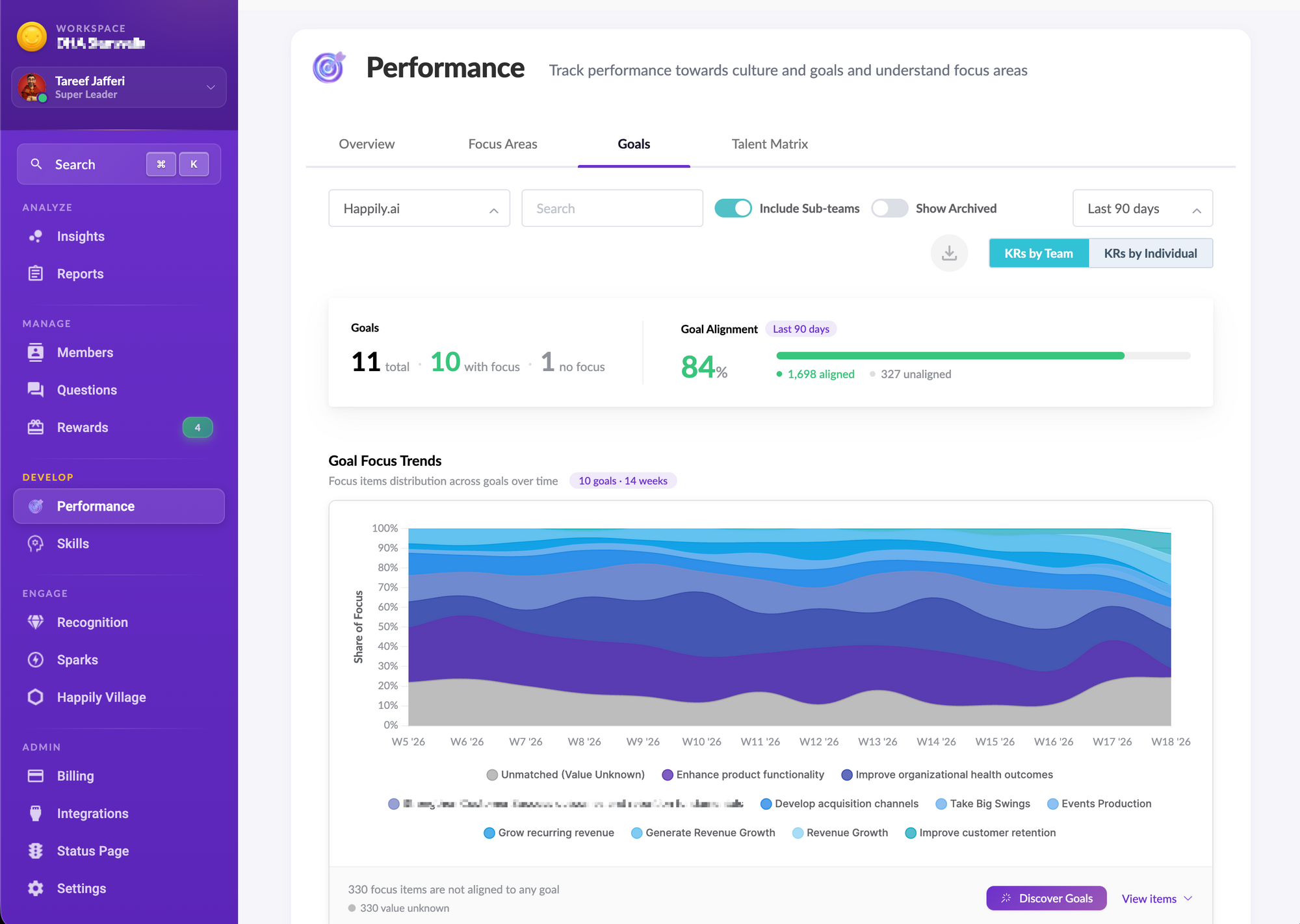
3. Key Results with measurement prompts. Each Key Result lives alongside its natural-language measurement prompt. The metric updates automatically from the connected source (analytics, CRM, support system, product warehouse). Every team member sees movement on the Key Results their work is tied to, every day, without anyone asking for a status update.
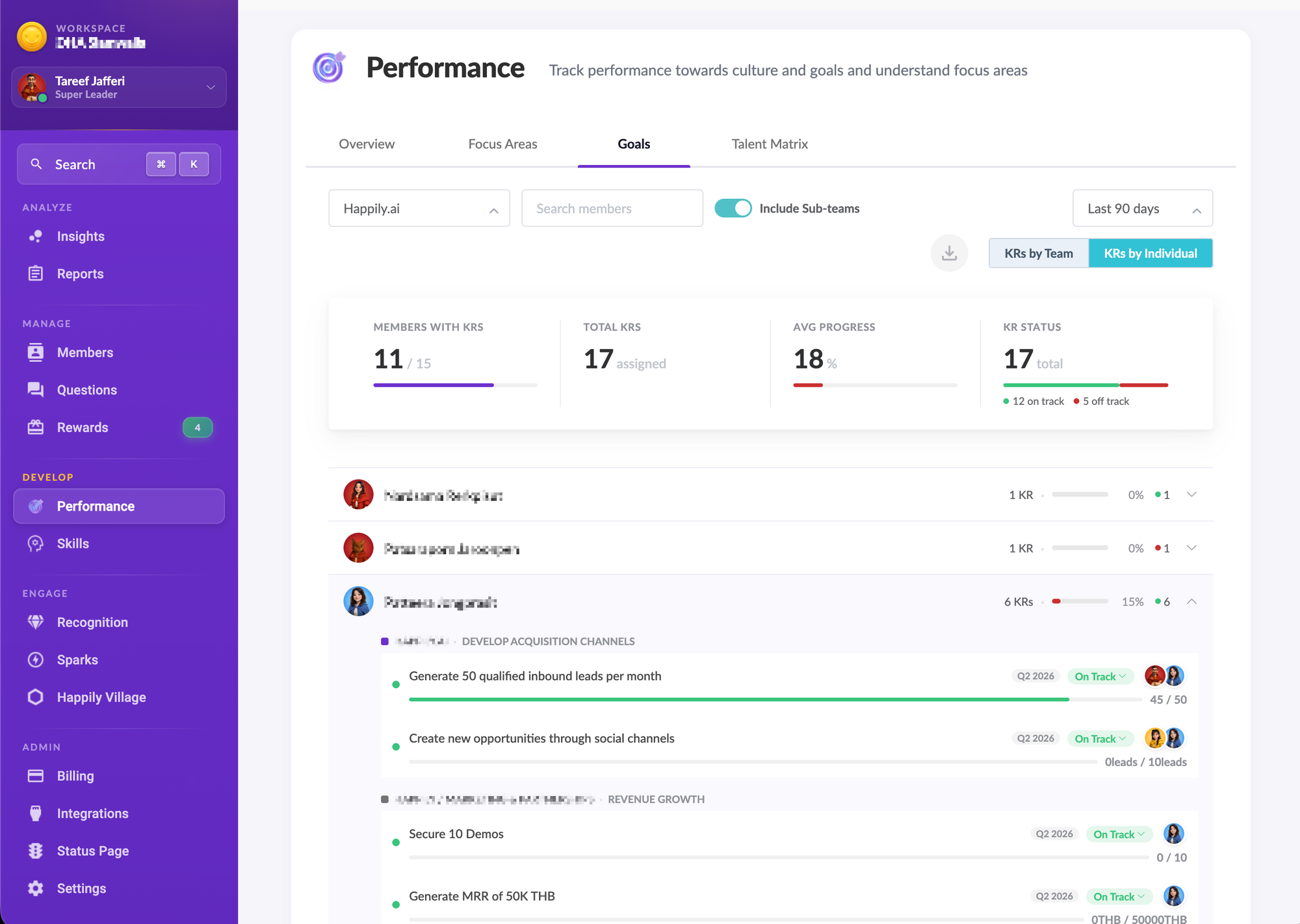
The behavioral science layer is what makes the system stick. Daily prompts reinforce the link between attention and outcome. Visible progress carries the team forward. Recognition flows toward the contributions that move Key Results, not the contributions that look busy. In our research across 250+ companies, teams operating OKRs this way report a 23% higher rate of weekly check-in completion and a 31% faster time to identify alignment drift, compared to teams running OKRs as a quarterly process.
Common OKR Mistakes (and How to Avoid Them)
A short list of the patterns we see most often, and the simplest fix for each.
| Mistake | Why it happens | Fix |
|---|---|---|
| Too many OKRs per team | Everyone wants a seat at the table | 3 Objectives max per team. 3-5 Key Results per Objective. |
| Key Results that are tasks | Output is easier to write than outcome | If the Key Result can be "done," rewrite it as a measurable outcome |
| OKRs not visible mid-quarter | No daily reference point | Surface the active OKR in the tools where work happens, weekly |
| Sandbagging | Fear of being measured against ambitious targets | Decouple OKR achievement from individual performance reviews |
| Cascading rigidly top-down | Confused with hierarchical goal-setting | Cascade context, not Key Results. Let teams set their own KRs that ladder up to leadership Objectives |
| Editing OKRs mid-quarter to look better | Lack of psychological safety around miss | Treat misses as information about reality, not as failures of effort |
The mistake that quietly destroys more OKR programs than any other is the last one. If a team cannot miss a Key Result without feeling unsafe, they will start writing Key Results they can hit. Once that happens, OKRs are no longer a signal. They are theater.
A Practical Quarterly Operating Rhythm
Putting it together, here is the rhythm we recommend for teams running OKRs as a real-time alignment system.
Once per quarter (2 hours). Set 1-3 Objectives per team. Write 3-5 Key Results per Objective. Pair each Key Result with a measurement prompt. Connect each prompt to its data source.
Once per week (15 minutes per person). Each team member states their top 1-3 focus areas for the week and the Key Result each one ladders up to. The system surfaces alignment drift to managers and leaders.
Daily (under 60 seconds per person). A short check-in surfaces in-the-moment focus. Key Results update automatically from their measurement prompts. Progress is visible. Recognition flows toward contributions that move the metrics that matter.
Once per month (30 minutes). Leaders review alignment drift, decide whether the Objectives still reflect reality, and adjust where needed. OKRs are not sacred. Reality wins.
Once per quarter, again (90 minutes). Retrospective on the cycle. What did we learn? Where did the focus actually go? What changes for next quarter?
This rhythm trades the quarterly review meeting (high cost, low frequency) for daily prompts and weekly check-ins (low cost, high frequency). The total time spent is similar. The behavior change is enormous.
Key Takeaways
OKRs were built to align an organization in real time. Most companies operate them as quarterly paperwork, then wonder why the framework underdelivers. The fix is structural and behavioral.
Write Objectives that describe a state of the world. Write Key Results that measure outcomes, not outputs. Pair every Key Result with a natural-language measurement prompt so the metric becomes automatable from day one. Operate OKRs through small, frequent prompts that surface focus and progress, instead of through infrequent reviews that surface only deadlines.
If your OKRs live in a document people open once a quarter, you do not have an alignment system. You have a record of intentions. The companies that pull ahead in the next decade will be the ones whose OKRs operate every day.
Ready to operate OKRs as a real-time alignment system? Book a Happily.ai demo to see how daily focus check-ins, alignment views, and self-measuring Key Results work together. Or read our companion guide on the hidden cost of misalignment for the data behind why this matters now.