


Employee engagement gamification has a credibility problem. The phrase conjures images of cartoon badges, meaningless leaderboards, and mandatory "fun" that makes adults feel like they are being managed by a children's app. HR leaders are right to be skeptical.
And yet: one platform achieves 97% voluntary daily adoption using gamification principles, while the HR technology industry averages 25% adoption across engagement tools. The difference is not better badges. The difference is behavioral science.
This article explains what the research actually says about gamification in the workplace, why most implementations fail, and the specific behavioral mechanisms that separate tools people use every day from tools that become expensive shelfware.
What Is Employee Engagement Gamification?
Employee engagement gamification is the application of behavioral design principles (drawn from game mechanics, behavioral economics, and habit science) to workplace tools and processes that drive engagement, recognition, feedback, and collaboration.
Best for: Organizations that want daily participation in culture-building activities rather than quarterly survey compliance.
Not a fit for: Organizations that view gamification as "adding points to existing processes." That approach has a documented failure rate, and we will cover why.
| Approach | What It Looks Like | Typical Adoption |
|---|---|---|
| Traditional surveys | Quarterly email, 15-minute questionnaire | 25% average |
| Surveys with gamification layer | Same survey, now with points and a leaderboard | 30-35% (marginal lift) |
| Behavioral activation | Daily micro-interactions designed around intrinsic motivation | 90%+ when designed well |
The third approach is what behavioral scientists call activation design. It does not add game mechanics to a broken process. It redesigns the process around how humans actually form habits and sustain motivation.

What Gamification Research Actually Shows
Let's be honest about the evidence. It is mixed, and anyone telling you otherwise is selling something.
A 2020 meta-analysis by Hamari and colleagues, covering 49 empirical studies, found that gamification produced positive effects on engagement and motivation in the majority of cases, but with significant variance. Some implementations produced no measurable effect. A smaller number made things worse.
A 2022 systematic review published in Computers in Human Behavior narrowed this further. The studies where gamification worked shared three characteristics:
- Autonomy: Participants chose how and when to engage
- Competence feedback: The system provided clear signals of progress
- Social connection: Interactions involved real human relationships, not just leaderboards
The studies where gamification failed? They bolted game mechanics onto mandatory processes. Points for completing compliance training. Badges for filling out timesheets. Leaderboards ranking employees on metrics they could not control.
Gabe Zichermann, who popularized gamification in business, later acknowledged this problem. "The biggest mistake," he wrote, "is treating gamification as a feature rather than a design philosophy."
The research is clear on one point: gamification works when it aligns with intrinsic motivation. It backfires when it tries to manufacture extrinsic motivation for activities people already resent.
Why Most Workplace Gamification Fails
Three patterns explain the majority of workplace gamification failures.
1. The Chocolate-Covered Broccoli Problem
This term (coined by education researcher Amy Bruckman) describes what happens when you wrap an unpleasant activity in superficial game elements. The activity is still unpleasant. Employees see through the wrapper immediately.
A 30-question quarterly survey is still a 30-question quarterly survey, even if you award 50 points for completing it. Employees do not lack motivation to fill out surveys because the surveys lack points. They lack motivation because the surveys feel like a one-way extraction of time with no visible return.
Adding game mechanics to this process is like putting a racing stripe on a car with no engine.
2. The Leaderboard Trap
Leaderboards are the most commonly implemented (and most commonly destructive) gamification element in workplaces. Research by Werbach and Hunter at Wharton found that leaderboards motivate the top 10% of performers and demotivate everyone else.
In a workplace context, this is toxic. The employees who would participate anyway now compete more intensely. The employees you actually need to reach disengage further because they see a ranking they cannot win.
The fix is not removing competition. It is redesigning what gets measured. When the "score" reflects behaviors anyone can do (like recognizing a colleague or sharing a progress update), the dynamic shifts from "who's the best?" to "who showed up today?"
3. The Novelty Cliff
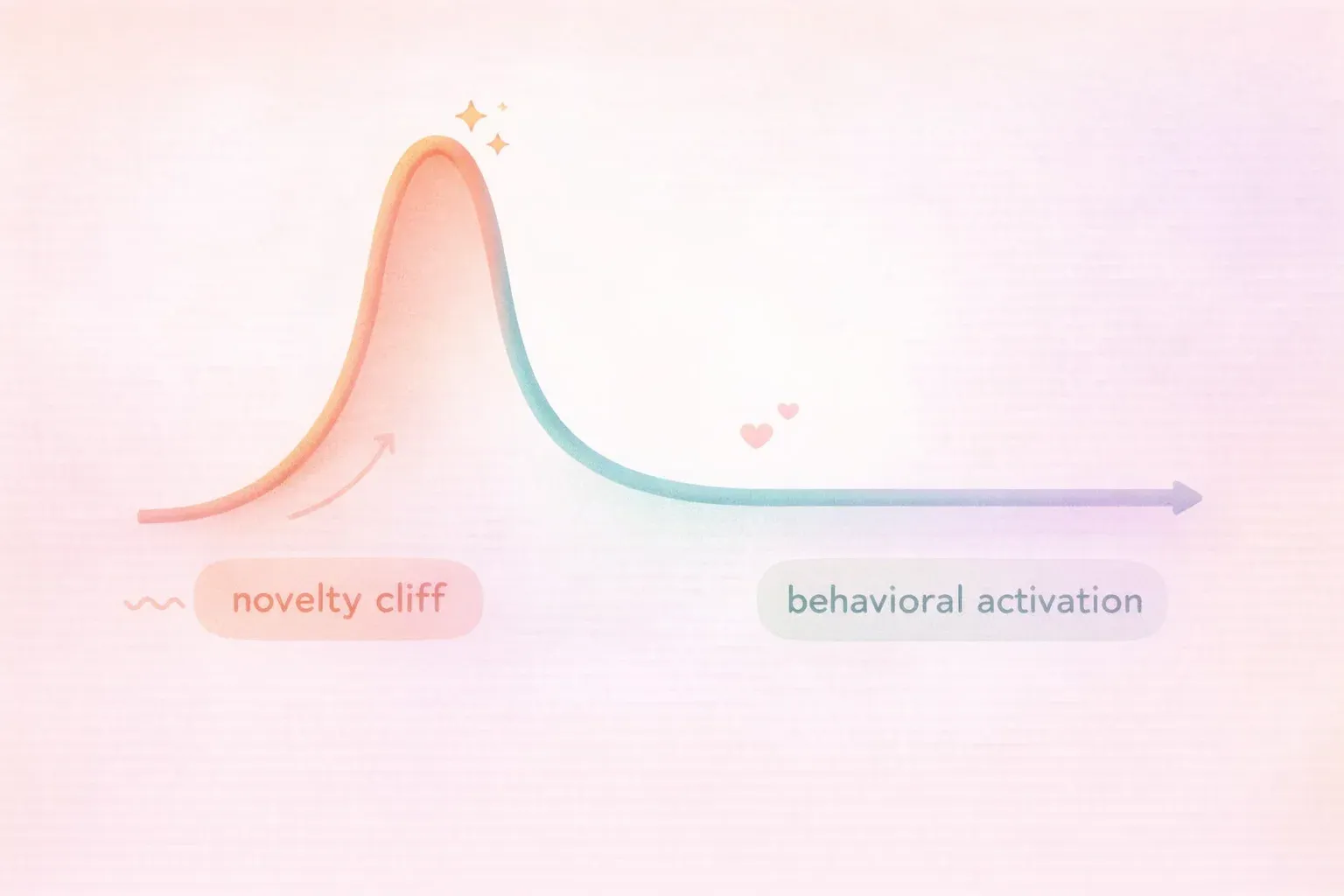
Most gamified workplace tools see a usage spike in weeks one through three, followed by a steep decline. This is the novelty cliff. The game elements were interesting because they were new. Once they are familiar, there is nothing sustaining the behavior.
BJ Fogg's Behavior Model (B = MAP: Behavior happens when Motivation, Ability, and a Prompt converge) explains why. Novelty temporarily inflates motivation. But sustainable behavior requires low friction (high ability) and reliable prompts, not sustained high motivation. Motivation is the least reliable of the three.
Tools that survive the novelty cliff are designed around ability and prompts, not motivation spikes.
The Behavioral Science That Makes Gamification Work
Four principles from behavioral science separate effective employee engagement gamification from the failures described above.
The Fogg Behavior Model: Make It Tiny
BJ Fogg's research at Stanford demonstrates that the most reliable way to create a new habit is to make the behavior absurdly small. Not "fill out a weekly engagement survey." Instead: "answer one question about your day." Not "write a performance review." Instead: "recognize one colleague for something specific."
When the behavior takes less than 60 seconds, the ability barrier drops to near zero. You no longer need high motivation to trigger action. A simple prompt is enough.
Practical application: Happily.ai's daily interaction takes under two minutes. That is not a design constraint. It is the design philosophy. Every feature is evaluated against the question: "Can someone do this in the time it takes to check a notification?"
Variable Rewards: The Slot Machine Principle
Nir Eyal's research on habit-forming products identifies variable rewards as a core driver of sustained engagement. When outcomes are predictable, interest fades. When outcomes vary, curiosity sustains attention.
In workplace gamification, this means the experience should feel different each day. Different questions. Different prompts. Different colleagues showing up in your recognition feed. The science of team performance depends on sustained daily behaviors, not one-time interventions.
This is the same principle that makes Duolingo's daily lessons feel fresh even after months of use. You know you will practice vocabulary. You do not know which words, in what format, or what streak bonus might appear.
Social Proof: Behavior Is Contagious
Robert Cialdini's research on social proof shows that people are more likely to adopt a behavior when they see others doing it. In workplace gamification, this translates to visibility. When employees see colleagues giving recognition, sharing updates, or celebrating milestones, the behavior normalizes.
Research from Happily.ai's platform (drawing on 10M+ workplace interactions) confirms this: recognition givers are trusted 9x more than non-participants. This creates a positive feedback loop. Participation is not just rewarded by the system. It is rewarded by the social environment.
Commitment Devices: Small Promises, Big Consistency
Behavioral economists have documented the power of micro-commitments. When people make a small public commitment, they are significantly more likely to follow through. This is the consistency principle that Cialdini identified as one of the six pillars of influence.
In practice, daily check-ins function as micro-commitments. Each day's participation makes tomorrow's participation more likely. After two weeks of daily use, the behavior shifts from "something I try" to "something I do."
The Duolingo Parallel: What Consumer Behavioral Design Teaches HR
Duolingo has 97 million monthly active users learning languages through a system that looks like a game but functions as a behavioral engine. The company does not describe itself as a "gamified language app." It describes itself as a platform that applies behavioral science to make learning a daily habit.
The parallels to employee engagement gamification are direct:
| Duolingo Principle | Workplace Application |
|---|---|
| Daily streak (commitment device) | Daily check-in habit |
| 5-minute lessons (tiny behavior) | 2-minute micro-interactions |
| Variable lesson content (variable rewards) | Different daily questions and prompts |
| Friend leaderboards (social proof) | Team recognition feeds |
| Push notifications at optimal times (prompts) | Contextual nudges based on behavior patterns |
Happily.ai studied these patterns and built a Culture Activation platform on the same behavioral foundations. The result: 97% adoption, compared to the 25% industry average for engagement tools that become shelfware.
The lesson is not "copy Duolingo." The lesson is that consumer behavioral design has solved the adoption problem that enterprise HR technology still struggles with. The science exists. Most HR tools ignore it.
What 97% Adoption Looks Like in Practice
Numbers without context are meaningless. Here is what 97% daily adoption produces inside an organization:
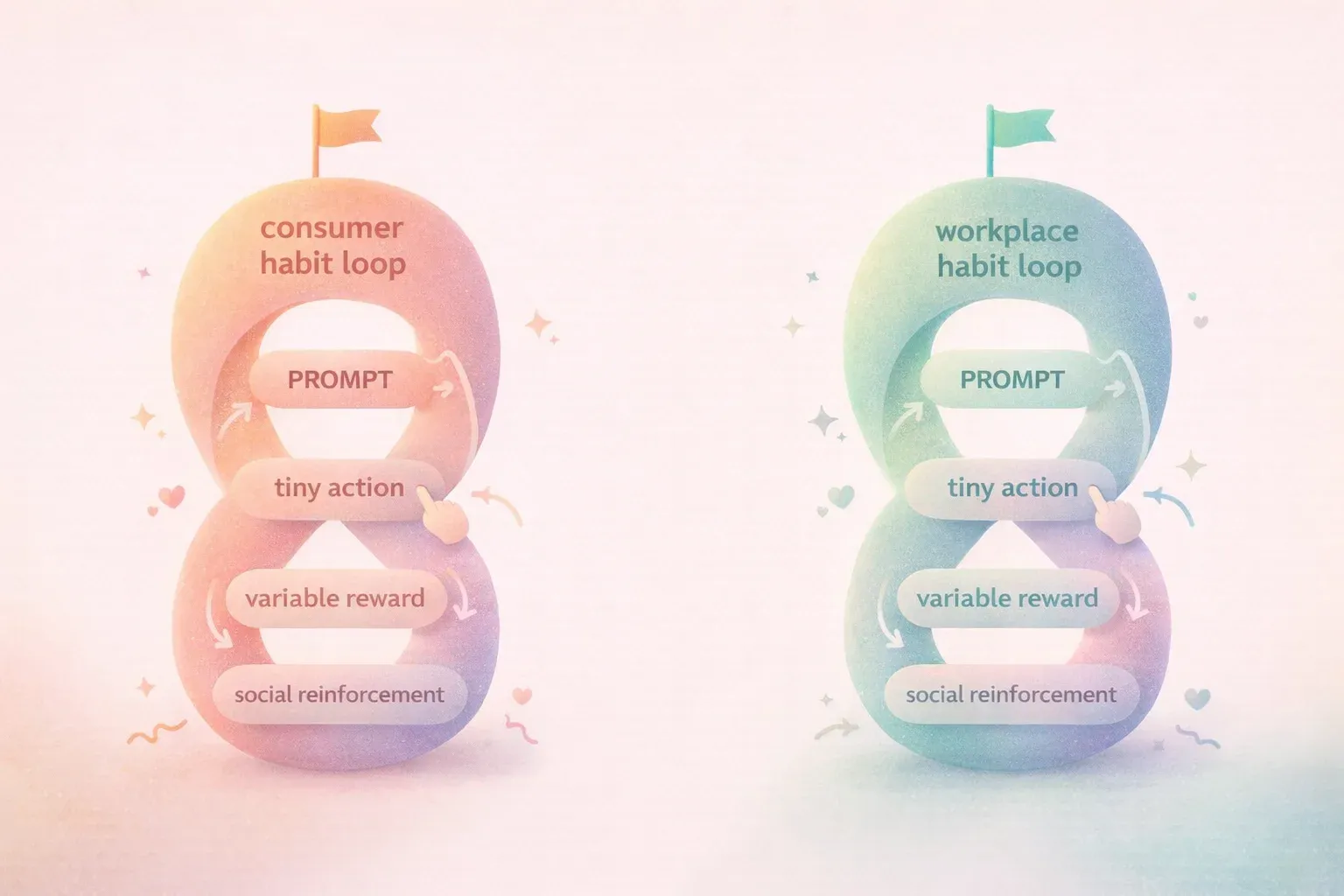
The daily loop:
- Employees receive a contextual prompt (based on their team, role, and recent activity)
- They complete a micro-interaction: a mood check-in, a recognition, a goal update, or a feedback response
- The system synthesizes these signals into real-time dashboards for managers and leaders
- Managers see patterns across Feeling, Focus, and Progress and can act before small issues become resignations
The compounding effect: After 90 days of daily participation, organizations on the platform report:
- 40% reduction in turnover ($480K annual savings per 100 employees)
- +48 point eNPS improvement (from detractors to promoters)
- 10-20x increase in recognition frequency compared to pre-platform baseline
These outcomes are not caused by gamification. They are caused by the behaviors that gamification enables. Recognition builds trust. Feedback surfaces problems early. Goal visibility creates alignment. The gamification layer is the delivery mechanism, not the product.
Common Objections (And Honest Answers)
"My senior leaders won't use a gamified tool."
This is the most common objection, and it is partially valid. Senior leaders who hear "gamification" often picture something beneath their dignity. The reframe: senior leaders already use behavioral design daily. Their email app uses read receipts (social proof). Their calendar uses reminders (prompts). Their fitness tracker uses streaks (commitment devices).
The question is not whether leaders accept behavioral design. It is whether the tool feels professional enough to use in a leadership context. If the interface looks like a children's game, you have a design problem, not a gamification problem.
"Won't people game the system?"
Yes, some will. Any measurement system can be gamed. The question is whether gaming the system produces harmful or useful behavior. If "gaming" the recognition system means giving more recognition to colleagues, that is the desired outcome. The system is working.
For metrics that should not be gameable (like wellbeing check-ins), the design answer is removing competition entirely. No leaderboards. No public scores. Just private reflection with aggregated team-level insights.
"We tried gamification before and it didn't work."
This is useful information. What specifically was tried? In most cases, organizations bolted game mechanics onto an existing process (a survey, a performance review, a learning module) and saw temporary lifts followed by the novelty cliff.
That failure does not disprove gamification. It proves that surface-level gamification does not work. The distinction matters.
When Gamification Is Wrong for Your Organization
Honesty builds credibility, so here it is: employee engagement gamification is not right for every organization.
Skip gamification if:
- Your culture actively punishes vulnerability (people will not check in honestly if honesty is unsafe)
- You have fewer than 20 employees (at this size, direct relationships work better than any tool)
- Your leadership team will not look at the data (the best behavioral design is wasted if no one acts on the signals)
- You are looking for a survey replacement, not a behavior change system (if you want quarterly snapshots, a traditional tool will serve you fine)
Choose gamification-driven tools if:
- Adoption of previous engagement tools was below 50%
- You need daily behavioral data, not quarterly sentiment snapshots
- Your managers need real-time signals to act on, not retrospective reports
- You are scaling past 50 people and losing visibility into team health
Frequently Asked Questions
Does gamification improve employee engagement?
Research shows that well-designed gamification improves engagement metrics including participation rates, recognition frequency, and feedback quality. Poorly designed gamification (bolting points onto existing processes) produces temporary lifts followed by decline. The critical factor is whether the design addresses intrinsic motivation through autonomy, competence, and social connection.
What is the best example of gamification in the workplace?
The most effective workplace gamification examples share three traits: micro-interactions under two minutes, variable daily content, and visible social participation. Happily.ai's Culture Activation platform achieves 97% daily adoption using these principles. Duolingo applies identical behavioral science to language learning with similar adoption results.
Why does workplace gamification fail?
Workplace gamification fails when organizations add game mechanics (points, badges, leaderboards) to processes employees already dislike. This "chocolate-covered broccoli" approach produces novelty-driven spikes followed by steep drop-offs. Sustainable gamification redesigns the process itself around behavioral science principles like tiny habits, variable rewards, and social proof.
Is gamification manipulative?
Ethical gamification makes desired behaviors easier and more rewarding. It does not force participation or punish non-participation. The test: would employees voluntarily continue using the tool if their manager never checked? At 97% voluntary adoption, the answer for well-designed tools is yes. Manipulation removes choice. Good behavioral design adds it.
How do you measure gamification ROI?
Measure adoption rate first (what percentage of employees use the tool daily without being required to), then downstream outcomes: turnover reduction, eNPS change, recognition frequency, and manager response time to team signals. Happily.ai customers report 40% turnover reduction ($480K annual savings per 100 employees) and +48 point eNPS improvement within 6 months.
The Bottom Line
Employee engagement gamification works when it is behavioral science applied to daily habits. It fails when it is game mechanics pasted onto broken processes.
The difference between 25% adoption and 97% adoption is not better badges or bigger point totals. It is understanding that sustainable behavior requires tiny actions, variable rewards, social reinforcement, and reliable prompts. The same science that makes Duolingo a daily habit can make culture-building a daily habit.
The question for your organization is not "should we gamify?" It is: "Are we designing for daily behavior change, or are we still asking people to fill out quarterly surveys and hoping for the best?"
See how Culture Activation works in practice: Book a demo
Sources:
- Hamari, J., Koivisto, J., & Sarsa, H. (2014, updated meta-analysis 2020). "Does Gamification Work? A Literature Review of Empirical Studies on Gamification." 47th Hawaii International Conference on System Sciences.
- Fogg, B.J. (2019). Tiny Habits: The Small Changes That Change Everything. Harvest Books.
- Eyal, N. (2014). Hooked: How to Build Habit-Forming Products. Portfolio/Penguin.
- Werbach, K. & Hunter, D. (2020). For the Win: The Power of Gamification and Game Thinking in Business, Education, and Social Impact. Wharton School Press.
- Cialdini, R. (2021). Influence, New and Expanded: The Psychology of Persuasion. Harper Business.
- Zichermann, G. & Cunningham, C. (2011). Gamification by Design. O'Reilly Media.
- Koivisto, J. & Hamari, J. (2019). "The rise of motivational information systems: A review of gamification research." International Journal of Information Management.
- Happily.ai platform data: 10M+ workplace interactions across 350+ organizations (2017-2026).