

Life is more convenient than ever. So why are we more exhausted?
We can order groceries without leaving our couch, access the world's information in seconds, and automate tasks that consumed hours of our parents' time. Yet instead of feeling liberated, many of us end the day feeling drained, unable to make one more decision about what to eat for dinner.
The answer lies in a concept called consideration span.
The Difference Between Attention and Consideration
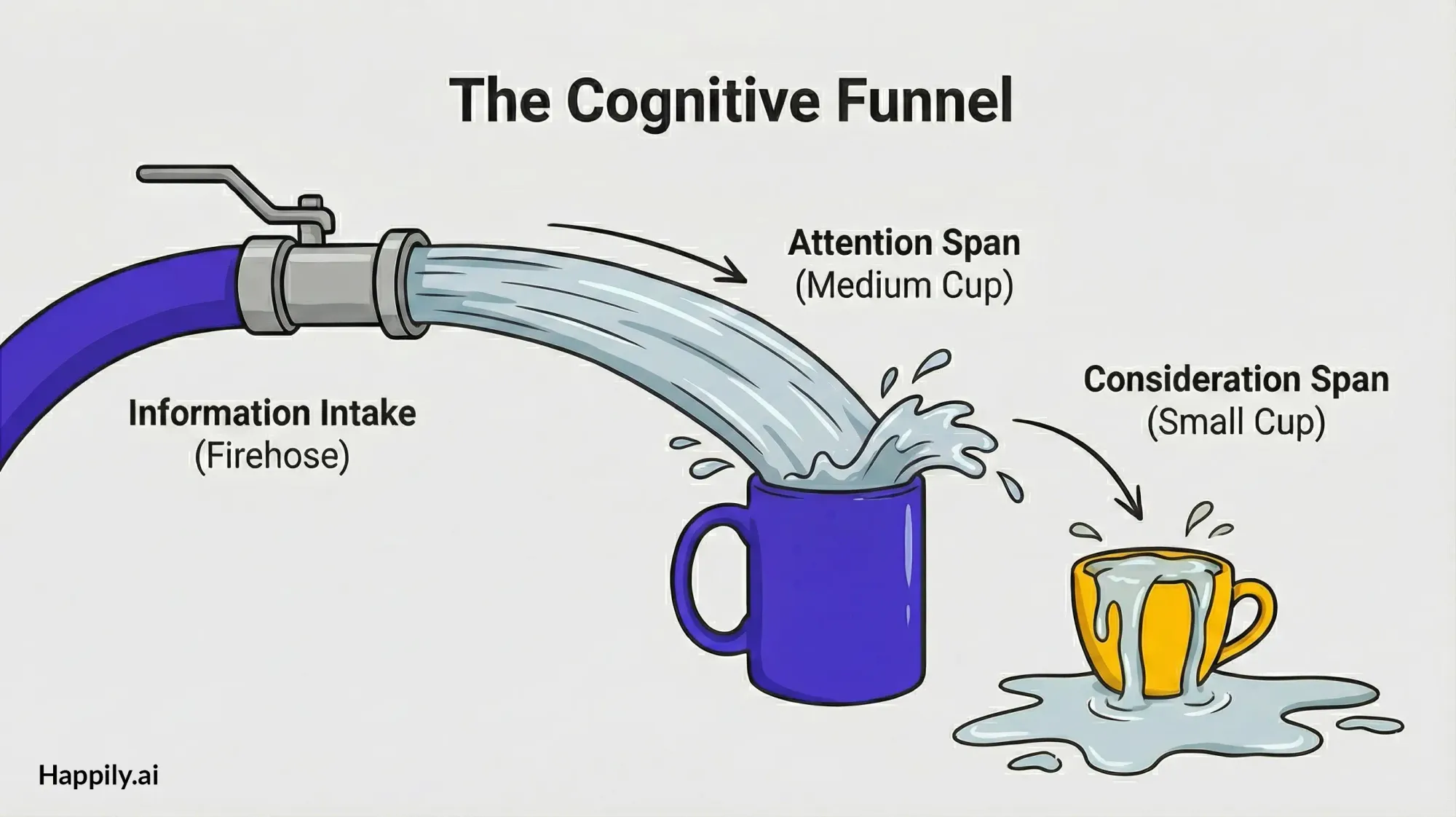
We talk endlessly about shrinking attention spans. But attention is just the first layer of cognitive engagement. It determines what information enters your mind.
Consideration is what happens next. It's the cognitive capacity to weigh options, evaluate tradeoffs, and make decisions. Attention lets you take in information. Consideration lets you do something useful with it.
And consideration is far more finite.
Think of attention as opening emails. Consideration is deciding which ones require action, what that action should be, and in what order. You can open hundreds of emails in a day. But try making hundreds of meaningful decisions about them, and you'll understand why your brain feels like it's running on fumes by 3 PM.
The Science of Why More Choices Make Us Worse Off
Barry Schwartz's research on the "paradox of choice" demonstrated that more options don't lead to better decisions (Schwartz, 2004). They lead to decision paralysis and decreased satisfaction. His work built on Iyengar and Lepper's famous jam study (2000), which found that consumers presented with 24 jam varieties were less likely to purchase than those offered just 6 options.
Every additional option taxes your consideration span, leaving less capacity for the decisions that actually matter.
This isn't just about consumer choices. Roy Baumeister's foundational research on ego depletion showed that self-control and decision-making draw from the same limited cognitive resource (Baumeister et al., 1998). In their experiments, participants who had to resist eating chocolate subsequently gave up faster on challenging puzzles. The act of deciding depleted the same resource needed for persistence.
Vohs and colleagues (2008) extended this research specifically to decision-making, finding that making choices impairs subsequent self-control. The mechanism is straightforward: every decision, no matter how small, withdraws from the same cognitive account.
The Modern Exhaustion
This explains the modern exhaustion. We've been considering all day: comparing products, evaluating opportunities, weighing tradeoffs, second-guessing choices. Our input tokens are maxed. Nothing left for thinking and output.
Consider how many decisions the average knowledge worker faces before lunch:
- Which emails to respond to first (and how to respond)
- Whether to accept meeting invitations
- How to prioritize competing tasks
- Which Slack messages need immediate attention
- What to eat (from infinite delivery options)
- How to phrase that sensitive message to a colleague
Each decision, however trivial it seems, makes a withdrawal from your consideration account. By afternoon, the account is overdrawn.
A study examining judicial parole decisions found that favorable rulings dropped from 65% at the start of the day to nearly 0% before breaks, then recovered after food and rest (Danziger, Levav & Avnaim-Pesso, 2011). Judges weren't becoming less fair. Their consideration capacity was depleting.
What's Draining Your Consideration Span
Three forces are particularly effective at exhausting consideration capacity:
Infinite scroll algorithms designed to surface endless options. Social media and e-commerce platforms are engineered to present you with more choices than you can possibly evaluate. Each swipe is a micro-decision: interesting or not? Worth my time or not? The algorithm never runs out of content. Your consideration span does.
Subscription overload. Newsletters, feeds, notifications, streaming services. We've subscribed to more information sources than we can possibly process, creating a permanent backlog of "inputs" demanding consideration. The cognitive load isn't just reading the content. It's deciding which content deserves our attention.
Uncertainty that forces continuous re-evaluation. When circumstances change rapidly, decisions that felt settled need to be reconsidered. Economic uncertainty, shifting workplace expectations, and evolving technology mean we're constantly re-evaluating choices we thought we'd already made.
Three Ways to Restore Capacity
1. Set Rules Once, Stop Re-Deciding
Only accept meetings with an agenda. Check email at fixed times, not reactively. If it's truly urgent, they'll call.
These aren't preferences. They're policies that eliminate hundreds of micro-decisions.
Schwartz (2004) calls these "second-order decisions": rules that govern future choices so you don't have to make them individually. The upfront cognitive cost of establishing a rule is far less than the ongoing cost of deciding case-by-case.
At Happily.ai, we've seen how establishing clear feedback rhythms removes the constant decision of "should I check in with my team today?" When the system prompts meaningful interaction at the right moments, managers preserve consideration capacity for higher-value decisions.
2. Enter With Intent or Not at All
Social media and e-commerce are consideration traps. Know what you want before you open the app.
The alternative is what researchers call "choice overload" (Iyengar & Lepper, 2000). You open Amazon to buy batteries. Forty-five minutes later, you've evaluated seventeen different options, read dozens of reviews, and you're now questioning whether you even need batteries at all.
Intent creates boundaries. "I'm looking for AA batteries under $15 with good reviews" is a filter that protects your consideration span. Browsing without intent is an invitation for the algorithm to drain your cognitive resources.
3. Subtract Aggressively
If what you follow no longer changes how you think or act, it's time to remove it.
This includes me. If these posts aren't useful, unfollow.
We accumulate information sources during seasons when they're valuable, then fail to prune them when circumstances change. That newsletter about remote work strategies was essential in 2020. Is it still serving you in 2025?
Every subscription is a standing claim on your consideration span. Audit them ruthlessly.
The Organizational Implication
This isn't just a personal productivity issue. It's an organizational design challenge.
When employees spend their consideration capacity navigating unclear priorities, decoding ambiguous feedback, or managing unnecessary complexity, they have less capacity for the creative and strategic thinking that drives business outcomes.
Research from MIT's Human Dynamics Laboratory found that communication patterns predict team success more accurately than individual intelligence, personality, or skills combined (Pentland, 2012). The quality of interactions matters more than quantity. Teams that communicate with clarity preserve consideration capacity. Teams drowning in noise exhaust it.
This is why effective managers focus on removing friction rather than adding initiatives. Every new process, every additional meeting, every ambiguous directive makes a withdrawal from their team's collective consideration account.
Organizations that understand this design systems to minimize unnecessary decisions. They create clear feedback loops so employees don't have to wonder where they stand. They establish shared values that guide decisions without requiring escalation. They build recognition practices that reinforce what matters so people don't have to constantly guess.
Protecting the Gate
Your attention and consideration spans deserve a discerning gatekeeper. Most of us have left the gate wide open.
The convenience economy has optimized for reducing friction on inputs. It's trivially easy to subscribe, follow, sign up, and opt in. The friction has been removed from adding to your cognitive load.
But no one is optimizing for your outputs. No one is protecting your consideration capacity. That responsibility falls to you.
The exhaustion you feel at the end of the day isn't laziness. It's a depleted cognitive resource that's been drained by thousands of micro-decisions, most of which added no value to your life or work.
Protecting that resource requires intentional design: of your information diet, your decision rules, and your environment. The goal isn't to make more decisions. It's to make fewer, better ones, and preserve the capacity for the thinking that matters.
Tareef Jafferi is the CEO of Happily.ai, an AI-powered platform that transforms workplace culture through behavioral science. By creating systems that reduce unnecessary cognitive load while strengthening meaningful interactions, Happily.ai helps organizations build environments where people can do their best thinking.
References
Baumeister, R. F., Bratslavsky, E., Muraven, M., & Tice, D. M. (1998). Ego depletion: Is the active self a limited resource? Journal of Personality and Social Psychology, 74(5), 1252-1265.
Danziger, S., Levav, J., & Avnaim-Pesso, L. (2011). Extraneous factors in judicial decisions. Proceedings of the National Academy of Sciences, 108(17), 6889-6892.
Iyengar, S. S., & Lepper, M. R. (2000). When choice is demotivating: Can one desire too much of a good thing? Journal of Personality and Social Psychology, 79(6), 995-1006.
Pentland, A. (2012). The new science of building great teams. Harvard Business Review, 90(4), 60-69.
Schwartz, B. (2004). The Paradox of Choice: Why More Is Less. Harper Perennial.
Vohs, K. D., Baumeister, R. F., Schmeichel, B. J., Twenge, J. M., Nelson, N. M., & Tice, D. M. (2008). Making choices impairs subsequent self-control: A limited-resource account of decision making, self-regulation, and active initiative. Journal of Personality and Social Psychology, 94(5), 883-898.