

You have dashboards for sales, finance, and operations. You can see pipeline velocity, cash flow, and production efficiency in real time. But when it comes to your people—the part of your business that actually does the work—you're flying blind.
Sure, you set OKRs quarterly. You run engagement surveys annually. You conduct performance reviews once or twice a year. But between those snapshots, you have no visibility into whether daily work actually connects to strategic priorities, whether your managers are effective, or which teams are at risk.
This gap isn't just inconvenient. It's expensive. Research shows that disengaged employees cost organizations between $6,720 and $38,400 annually per person through lost productivity, turnover, and failed deliverables.
Performance Intelligence changes this. It's not another HR program or a fancier way to do annual reviews. It's real-time visibility into whether your organization can actually perform—delivered through daily habits, not tedious workflows.
The Problem Performance Intelligence Solves
Traditional performance management operates in batch mode. You set goals at the start of a quarter, then hope everyone stays aligned until review time. You survey employees once a year, then scramble to address issues that have been festering for months.
The result? Leaders discover problems only after they've become crises. A key employee leaves "suddenly"—except the warning signs were there for weeks. A project fails "unexpectedly"—except the team had been struggling with unclear priorities all along.
Research from Asana reveals that only 26% of employees clearly understand how their individual work contributes to company goals. This isn't because goals weren't set. It's because quarterly goal-setting without continuous visibility creates what we call "quarterly blindness"—the dangerous gap between setting direction and knowing whether anyone is actually heading that way.
Performance Intelligence fills this gap by providing three things traditional performance management cannot:
Alignment Intelligence: Are people focused on what matters? Is daily work connecting to strategic priorities? You see this in real time, not at quarter's end.
Manager Intelligence: Are your managers effective? Who needs support? Who's struggling? You know this before their teams start leaving.
Team Health Intelligence: Is the organization healthy? Where are the risks? Who might leave? You get early warnings, not exit interviews.
How Performance Intelligence Differs from Performance Management
The difference isn't semantic. It's structural.
Performance Management asks: "How did this person perform against their goals?"
Performance Intelligence asks: "Is this organization capable of performing right now?"
One looks backward. The other looks forward. One measures outcomes after the fact. The other surfaces the conditions that determine outcomes before they happen.
Consider how this plays out in practice:
| Performance Management | Performance Intelligence |
|---|---|
| Quarterly OKRs become stale by week 3 | Real-time visibility into whether daily work connects to goals |
| Annual surveys capture outdated sentiment | Daily pulse reveals emerging issues immediately |
| Reviews happen after problems compound | Early warning surfaces risks before they escalate |
| Manager effectiveness is assumed | Manager impact is visible and measurable |
| Engagement is a score you report | Engagement is a capability you build |
This shift matters because managers account for 70% of the variance in employee engagement. Yet most organizations have no visibility into manager effectiveness until someone complains or quits. Performance Intelligence makes manager impact visible in real time—not to monitor or punish, but to support.
The Three Pillars of Performance Intelligence
1. Alignment Intelligence
The most fundamental question in any organization is: Are we all heading in the same direction?
Traditional goal-setting creates the illusion of alignment. Leadership sets objectives. Teams translate them into departmental goals. Individuals write their OKRs. Everyone feels aligned—until quarter's end reveals that daily work drifted far from strategic priorities.
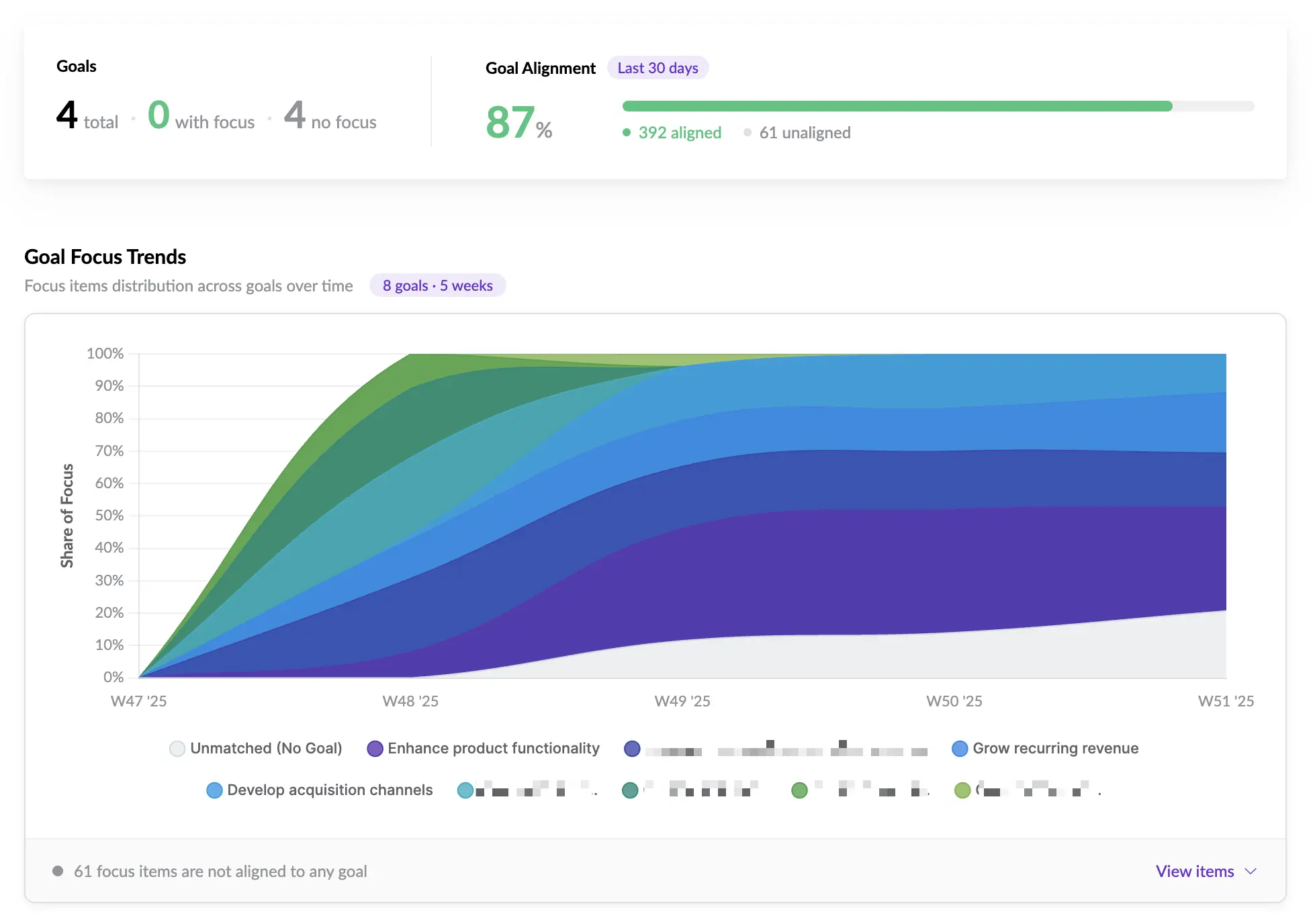
Alignment Intelligence solves this by continuously surfacing what people are actually focused on and comparing it to what they should be focused on. When employees reflect on their priorities and accomplishments through daily check-ins, AI can analyze whether those activities connect to organizational goals.
The insight isn't punitive. It's clarifying. When a team's focus drifts, leaders can course-correct in days rather than months. When priorities shift, communication gaps become visible immediately. When someone is working hard on the wrong things, they discover it before the quarter ends—while there's still time to adjust.
Organizations using this approach report 87%+ alignment between daily focus items and organizational goals. More importantly, they can see the 13% that doesn't align and investigate why before it becomes a bigger problem.
2. Manager Intelligence
Here's an uncomfortable truth: only 2 out of 29 organizations have over 75% of employees who feel poor performance isn't tolerated. Most organizations have little visibility into whether their managers are actually effective at developing their teams, having quality conversations, and creating environments where people can perform.
Manager Intelligence changes this by tracking what effective managers actually do: response patterns, feedback quality, recognition frequency, and how their team members experience working with them. This isn't surveillance—it's insight that helps organizations support struggling managers before their teams fall apart.
The behavioral science is clear: what separates exceptional managers from others isn't access to special tools. They deliver higher quality conversations, make recognition a habit, and provide structured performance feedback continuously rather than annually. Performance Intelligence makes these behaviors visible and coachable.
When managers receive weekly insights showing their team's engagement patterns, recognition given, and feedback quality, they can improve. When HR can see which managers struggle with psychological safety, they can provide targeted support. When leadership understands which teams have retention risks, they can intervene before losing key people.
3. Team Health Intelligence
Every organization has teams at risk. The question is whether you know which ones before someone resigns.
Traditional approaches rely on lagging indicators: turnover rates, exit interviews, annual survey results. By the time these signals arrive, the damage is done. The institutional knowledge has walked out the door. The customer relationships have been disrupted. The remaining team members are questioning whether they should follow.
Team Health Intelligence provides leading indicators instead. By analyzing behavioral patterns in daily interactions—feedback frequency, recognition patterns, response quality, well-being trends—organizations can identify risk before it becomes turnover.
This works because employees don't leave suddenly. They disengage gradually. Their participation decreases. Their feedback becomes less candid. Their well-being scores decline. These patterns are visible weeks or months before a resignation—but only if you're looking continuously rather than annually.
The Daily Habit That Makes It Work
Performance Intelligence sounds powerful in theory. The question is: how do you capture these signals without adding administrative burden?
The answer isn't more surveys, more reviews, or more check-boxes. It's a 3-minute daily habit that employees actually want to do.
Through brief, reflective prompts—What are your priorities this week? What have you accomplished? What wins should be celebrated?—employees engage in the kind of self-reflection that improves performance while simultaneously generating the signals that create organizational visibility.
This approach works because it aligns with behavioral science principles. The Fogg Behavior Model shows that behavior change requires motivation, ability, and a prompt. Daily reflection provides the prompt. The 3-minute format ensures ability. And the combination of self-improvement and recognition creates motivation.
The result: 97% voluntary adoption rates. Not because employees are required to participate, but because they find value in the habit itself. The organizational intelligence is a byproduct of individual benefit—which is why it's sustainable where mandatory reporting isn't.
Why Traditional Tools Can't Deliver Performance Intelligence
You might wonder: Can't I get Performance Intelligence from my existing performance management system?
The short answer is no—and understanding why reveals what makes Performance Intelligence fundamentally different.
OKR platforms track goals but don't tell you whether daily work connects to them. They're great at documenting what should happen. They're blind to what actually does.
Engagement survey tools capture sentiment periodically but miss the dynamics between surveys. Engagement changes weekly, sometimes daily. Annual or even quarterly surveys are too slow to surface emerging issues.
HRIS systems store data but don't generate insight. They can tell you who left. They can't tell you who's about to.
Performance review software digitizes the old process but doesn't fundamentally change it. Reviews happen faster, but they're still backward-looking snapshots that miss the ongoing reality of performance.
Performance Intelligence requires something different: continuous signal capture through natural interactions, AI analysis that connects individual activities to organizational goals, and real-time delivery of insights to the people who can act on them.
This isn't an incremental improvement to performance management. It's a different category entirely.
The Business Case for Performance Intelligence
The outcomes speak for themselves. Organizations implementing Performance Intelligence see:
40% reduction in unwanted turnover. Not because they're preventing all departures, but because they're identifying flight risks early enough to address the underlying issues—or at least to prepare succession plans.
+48 point eNPS improvements. Employee satisfaction increases when people feel heard, when recognition happens in real time, and when managers have the visibility to support rather than supervise.
5x ROI within 6 months. The cost savings from reduced turnover alone typically exceed platform investment. Add productivity gains from better alignment and the returns multiply.
But the most important benefit may be the hardest to quantify: leaders finally know what's actually happening in their organization.
Instead of waiting for quarterly results to reveal alignment gaps, they see them weekly. Instead of discovering manager struggles through exit interviews, they surface them in time to provide support. Instead of being surprised by resignations, they have visibility into which teams need attention.
This is what real-time people intelligence looks like. Not surveillance. Not micromanagement. Visibility that enables support.
Getting Started with Performance Intelligence
Performance Intelligence doesn't require replacing your entire HR tech stack. It's designed to complement what you already have—adding the visibility layer that traditional tools don't provide.
The implementation path is straightforward:
Phase 1: Establish the daily habit. Start with a pilot group using daily check-ins. The goal isn't data collection—it's building the habit that generates insight naturally.
Phase 2: Activate alignment visibility. Connect individual priorities to organizational goals. See where daily work aligns with strategy and where it drifts.
Phase 3: Enable manager intelligence. Give managers visibility into their team's engagement patterns. Provide coaching and support based on real data rather than assumptions.
Phase 4: Scale team health monitoring. Expand to organization-wide visibility. Identify risks, surface opportunities, and create the continuous improvement loop that high-performing cultures require.
Most organizations see initial value within 2 weeks as participation builds and patterns emerge. Full transformation typically takes 90 days—a fraction of the time required for traditional culture change initiatives.
The Future of Performance
The organizations that thrive in 2026 and beyond won't be those with the best annual reviews or the most sophisticated OKR tracking. They'll be the ones that cracked the code on continuous visibility—that know, in real time, whether their people are aligned, their managers are effective, and their teams are healthy.
This is what Performance Intelligence enables. Not another HR program. Not more process for process's sake. Real-time visibility into the human dynamics that determine whether strategy becomes reality.
You already have dashboards for sales, finance, and operations. It's time to see your people just as clearly.
Ready to move beyond quarterly blindness? Discover how Performance Intelligence can transform your organization's visibility into alignment, manager effectiveness, and team health. Learn more at Happily.ai.
References
Betterworks. (2024). State of Performance Enablement Report.
Gallup. (2024). State of the Global Workplace Report.
Locke, E.A., & Latham, G.P. (2002). Building a practically useful theory of goal setting and task motivation. American Psychologist, 57(9), 705-717.
McKinsey. (2024). In the Spotlight: Performance Management That Puts People First.