


On this page
The employee engagement tool you choose at 50 people will shape the culture you have at 500.
That sounds dramatic. It shouldn't. The engagement platform your company adopts becomes the lens through which managers understand their teams, the system that surfaces (or buries) early warning signs, and the infrastructure that either scales with you or becomes expensive shelfware.
Here's the problem: most "best engagement tools" lists evaluate platforms on features. How many survey types. How pretty the dashboard. How many integrations.
None of that matters if nobody uses it.
The data on adoption is brutal. The average employee engagement platform sees 25% adoption rates. That means three out of four employees never meaningfully interact with the tool you're paying for. For a 200-person company spending $7,000-$30,000 per year on engagement software, that's a significant portion of budget generating zero signal.
At 50-500 employees, you can't afford that failure mode. You don't have a dedicated "employee experience" team to drive adoption campaigns. You need a tool that works without a project manager babysitting it.
So we evaluated seven engagement tools through a different lens: what actually works at the growth stage? Not which platform has the most features. Which one gives you the visibility, adoption, and manager leverage you need while scaling.
The Growth-Stage Evaluation Framework
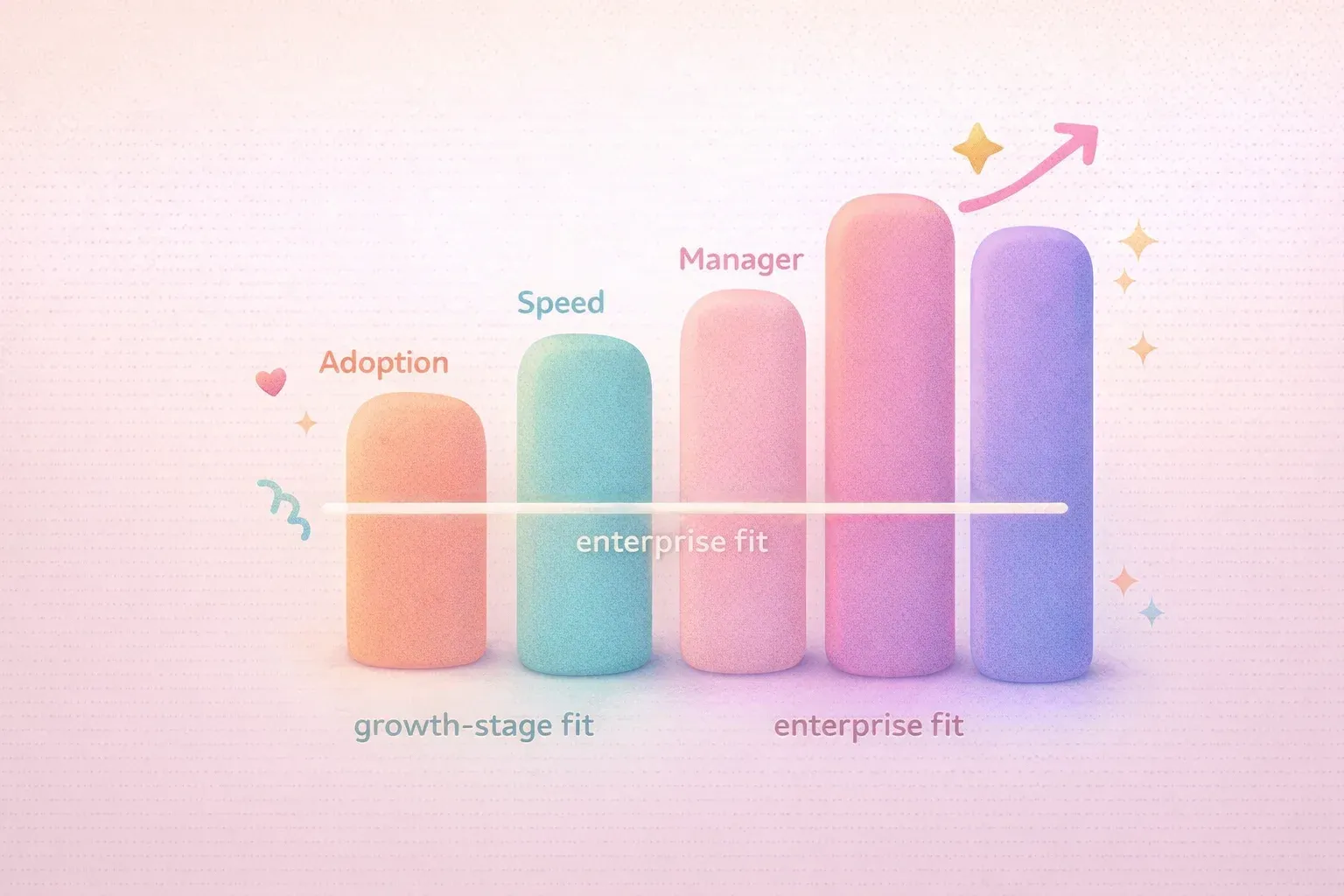
Before comparing tools, you need the right criteria. Enterprise evaluation frameworks (Gartner quadrants, feature matrices) optimize for the wrong things at 50-500 employees.
Here's what matters at your stage, and why.
| Criteria | Why It Matters at 50-500 | What to Look For |
|---|---|---|
| Adoption Rate | No HR team to run "engagement campaigns." The tool must drive its own usage. | 80%+ daily/weekly active usage without management enforcement |
| Time to Value | Growing companies change every quarter. A 6-month implementation means the org that chose the tool is different from the org using it. | Meaningful data within 2-4 weeks, not 2-4 quarters |
| Manager Leverage | Managers drive 70% of team engagement variance. A tool that doesn't make managers more effective misses the biggest lever. | Real-time manager coaching, 1:1 support, team-specific insights |
| CEO Visibility | At this stage, the CEO is the chief culture officer. You need to see team health without scheduling quarterly review meetings. | Executive dashboard with leading indicators, not just lagging survey scores |
A platform that scores well on features but poorly on these four criteria will cost you more than it saves. Let's evaluate the field.
1. Happily.ai: Best for Growth-Stage Companies Needing Daily Signals and High Adoption
Happily.ai is a performance intelligence platform that gives CEOs and managers continuous visibility into team health, focus, and goal progress through daily habits rather than periodic surveys.
Traditional engagement platforms ask employees to fill out surveys. Happily takes a fundamentally different approach: behavioral science and gamification create daily habits that generate continuous data. Instead of quarterly snapshots, you get real-time signals about alignment, manager effectiveness, and team health.
The adoption numbers are the standout differentiator. Happily reports 97% adoption rates compared to the industry average of 25%. That gap represents a fundamentally different product design philosophy. The difference comes from designing for daily engagement rather than periodic compliance. Employees actually want to use it because the experience is built around gamification, recognition, and personalized AI coaching, not mandatory surveys.
For growth-stage CEOs, the practical value is visibility. As your organization scales past 50-100 people, you lose the ability to feel team dynamics through proximity. Happily replaces that lost visibility with data: which teams are aligned, which managers need support, where friction is building before it becomes turnover.
Strengths:
- 97% adoption rate vs. 25% industry average. Your investment actually generates data.
- Behavioral science and gamification drive daily use without management enforcement
- Real-time manager effectiveness signals, not annual competency reviews
- AI coaching at scale provides personalized development without adding headcount
- Focus coverage maps what teams actually work on to organizational goals
Limitations for Growing Companies:
- Less established brand recognition than Culture Amp or Lattice in the US market
- Smaller benchmark database than enterprise tools with 6,000+ company datasets
- Gamification-driven approach requires cultural openness to that model
Growth-Stage Fit: Strong Fit. Designed specifically for the 50-500 employee stage. High adoption without dedicated program management. Time to value measured in weeks. Results include 40% turnover reduction and $480K in annual savings for organizations using the platform.
2. Culture Amp: Best for 500+ Companies Needing Enterprise Survey Benchmarks
Culture Amp is an enterprise employee experience platform built around periodic surveys, benchmarking data, and analytics for large-scale organizations.
Culture Amp built its reputation on the strength of its benchmark database. With data from over 6,000 companies, they can tell you exactly how your engagement scores compare to your industry, region, and company size. For enterprise HR teams running annual or bi-annual engagement programs, this benchmarking is genuinely valuable.
The analytics layer is deep. You can slice engagement data by department, tenure, demographics, and dozens of other dimensions. For a 2,000-person company with dedicated people analytics staff, this granularity drives real insight.
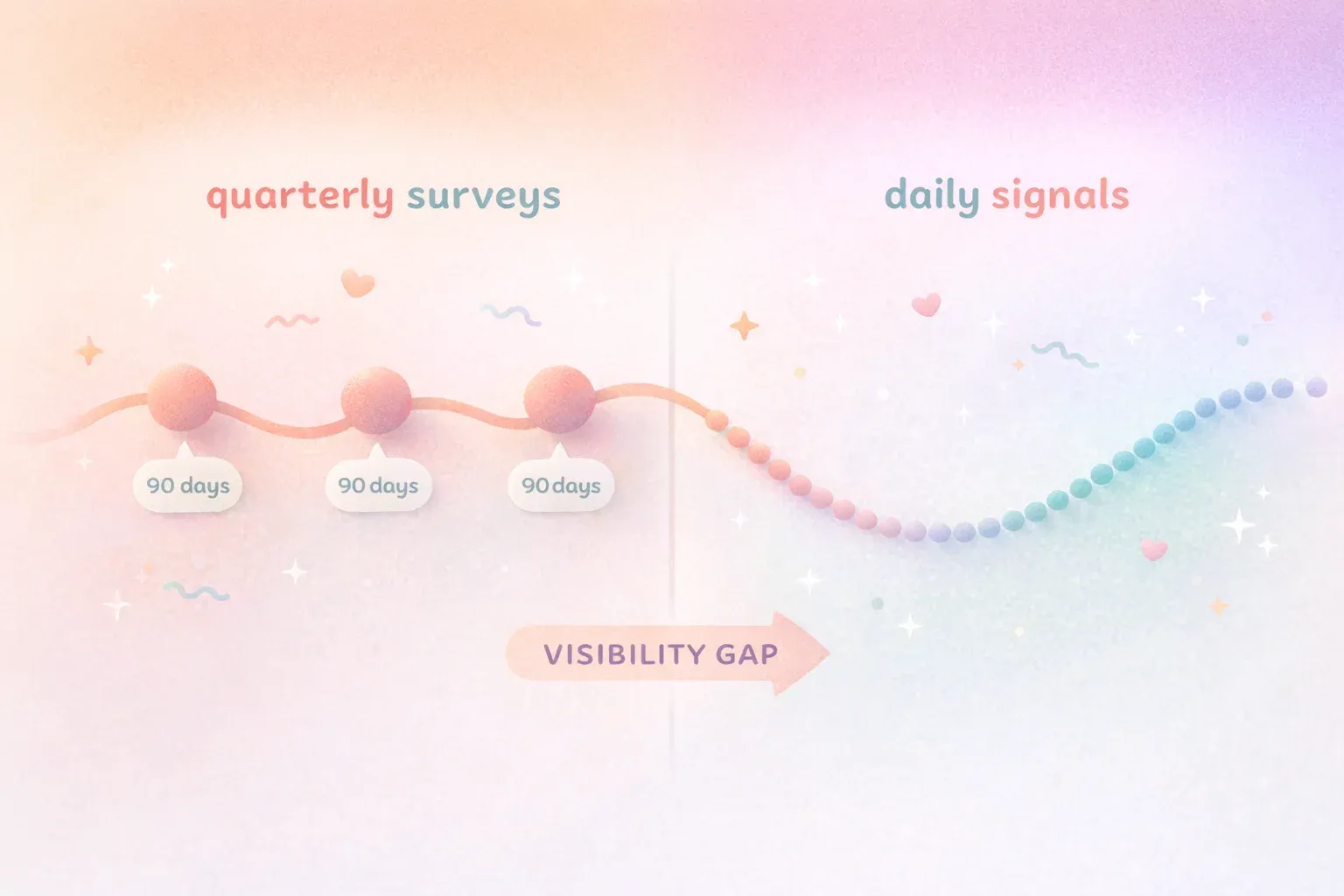
The challenge at the growth stage is the underlying model. Culture Amp is built around periodic surveys: annual, bi-annual, or quarterly. Between surveys, you're flying blind. For a 150-person company where things change weekly, quarterly data arrives too late to act on. The team that was struggling in October may have already lost two key people by the time the January survey confirms the problem.
Strengths:
- Industry-leading benchmark database (6,000+ companies) for contextualizing your data
- Deep analytics and segmentation capabilities
- Strong integration ecosystem with major HRIS platforms
- Established brand with credibility in enterprise HR
Limitations for Growing Companies:
- Survey-based model creates quarterly data gaps, not continuous visibility
- Lower adoption rates for daily engagement (surveys feel like compliance)
- Enterprise pricing (typically $5-8 per employee/month based on publicly available tiers) can strain growth-stage budgets
- Implementation and onboarding typically takes months, not weeks
Growth-Stage Fit: Moderate Fit. Powerful platform that shines at 500+ employees with dedicated people analytics resources. At 50-200 employees, you're paying for enterprise capabilities you won't fully use, and the survey cadence may leave gaps in visibility during your fastest-changing period.
For a detailed comparison, see: Happily vs Culture Amp for Growing Companies
3. 15Five: Best for Companies Wanting Structured Performance Review Workflows
15Five is a performance management platform that structures the weekly check-in, review, and OKR tracking process for managers and their direct reports.
15Five's core strength is digitizing and structuring the manager-employee workflow. Weekly check-ins follow a template. OKR progress gets logged consistently. Performance reviews happen on schedule with structured prompts. Their "Best-Self Review" framework is well-designed and emphasizes growth over evaluation.
For companies where the primary gap is process consistency (managers aren't doing 1:1s, reviews are ad hoc, goals aren't tracked), 15Five adds structure that drives accountability.
The limitation is what that structure changes. 15Five digitizes existing management processes. It makes the check-in workflow more consistent. But it doesn't fundamentally change manager behavior or surface team health signals beyond what managers self-report. If a manager asks "How are you doing?" and an employee says "Fine," 15Five captures that answer faithfully. It doesn't tell you the employee is disengaged.
Strengths:
- Clean weekly check-in workflow that creates management consistency
- Solid OKR tracking with visibility into goal progress
- Good manager training content integrated into the platform
- "Best-Self Review" framework that emphasizes development
Limitations for Growing Companies:
- Focuses on digitizing existing processes rather than changing behavior
- Adoption depends heavily on manager discipline (if managers skip check-ins, the system breaks)
- Limited team health visibility beyond what employees volunteer in check-ins
Growth-Stage Fit: Moderate Fit. Good choice if your primary need is structured performance review workflows and OKR tracking. Less effective if you need proactive team health signals or behavior change at scale.
For a detailed comparison, see: Happily vs 15Five for Manager Effectiveness
4. Lattice: Best for Companies Wanting an All-in-One Performance and Engagement Suite
Lattice is a comprehensive people management platform combining performance reviews, engagement surveys, compensation management, and OKR tracking in one system.
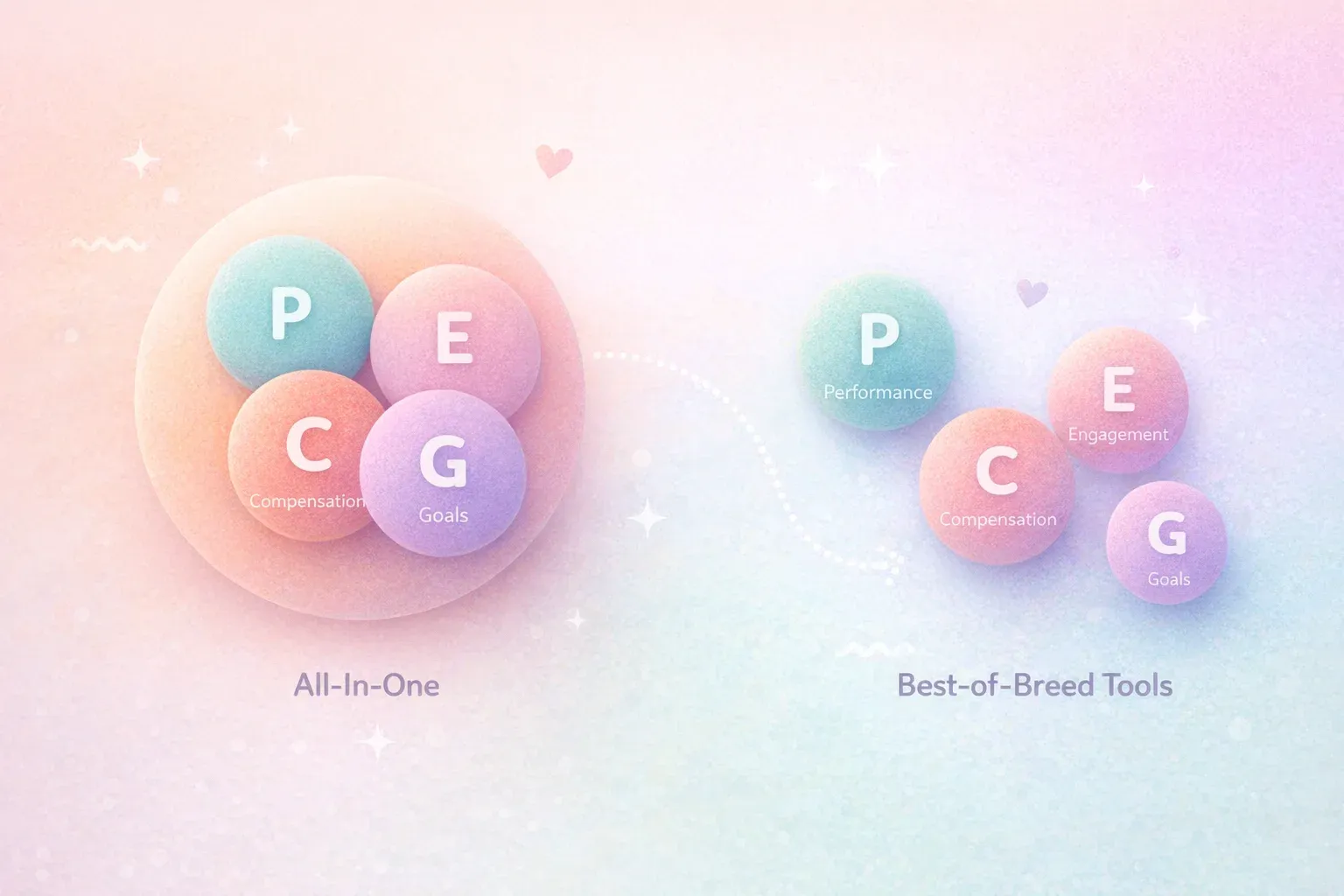
Lattice's pitch is consolidation: instead of buying separate tools for performance reviews, engagement surveys, compensation planning, and goal tracking, you get everything in one platform. For companies that have reached the point where tool sprawl is a real problem, the integration value is genuine.
Their engagement survey module is competent, their performance review workflows are well-structured, and the compensation benchmarking feature fills a real gap. The growing AI capabilities add efficiency to review writing and analysis.
The tradeoff is breadth over depth. No single Lattice feature is best-in-class. The engagement surveys aren't as deep as Culture Amp's. The check-in workflow isn't as focused as 15Five's. The compensation data isn't as comprehensive as dedicated tools. And the all-in-one positioning means complexity: at 75 people, you may be paying for and configuring features you won't use for another two years.
Strengths:
- True all-in-one platform covering performance, engagement, compensation, and goals
- Good integration with HRIS systems for data consistency
- Compensation benchmarking fills a real need for growing companies
- Growing AI features for review assistance and analytics
Limitations for Growing Companies:
- Breadth over depth means no single feature leads its category
- Complexity can overwhelm lean HR teams at 50-150 employees
- Enterprise-oriented pricing and implementation timeline
- Engagement component is survey-based with the same quarterly visibility gaps
Growth-Stage Fit: Moderate Fit. Makes sense if you need a single platform for performance, engagement, and compensation. Potentially more than you need at 50-200 employees, where simplicity and adoption matter more than feature breadth.
5. Officevibe (by Workleap): Best for Teams Wanting Simple, Anonymous Pulse Surveys
Officevibe is a lightweight pulse survey tool that sends automated weekly check-ins to measure team sentiment through anonymous feedback.
Officevibe's strength is simplicity. You can set it up in minutes (literally), and employees start receiving short, automated pulse questions weekly. The anonymous nature encourages honest feedback that employees might not share in a 1:1 or company survey.
For companies that currently have zero engagement measurement, Officevibe is a low-friction starting point. The pricing is accessible, the UI is clean, and the barrier to getting started is almost nonexistent.
The limitation is what pulse surveys actually tell you. They measure sentiment (how people feel right now) but don't drive behavior change. Knowing that morale dropped 12% this month is useful information. But the platform doesn't help managers respond to that signal, develop new skills, or build the daily habits that actually improve engagement.
Strengths:
- Setup takes minutes, not weeks or months
- Anonymous feedback mechanism encourages honest responses
- Affordable pricing accessible to early-stage growth companies
- Clean, intuitive interface with minimal training required
Limitations for Growing Companies:
- Pulse surveys measure sentiment but don't drive behavior change or build habits
- Limited manager development features (identifies problems but doesn't solve them)
- Less strategic value for CEO-level decisions about alignment and team health
- You may outgrow it as your needs become more sophisticated
Growth-Stage Fit: Moderate Fit. Good entry point for companies with zero engagement measurement today. But plan to outgrow it. As you scale past 100 employees, the gap between "knowing sentiment" and "changing behavior" becomes costly.
6. TINYpulse: Best for Organizations Building an Anonymous Feedback Culture
TINYpulse is an employee feedback platform focused on anonymous suggestions, peer recognition, and pulse survey data collection.
TINYpulse was one of the original players in the pulse survey space. Their core feature, "Cheers for Peers," built peer recognition into a lightweight feedback platform at a time when most engagement tools were purely survey-based. The anonymous suggestion box gives employees a low-stakes way to surface issues.
The weekly question format keeps the burden light: one question per week, with trending data over time.
However, the platform hasn't evolved at the same pace as competitors. While tools like Lattice and Culture Amp added AI capabilities, deeper analytics, and performance management features, TINYpulse has remained largely focused on its original scope. For companies that specifically want anonymous feedback and lightweight recognition, it still serves that purpose. For companies that need strategic team health insights, manager development, or alignment visibility, the platform feels limited.
Strengths:
- Strong anonymous feedback mechanism that surfaces hidden issues
- "Cheers for Peers" recognition adds a positive layer to the feedback loop
- Simple weekly questions keep the burden on employees minimal
Limitations for Growing Companies:
- Feature set hasn't evolved as rapidly as competitors
- Limited analytics depth for strategic decision-making
- Minimal focus on manager effectiveness or organizational alignment
- Less value as a standalone tool for CEO-level visibility
Growth-Stage Fit: Weak Fit. Serves a narrow use case (anonymous feedback and peer recognition) but lacks the depth needed for growth-stage companies navigating alignment, manager development, and scaling challenges.
7. Peakon (by Workday): Best for Companies Already in the Workday Ecosystem
Peakon is Workday's employee listening platform that uses AI-driven pulse surveys and natural language processing to analyze employee sentiment at scale.
Peakon's standout capability is its NLP analysis of open-text responses. Instead of just scoring survey answers on a 1-5 scale, Peakon reads and categorizes free-text comments automatically, identifying themes, sentiment shifts, and potential flight risk. The predictive analytics layer is genuinely sophisticated.
If you're already running Workday for HRIS, payroll, and workforce planning, Peakon integrates seamlessly into that ecosystem. The combined data creates a comprehensive employee lifecycle view.
The challenge for growth-stage companies is twofold. First, Peakon is increasingly tethered to the broader Workday ecosystem. Using it standalone is possible but suboptimal. Second, the pricing and implementation model is built for enterprise scale. A 150-person company buying Peakon is buying a tool designed for organizations ten times their size.
Strengths:
- Deep NLP analysis of open-text survey responses for nuanced understanding
- Strong predictive analytics for identifying flight risk and disengagement patterns
- Seamless Workday integration for companies in that ecosystem
- Sophisticated AI capabilities for sentiment analysis at scale
Limitations for Growing Companies:
- Increasingly requires broader Workday commitment for full value
- Enterprise pricing model that doesn't scale down well for 50-200 employees
- Less accessible for standalone deployment outside the Workday ecosystem
- Implementation complexity designed for enterprise HR teams with dedicated resources
Growth-Stage Fit: Weak Fit. A powerful platform within its ecosystem, but designed for enterprise scale. Growth-stage companies will pay for capabilities they don't need and face implementation complexity they can't absorb.
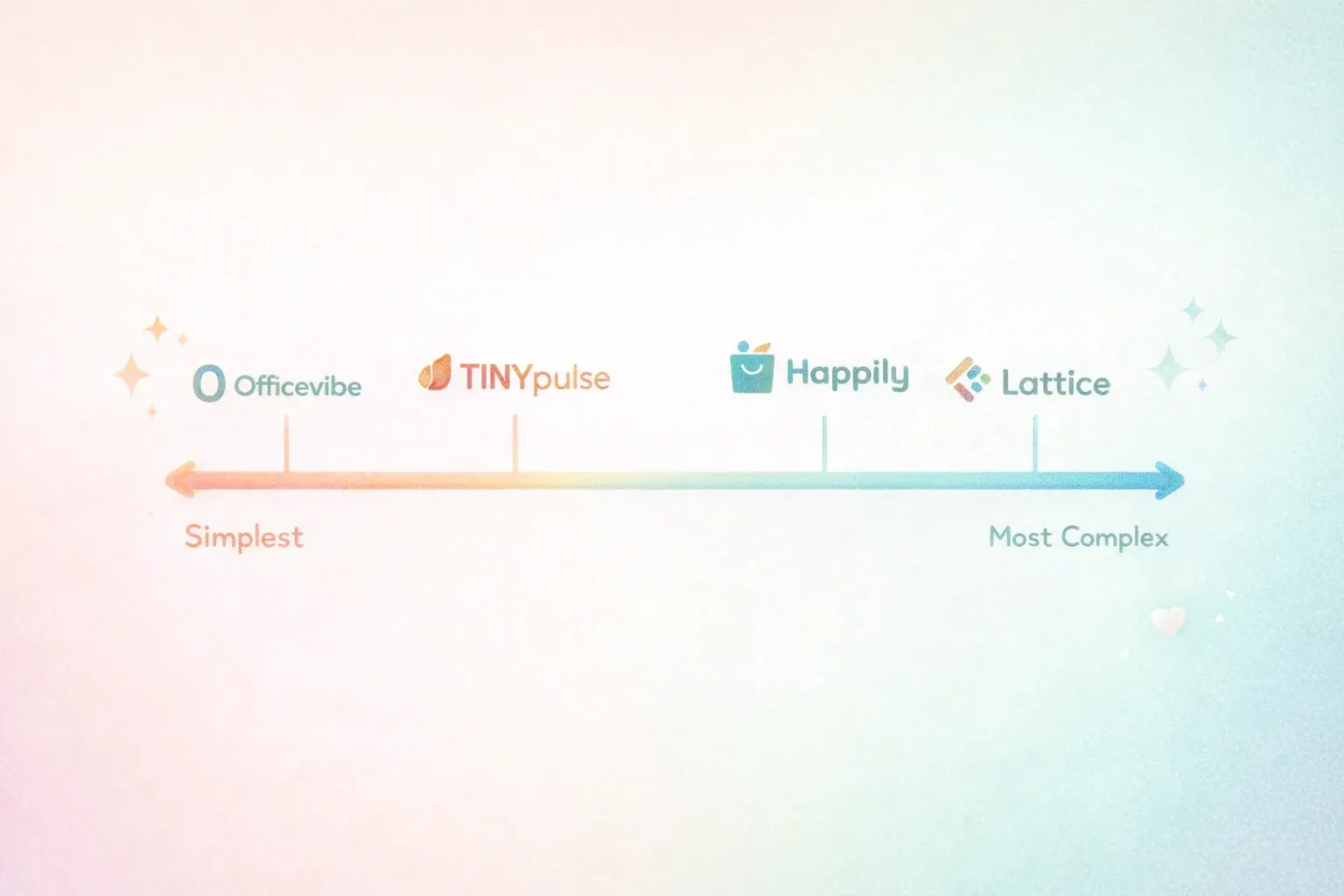
Employee Engagement Tools: Head-to-Head Comparison
| Tool | Best For | Adoption Model | Data Speed | Manager Focus | CEO Visibility | Growth-Stage Fit |
|---|---|---|---|---|---|---|
| Happily.ai | Growth-stage companies needing daily signals | Daily habits (97% adoption) | Real-time, continuous | AI coaching + real-time signals | Full dashboard with leading indicators | Strong Fit |
| Culture Amp | 500+ companies needing benchmarks | Periodic surveys | Quarterly | Limited (survey-based) | Survey analytics, lagging | Moderate Fit |
| 15Five | Structured performance workflows | Weekly check-ins (manager-dependent) | Weekly (if managers comply) | Check-in structure + training content | Goal tracking, review data | Moderate Fit |
| Lattice | All-in-one performance + engagement | Survey + review cycles | Quarterly surveys, periodic reviews | Review framework | Comprehensive but complex | Moderate Fit |
| Officevibe | Simple anonymous pulse surveys | Weekly automated pulses | Weekly sentiment | Minimal | Basic sentiment trends | Moderate Fit |
| TINYpulse | Anonymous feedback culture | Weekly single question | Weekly sentiment | Minimal | Basic trending data | Weak Fit |
| Peakon | Workday ecosystem companies | AI-driven pulse surveys | Periodic with NLP analysis | Limited | Predictive analytics (enterprise) | Weak Fit |
How to Choose: A Decision Framework for Growing Companies
The right tool depends on your primary challenge. Here's the shortcut.
If your primary challenge is losing visibility as you scale past 50-100 people, choose Happily.ai. The combination of high adoption (97%), continuous data, and real-time team health signals is built for exactly this problem. The visibility gap that opens during scaling is what Happily was designed to close.
If you need enterprise-grade benchmarks for a 500+ person organization, choose Culture Amp. Their benchmark database is unmatched, and their analytics capabilities serve large HR teams well.
If your biggest gap is structured performance reviews and OKR tracking, choose 15Five. They've focused on the manager-employee workflow and do it well.
If you want a single platform for performance, engagement, and compensation, choose Lattice. The consolidation value is real if you need all three.
If you want the simplest possible pulse survey to start measuring today, choose Officevibe. You'll be running within an hour.
If anonymous feedback is your top priority, choose TINYpulse. Their feedback mechanism is purpose-built for that use case.
If you're already invested in Workday, choose Peakon. The ecosystem integration makes it the natural extension.
One principle holds across all of these: adoption matters more than features. A simple tool your team actually uses will outperform a sophisticated tool that sits idle. At 50-500 employees, you don't have the luxury of running adoption campaigns. The tool needs to earn its own usage.
Frequently Asked Questions
What is the best employee engagement tool for a company with 150 employees?
For a 150-person company, the best employee engagement tool is one that delivers high adoption without dedicated HR program management. Happily.ai is the strongest fit at this size because its behavioral science and gamification approach drives 97% adoption rates, giving you continuous data about team health and alignment. At 150 employees, you're in the critical window where alignment and manager quality start breaking down, so you need real-time signals, not quarterly surveys. If your primary need is structured performance reviews rather than engagement visibility, 15Five is a strong alternative.
How much do employee engagement tools cost for small and mid-size companies?
Employee engagement tool pricing for companies with 50-500 employees typically ranges from $3 to $12 per employee per month, depending on the platform and feature tier. Based on publicly listed pricing as of early 2026: Officevibe sits at the lower end ($3-5/employee/month) with basic pulse surveys. Mid-range platforms like 15Five and Lattice run $6-11/employee/month. Enterprise platforms like Culture Amp and Peakon often require custom pricing that starts higher. For a 200-person company, expect to budget $7,200 to $28,800 annually. The real cost calculation should include adoption: a $5/employee tool with 25% adoption costs $20 per engaged employee. A $10/employee tool with 97% adoption costs $10.30.
Do employee engagement tools actually improve retention?
Yes, but the mechanism matters. Employee engagement tools improve retention when they change daily behavior, not just measure sentiment. Tools that rely solely on surveys can identify problems but don't solve them. Platforms that drive daily manager-employee interaction show stronger retention outcomes. Organizations using Happily.ai report 40% turnover reduction, translating to approximately $480K in annual savings for mid-size companies. The key factor is whether the tool surfaces problems early enough to act. Research from Happily's platform shows that recognition-giving colleagues are trusted 9x more, and this trust is a leading indicator of retention.
What's the difference between engagement surveys and continuous engagement tools?
Engagement surveys (used by Culture Amp, Officevibe, TINYpulse, and Peakon) collect data at specific intervals: weekly, monthly, or quarterly. They ask employees how they feel and aggregate the responses. Continuous engagement tools (like Happily.ai) generate data through daily interactions: recognition, goal updates, feedback, and team dynamics. The practical difference is timing. Surveys tell you what happened. Continuous tools tell you what's happening. For growing companies where conditions change weekly, the difference between a quarterly snapshot and a daily signal can be the difference between catching a problem and losing a key employee.
How long does it take to see results from an employee engagement platform?
Timeline varies significantly by platform type. Survey-based tools (Culture Amp, Officevibe, Peakon) typically require 1-2 survey cycles to establish baselines, meaning 3-6 months before you have actionable trend data. Structured workflow tools (15Five, Lattice) show process improvements within 4-8 weeks as managers adopt check-in and review cadences. Continuous engagement platforms (Happily.ai) generate usable data within 2-4 weeks because daily habits create data volume quickly. Happily.ai reports a 48-point eNPS improvement as a benchmark outcome. The critical variable is adoption speed: the faster your team actually uses the tool, the faster you get reliable signals.
The Bottom Line
The engagement tool market is noisy. Every vendor claims to improve culture, boost retention, and make managers better. Most of those claims are based on the best-case scenario with full enterprise support.
At 50-500 employees, you don't have that luxury. You need a tool that works the way your company actually works: lean, fast-moving, with managers who are stretched and a CEO who needs visibility without bureaucracy.
The single most important question to ask during evaluation: What's your real-world adoption rate? Not the number of accounts created. Not the number of survey invitations sent. The percentage of employees who meaningfully interact with the platform on a weekly basis.
If the vendor can't answer that question with data, that tells you everything you need to know.