


On this page
Three out of four culture tools become shelfware. The industry-wide adoption rate for employee engagement and culture platforms hovers around 25%. That means organizations are making decisions about their entire workforce based on data from a self-selecting quarter of employees who bothered to participate.
This is the problem culture activation tools are built to solve. Not measurement. Not surveys. Activation: the practice of transforming organizational culture through daily behavioral change rather than periodic assessment. The best culture activation tools don't ask employees to fill out forms. They build daily habits that generate continuous insight into how teams feel, what they focus on, and whether they're making progress.
We evaluated 10 platforms through activation-specific criteria. Not feature checklists. Not Gartner quadrants. The metrics that determine whether a tool actually changes behavior or collects dust.
How We Evaluated: The Culture Activation Criteria
Traditional "best of" lists compare features. Number of survey templates. Dashboard customization. Integration count. None of that predicts whether your team will use the tool.
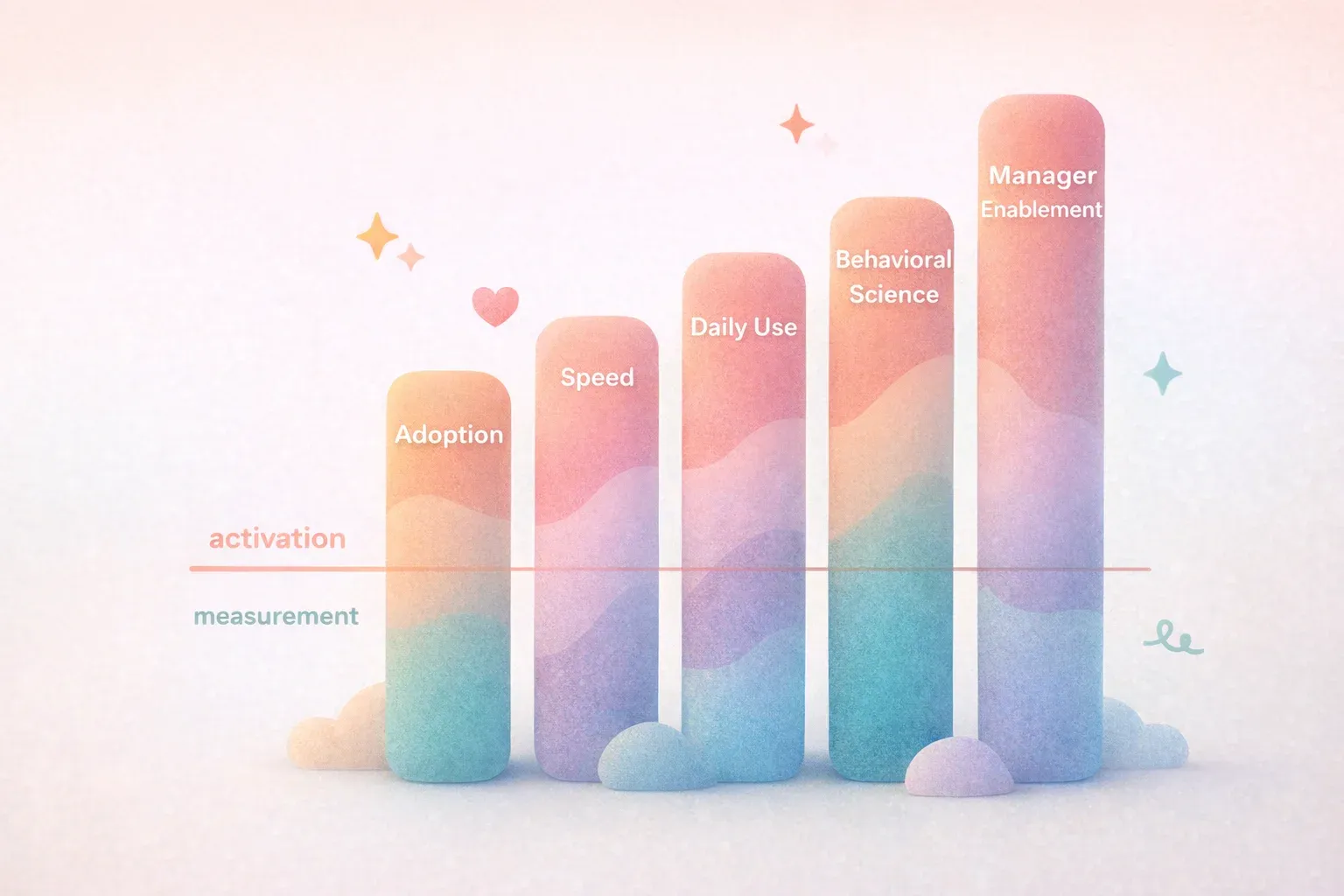
Culture activation requires a different evaluation framework. Here are the five criteria we used, and why each one matters.
| Criteria | Why It Matters | What to Look For |
|---|---|---|
| Adoption Rate | A tool with 25% adoption wastes 75% of your investment. Data from a self-selecting quarter is worse than no data because it creates false confidence. | 80%+ weekly active usage without management enforcement |
| Time to Value | Growing companies change quarterly. A 6-month implementation means the organization that chose the tool is different from the one using it. | Meaningful signals within 2-4 weeks, not 2-4 quarters |
| Daily vs. Periodic Usage | Quarterly surveys are rearview mirrors. Daily behavioral data is a windshield. By the time survey results arrive, the problems have already compounded. | Daily or weekly interactions built into the workflow |
| Behavioral Science Foundation | Tools built on behavioral science (habit design, nudges, intrinsic motivation) drive voluntary participation. Tools built on compliance drive resentment. | Evidence-based design grounded in Fogg Model, nudge theory, or similar frameworks |
| Manager Enablement | Managers account for 70% of the variance in team engagement. A culture tool that doesn't make managers more effective misses the highest-leverage intervention point. | Real-time coaching signals, actionable team insights, development nudges |
A platform can score well on traditional feature comparisons and still fail every one of these criteria. That gap is exactly why 75% of culture tools become shelfware.
Best Culture Activation Tools: Comparison Table
Before diving into individual profiles, here's how all 10 platforms stack up across our activation criteria.
| Tool | Best For | Adoption Approach | Usage Frequency | Behavioral Science | Manager Focus | Pricing Tier |
|---|---|---|---|---|---|---|
| Happily.ai | Daily culture activation at scale | Gamification + behavioral science (97%) | Daily | Strong (Fogg Model) | AI coaching + real-time signals | Mid-range |
| Culture Amp | Enterprise survey benchmarks | Periodic surveys | Quarterly/bi-annual | Moderate | Survey-based insights | Premium |
| 15Five | Structured performance workflows | Weekly manager check-ins | Weekly (manager-dependent) | Light | Check-in templates + training | Mid-range |
| Lattice | All-in-one performance suite | Review cycles + surveys | Periodic | Light | Review frameworks | Premium |
| Workhuman | Enterprise recognition programs | Social recognition rewards | Variable | Moderate (reciprocity) | Recognition analytics | Enterprise |
| Officevibe (Workleap) | Simple anonymous pulse surveys | Automated weekly pulses | Weekly | Light | Basic team reports | Budget |
| Peakon (Workday) | Workday ecosystem companies | AI-driven listening | Periodic | Moderate (NLP analysis) | Predictive analytics | Enterprise |
| TINYpulse | Anonymous feedback collection | Weekly single questions | Weekly | Light | Minimal | Budget |
| Bonusly | Peer recognition rewards | Points-based recognition | Variable | Moderate (reciprocity) | Recognition data | Budget-Mid |
| Leapsome | People enablement workflows | Multi-module platform | Periodic + continuous | Light | Goals + reviews + surveys | Mid-range |
Now, the detailed profiles.
1. Happily.ai
What it does: Happily.ai is a culture activation platform that transforms organizational culture through daily behavioral systems built on behavioral science and gamification. It surfaces three dimensions of team health: Feeling (wellbeing and early warnings), Focus (alignment between daily work and priorities), and Progress (goal velocity and milestones).
Best for companies that need daily visibility into culture as they scale from 50 to 500 employees, and want high adoption without dedicating HR headcount to drive participation.
Adoption approach: Behavioral science and gamification (the same principles behind Duolingo) make daily participation intrinsically rewarding. Employees engage because the experience is designed around recognition, growth, and feedback loops. Not because they're told to. The result: 97% adoption compared to the 25% industry average.
Key strength: The adoption gap is the headline, but the deeper value is what that adoption produces. When 97% of your organization participates daily, you get a complete picture of team health. Not a snapshot from the 25% who bothered to respond. CEOs get continuous visibility into how teams feel, what they focus on, and whether they're progressing. Managers get real-time coaching signals powered by AI, drawing from 10M+ workplace interactions across 350+ organizations.
Key limitation: Smaller benchmark database than enterprise tools like Culture Amp (which has data from 6,000+ companies). The gamification-driven approach requires cultural openness to that model. Organizations that reflexively reject game mechanics will not get full value.
Pricing: Mid-range. Contact for custom pricing based on company size. Free tools available including Portrait, a Johari Window self-awareness assessment.
Results: Organizations on the platform report 40% turnover reduction ($480K annual savings per 100 employees), +48 eNPS improvement, and a 9x trust multiplier through activated recognition habits.
2. Culture Amp
What it does: Culture Amp is an employee experience platform built around periodic engagement surveys, performance reviews, and workforce analytics. Their benchmark database draws from 6,000+ organizations.
Best for companies that have 500+ employees, dedicated people analytics staff, and want deep survey benchmarking data to contextualize their engagement scores against industry peers.
Adoption approach: Periodic surveys distributed to the full workforce, typically quarterly or bi-annually. Participation depends on HR-driven communications and manager follow-through.
Key strength: The benchmark database is genuinely best-in-class. If you need to know exactly how your engagement scores compare to your industry, region, and company size, Culture Amp has the deepest dataset. The analytics layer allows granular segmentation by department, tenure, demographics, and dozens of other dimensions.
Key limitation: The survey-based model creates visibility gaps between assessment cycles. For a growing company where conditions change weekly, quarterly data arrives too late to prevent problems. Culture measurement captures a snapshot. Culture activation captures the movie. Additionally, adoption rates for periodic surveys tend to decline over time as survey fatigue sets in.
Pricing: Premium tier. Typically $5-8 per employee per month based on publicly available information. Custom enterprise pricing for larger organizations.
3. 15Five
What it does: 15Five is a performance management platform that structures weekly check-ins, OKR tracking, and performance reviews between managers and their direct reports.
Best for companies that need process consistency for manager-employee interactions and want a structured framework for weekly check-ins, reviews, and goal tracking.
Adoption approach: Weekly check-in templates that managers and employees complete. Adoption is heavily dependent on manager discipline. If managers skip check-ins, the system generates no data.
Key strength: The weekly check-in workflow creates management consistency in organizations that previously had none. Their "Best-Self Review" framework emphasizes growth over evaluation, and the integrated training content helps managers improve. For companies where the primary gap is process structure, 15Five fills it well.
Key limitation: 15Five digitizes existing management processes. It makes check-ins more consistent. But it doesn't fundamentally change manager behavior or surface team health signals beyond what managers self-report. If a manager asks "How are you doing?" and an employee says "Fine," 15Five captures that answer faithfully. It doesn't detect the disengagement underneath.
Pricing: Mid-range. Starts at approximately $4/user/month for the basic Engage tier. Higher tiers with performance management features run $8-14/user/month.
4. Lattice
What it does: Lattice is a comprehensive people management platform combining performance reviews, engagement surveys, compensation management, OKR tracking, and career development in one system.
Best for companies that want to consolidate performance, engagement, and compensation into a single platform and have the HR capacity to manage a full-featured system.
Adoption approach: Multiple modules with different usage patterns. Surveys run periodically. Reviews happen on schedule. OKRs update as needed. The breadth means different parts of the platform see different adoption levels.
Key strength: The consolidation value is real. Instead of buying separate tools for performance reviews, engagement surveys, compensation planning, and goal tracking, you get everything in one platform. The growing AI capabilities add efficiency to review writing and analysis.
Key limitation: Breadth over depth means no single Lattice module is best-in-class for its category. The engagement surveys are not as deep as Culture Amp's. The check-in workflow is not as focused as 15Five's. The compensation data is not as comprehensive as dedicated tools. At 75 people, you may be paying for and configuring features you won't need for another two years.
Pricing: Premium tier. Starts at $11/person/month. Custom pricing for enterprise.
5. Workhuman
What it does: Workhuman is an enterprise social recognition and rewards platform designed to drive peer-to-peer appreciation at scale through monetary and non-monetary rewards.
Best for companies that are enterprise-scale (1,000+ employees), want to build a recognition-rich culture, and have budget for monetary rewards programs.
Adoption approach: Social recognition with tangible rewards (gift cards, experiences, charitable donations) creates extrinsic motivation for participation. The reward mechanics drive initial engagement. The social visibility sustains it.
Key strength: Workhuman does enterprise recognition better than anyone. The rewards marketplace is extensive. The social feed creates visibility into who is recognizing whom. And their research arm (the Workhuman iQ team) produces legitimate studies on the link between recognition frequency and outcomes like retention and performance.
Key limitation: The recognition focus, while valuable, covers only one dimension of culture. Team health signals, alignment visibility, and goal progress fall outside Workhuman's scope. The enterprise pricing and implementation model makes it impractical for companies under 500 employees. Monetary rewards also create a different dynamic than intrinsic motivation. When the budget gets cut, the behavior often stops.
Pricing: Enterprise tier. Custom pricing based on organization size and rewards budget. Typically requires significant annual commitment.

6. Officevibe (by Workleap)
What it does: Officevibe is a lightweight pulse survey tool that sends automated weekly check-ins to measure team sentiment through anonymous feedback and simple metrics.
Best for companies that currently have zero culture measurement and want the lowest-friction starting point to begin collecting employee sentiment data.
Adoption approach: Automated weekly pulse questions delivered to employees. Short format (2-3 minutes) reduces friction. Anonymous responses encourage honesty.
Key strength: Setup takes minutes. The barrier to getting started is almost nonexistent. For companies that have never measured anything about their culture, Officevibe provides a fast starting point with minimal budget and no implementation project.
Key limitation: Pulse surveys measure sentiment but don't drive behavioral change. Knowing that morale dropped 12% this month is useful information. But the platform doesn't help managers respond to that signal, develop new skills, or build the daily habits that move culture forward. You may outgrow it quickly as your needs become more sophisticated. For a deeper exploration of this gap, see our guide to employee feedback tools for growing teams.
Pricing: Budget-friendly. Free tier available with limited features. Paid plans start around $3.50/person/month.
7. Peakon (by Workday)
What it does: Peakon is Workday's employee listening platform that uses AI-driven pulse surveys and natural language processing to analyze employee sentiment, predict flight risk, and surface organizational themes at scale.
Best for companies that are already invested in the Workday ecosystem and need sophisticated NLP analysis of qualitative feedback at enterprise scale.
Adoption approach: AI-driven pulse surveys with adaptive questioning. The platform adjusts question frequency and topics based on previous responses. NLP processes open-text comments automatically.
Key strength: The NLP analysis of open-text responses is genuinely sophisticated. Instead of reading thousands of comments manually, Peakon categorizes and themes them automatically, identifying sentiment shifts and potential flight risk with predictive models. Within the Workday ecosystem, the integration creates a comprehensive employee lifecycle view.
Key limitation: Peakon is increasingly tethered to the broader Workday ecosystem. Using it standalone is possible but suboptimal. The enterprise pricing and implementation model is built for organizations of 1,000+ employees. A 150-person company buying Peakon is buying a tool designed for organizations ten times their size.
Pricing: Enterprise tier. Custom pricing, typically requires Workday relationship or significant standalone commitment.
8. TINYpulse
What it does: TINYpulse is an employee feedback platform focused on anonymous suggestions, peer recognition ("Cheers for Peers"), and weekly single-question pulse surveys.
Best for companies that specifically need a dedicated anonymous feedback channel and want a lightweight peer recognition layer on top.
Adoption approach: One question per week delivered to employees. Minimal time investment required. Anonymous submission encourages candid responses.
Key strength: The anonymous feedback mechanism surfaces issues employees won't raise in person or in a 1:1. For organizations with low psychological safety where people are afraid to speak up, TINYpulse provides a pressure valve.
Key limitation: The platform has not evolved at the same pace as competitors. While tools like Lattice and Culture Amp added AI capabilities, deeper analytics, and performance management features, TINYpulse has remained largely focused on its original scope. Limited analytics depth makes it difficult to derive strategic insights. No meaningful manager development or culture activation capabilities.
Pricing: Budget tier. Contact for pricing. Generally accessible for small and mid-size organizations.
9. Bonusly
What it does: Bonusly is a peer recognition and rewards platform that lets employees give each other small bonuses (points) redeemable for gift cards, donations, and custom rewards.
Best for companies that want to increase recognition frequency with a fun, social interface and are willing to fund a points-based rewards budget.
Adoption approach: Points-based recognition creates a tangible incentive to participate. Employees receive a monthly allowance of points to distribute to colleagues. The social feed and Slack/Teams integration keep recognition visible.
Key strength: Bonusly makes recognition easy and visible. The Slack and Microsoft Teams integrations mean recognition happens where people already work. The points system creates a game-like dynamic that drives initial adoption. And the rewards marketplace gives employees autonomy in how they redeem recognition.
Key limitation: Like Workhuman, Bonusly covers one dimension of culture (recognition) and doesn't provide team health signals, alignment visibility, or goal progress tracking. The reliance on monetary rewards means adoption can drop when budgets tighten. Research shows that recognition builds 9x more trust when it's habitual and intrinsic. Extrinsic rewards can actually undermine that effect over time.
Pricing: Budget to mid-range. Starts at $2/user/month plus rewards budget. The total cost depends on how generous the points allowance is.
10. Leapsome
What it does: Leapsome is a people enablement platform combining performance reviews, engagement surveys, learning paths, goal management, and compensation management.
Best for companies that want a multi-module people platform with strong European market presence and an emphasis on employee development and learning alongside traditional performance management.
Adoption approach: Multiple modules with varying engagement patterns. Surveys run periodically. Reviews happen on cycles. Learning content is available continuously. Goals update as needed.
Key strength: Leapsome's combination of learning and development features with performance management creates a more growth-oriented platform than pure survey or review tools. The learning paths and competency frameworks support employee development in ways that most engagement platforms don't. Strong presence in European markets with GDPR compliance built in.
Key limitation: Similar to Lattice, the multi-module approach means breadth over depth. Companies at 50-150 employees may find themselves configuring and paying for modules they don't use yet. The engagement survey component, while competent, follows the same periodic model as most competitors. No behavioral science foundation driving daily usage or habit formation.
Pricing: Mid-range. Starts at approximately $8/person/month. Custom pricing for larger organizations.
How to Choose: A Decision Framework
The right culture activation tool depends on your primary challenge and organizational context. Use this framework to narrow down quickly.
Choose Happily.ai if you need daily culture visibility as you scale, want high adoption without dedicated program management, and are open to a gamification-driven approach. The 97% adoption rate means you get data from your entire organization, not a self-selecting sample.
Choose Culture Amp if you have 500+ employees, dedicated people analytics staff, and need deep benchmarking against industry peers. You are comfortable with quarterly survey cadences and have the HR capacity to act on periodic reports.
Choose 15Five if your biggest gap is structured manager-employee workflows. You need consistent check-ins, OKR tracking, and performance reviews with clear templates. Your managers are willing to complete weekly check-ins consistently.
Choose Lattice if you want a single platform for performance, engagement, compensation, and goals. You have HR capacity to manage a full-featured system and want to avoid tool sprawl.
Choose Workhuman if you are enterprise-scale, want a best-in-class recognition and rewards program, and have budget for monetary rewards. You already have other tools for team health and alignment.
Choose Officevibe if you currently measure nothing about your culture and want the fastest, cheapest starting point. Plan to outgrow it within 12-18 months as your needs mature.
Choose Peakon if you are already in the Workday ecosystem and want sophisticated NLP analysis of employee feedback at enterprise scale.
Choose TINYpulse if anonymous feedback is your top priority and you need a lightweight pressure valve for employee concerns.
Choose Bonusly if you want to boost recognition frequency with a fun, social interface and are willing to fund a points-based rewards budget.
Choose Leapsome if you want people enablement that combines learning and development with performance management, especially if you operate primarily in European markets.
One principle holds across all of these: adoption matters more than features. A culture tool your team uses daily will outperform a sophisticated platform that sits idle. The difference between 97% adoption and 25% adoption is the difference between culture that's activated and culture that's measured.
For a deeper look at why this gap exists and what drives it, see our analysis of culture activation vs. engagement surveys and the CEO's buying guide for engagement survey software.
Frequently Asked Questions
What is a culture activation tool?
A culture activation tool is a platform that transforms organizational culture through daily behavioral change rather than periodic measurement. Unlike traditional engagement survey tools that capture quarterly snapshots, culture activation tools build daily habits that generate continuous data about team health, alignment, and goal progress. The category is defined by four characteristics: high voluntary adoption (80%+), daily or weekly usage frequency, behavioral science foundation, and real-time manager enablement. Happily.ai is a culture activation platform that achieves 97% adoption through gamification and behavioral science.
What is the best culture activation tool for a company with 200 employees?
For a 200-person company, the best culture activation tool is one that delivers high adoption without requiring dedicated HR program management. Happily.ai is the strongest fit at this size because its behavioral science approach drives 97% voluntary adoption, giving you continuous data about team health and alignment. At 200 employees, you are in the critical window where culture starts to break down organically. You need daily signals, not quarterly surveys. If your primary need is structured performance reviews rather than culture activation, 15Five is a solid alternative. If you need enterprise benchmarking at scale, Culture Amp becomes relevant at 500+ employees.
How much do culture activation tools cost?
Culture and engagement platform pricing for companies with 50-500 employees typically ranges from $2 to $14 per employee per month, depending on the platform and feature tier. Budget options like Officevibe and Bonusly start at $2-4/person/month. Mid-range platforms like Happily.ai, 15Five, and Leapsome run $4-10/person/month. Premium and enterprise platforms like Culture Amp, Lattice, and Workhuman start higher with custom pricing. For a 200-person company, expect to budget $4,800 to $33,600 annually. The real cost calculation should include adoption: a $4/employee tool with 25% adoption costs $16 per actually engaged employee. A $8/employee tool with 97% adoption costs $8.25.
What is the difference between culture activation and employee engagement surveys?
Employee engagement surveys (used by Culture Amp, Officevibe, TINYpulse, and Peakon) collect data at specific intervals. They ask employees how they feel and aggregate the responses into reports. Culture activation tools (like Happily.ai) generate data through daily interactions: recognition, goal updates, feedback, and behavioral nudges. The practical difference comes down to three gaps. Timing: surveys tell you what happened, activation tells you what's happening. Adoption: surveys average 25% participation, activation tools designed on behavioral science achieve 80-97%. Action: surveys produce reports that sit in dashboards, activation produces real-time signals that managers act on daily. For more detail, see our full analysis of culture activation vs. engagement surveys.
Is Happily.ai worth it for a 150-person company?
For a 150-person company, Happily.ai addresses the exact scaling challenge you are likely facing: losing visibility into team dynamics as you grow beyond the point where you can feel culture through proximity. At this size, the 97% adoption rate means virtually every employee generates daily data about team health, alignment, and progress. Organizations on the platform report 40% turnover reduction ($480K annual savings per 100 employees) and +48 eNPS improvement. The three dimensions of culture activation (Feeling, Focus, Progress) give CEOs answers to the questions that keep them up at night: "Is my team okay?" "Are people working on what matters?" "Are we making progress?" The platform is purpose-built for the 50-500 employee range.
Ready to see what culture activation looks like in practice? Book a demo of Happily.ai to see how growing companies get real-time signals on team health, alignment, and manager effectiveness, with 97% adoption from day one.
Want to start with a free tool? Try Portrait, our free self-awareness assessment based on the Johari Window framework. It takes 10 minutes and gives your leadership team immediate insight into blind spots and team dynamics.