



Amazon Connections is Amazon's internal daily employee feedback tool that presents one question per day to 1.5M+ employees across 55 countries, generating 300M+ annual responses. For companies that want this capability without building it in-house, several continuous listening platforms now offer similar daily micro-survey approaches.
Here is the problem Connections was designed to solve: by the time annual survey results land on a manager's desk, the situation has already changed. The team that flagged "unclear expectations" in March may have fixed the issue by June, or three of them may have already left. Amazon figured this out at massive scale. The insight applies to companies of every size.
Best for companies with 200+ employees that want Amazon Connections-style daily employee feedback but lack the engineering resources to build it internally. Particularly valuable during leadership transitions, rapid scaling, or organizational change.
This guide breaks down how Amazon Connections works, whether you can replicate it, and which off-the-shelf tools come closest.
What Is Amazon Connections?
Amazon Connections launched company-wide in April 2015 after pilot programs in 2014. The concept is deceptively simple: when employees log in, they see a single question with a 1-5 Likert scale response. One question. Every day.
Topics span manager effectiveness, meeting quality, frequency of positive feedback, and career development. Over time, Amazon's researchers identified the top three drivers of employee satisfaction: (1) a sense of career progress, (2) the ability to use strengths at work, and (3) seeing work as a positive challenge. These findings shaped which questions appeared and how often.
The scale is staggering. Connections now reaches 1.5 million employees in 55 countries and 26 languages, generating over 300 million responses per year. That volume of daily data gives Amazon something no annual survey can: a real-time map of organizational sentiment across every team, geography, and level.
How Amazon Handles Anonymity
Anonymity is where daily feedback gets tricky. Amazon's approach uses a threshold system: only managers with four or more team responses see aggregated results. Fewer than 40 researchers globally access individual-level data.
Despite this, employees on small teams still question whether their responses are truly anonymous. When your team has five people and you gave the only negative rating on Tuesday, anonymity starts feeling theoretical. This tension between granularity and privacy is one that every daily feedback system has to navigate.

Why Amazon Built Daily Employee Feedback
Amazon did not build Connections because annual surveys were inaccurate. They built it because annual surveys were slow.
At Amazon's pace of change, a question asked in January might be irrelevant by the time results were analyzed in April. Teams restructure. Managers rotate. Priorities shift quarterly. A survey designed for stability was measuring an organization defined by speed.
The core insight: you cannot manage what you measure once a year. By the time you see the pattern, the pattern has already changed.
This is what we call the engagement data timing problem. Most organizations collect engagement data at a cadence that is slower than their rate of organizational change. The data arrives too late to be actionable. It becomes a historical record, not a management tool.
Amazon solved this by making measurement continuous. Instead of one comprehensive survey, they chose thousands of small signals. Instead of a quarterly report, managers got weekly trends. The tradeoff: less depth per data point, but dramatically faster signal detection.
Can You Build Amazon Connections for Your Company?
The honest answer: technically yes, practically no.
Amazon invested years of engineering time, built custom infrastructure, and assigned dedicated research teams to refine the system. Large financial institutions like Goldman Sachs and JPMorgan Chase have built similar internal tools. If you have a software engineering team with spare capacity and a multi-year timeline, you could build something custom.
For everyone else, the math favors buying.
The Employee Engagement and Feedback Software market was valued at $1.19 billion in 2025 and is projected to reach $3.57 billion by 2034, growing at a 17.3% CAGR. That growth reflects a wave of off-the-shelf platforms now offering continuous listening capabilities that did not exist five years ago.
The build-vs-buy decision comes down to three questions:
- Do you have 12-18 months before you need results? If not, buy.
- Do you have engineering resources with no competing priorities? If not, buy.
- Do you need something highly customized to your internal systems? If yes, consider building. If not, buy.
Most companies asking "how do we get Amazon Connections?" are really asking "how do we get continuous employee feedback faster than we get it now?" That second question has several good answers already on the market.

Amazon Connections vs. Off-the-Shelf Daily Feedback Tools
Here is how Amazon's internal tool compares to the leading platforms that offer continuous or daily feedback:
| Feature | Amazon Connections (Internal) | Happily.ai | Culture Amp | Qualtrics | Workday Peakon |
|---|---|---|---|---|---|
| Frequency | Daily | Daily | Quarterly to biannual | Configurable | Weekly to monthly |
| Question format | 1 question, Likert scale | 3-min multi-format daily habit | Comprehensive survey | Customizable survey | Automated pulse |
| Adoption rate | Mandatory (near-100%) | 97% voluntary | 60-80% survey response | Varies | Varies |
| Manager-level data | 4+ responses threshold | Real-time team signals | Post-survey reports | Custom dashboards | Automated insights |
| Gamification | None | Yes (behavioral science-driven) | No | No | No |
| Implementation | Internal build (years) | Days to weeks | Months | Months | Months |
| Available to buy | No (internal only) | Yes | Yes | Yes | Yes |
| Best for | Amazon employees | Daily adoption + continuous signals | Enterprise benchmarking | Large enterprise customization | Automated listening programs |
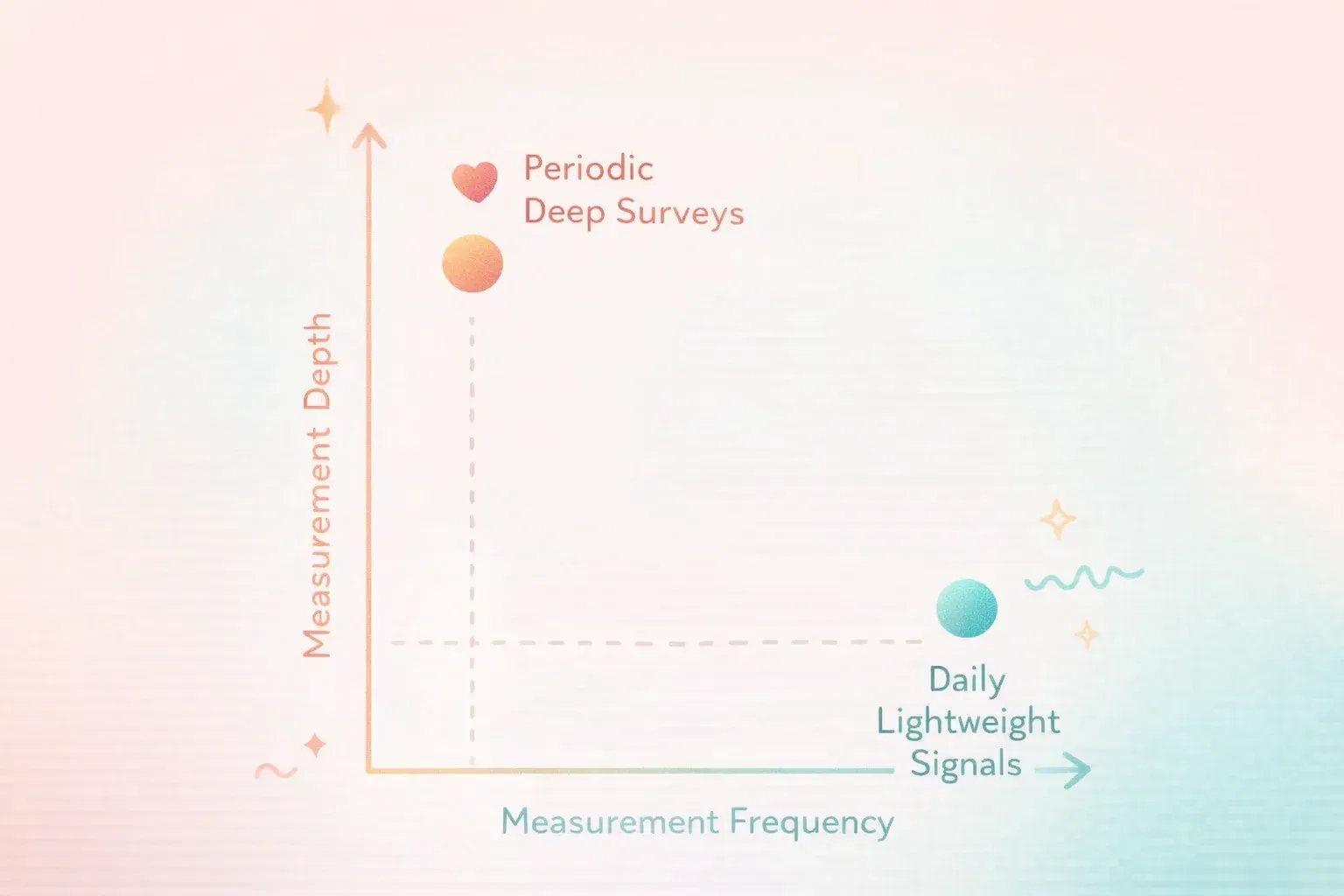
The most important row in that table is frequency. Culture Amp, Qualtrics, and similar platforms are excellent tools, but they were designed for periodic deep-dives, not daily continuous signals. If you want something that functions like Amazon Connections (one interaction per day, lightweight, continuous), the field narrows significantly.
Where Each Tool Excels
Culture Amp offers the deepest psychometric validation and the largest benchmark database. If your primary need is comparing your engagement scores against thousands of other companies, Culture Amp's survey methodology is rigorous. Their platform was built for comprehensive measurement, not daily habits.
Qualtrics provides the most customization for large enterprises with dedicated analytics teams. If you need to build complex, multi-branching survey logic and integrate with dozens of internal systems, Qualtrics has the infrastructure.
Workday Peakon automates pulse surveys at weekly or monthly intervals and uses natural language processing to analyze open-ended responses. For organizations already in the Workday ecosystem, the integration is seamless.
Happily.ai is the closest analog to Amazon Connections in daily cadence. It uses behavioral science and gamification to drive 97% voluntary adoption (compared to the 25% industry average for engagement tools). The daily interaction takes roughly 3 minutes, covering recognition, feedback, and wellbeing signals. For organizations that want daily pulse data with high participation, it is the most direct Amazon Connections alternative available to buy.
The Honest Tradeoff
Amazon Connections was built for Amazon's unique culture and scale. No off-the-shelf tool perfectly replicates it. If your organization values scientific rigor and comprehensive benchmarking over daily frequency, tools like Culture Amp or Qualtrics offer deeper psychometric validation and larger benchmark databases. Daily tools like Happily.ai trade comprehensive survey depth for adoption and real-time signals. They measure different things at different cadences.
The question is which tradeoff matters more for your situation right now.
When Daily Employee Feedback Matters Most
Daily feedback is not always necessary. Stable organizations with low turnover and strong manager relationships may get everything they need from quarterly check-ins.
But certain conditions make daily signals dramatically more valuable:
Leadership transitions. When a CEO or senior leader changes, employee sentiment can shift within days of the announcement. If your survey cadence is biannual, you have a six-month blind spot during the most critical period of change. Daily feedback closes that gap. A structured manager onboarding checklist helps, but without continuous measurement, you are flying blind on how the transition is landing.
Rapid scaling past 200 people. Research shows that culture breaks at roughly 200 people. The informal communication channels that worked at 50 people collapse. Daily signals help leaders see what they can no longer observe firsthand.
M&A integration. Merging two cultures is one of the highest-risk organizational changes. Daily data reveals friction points between legacy teams before they calcify into permanent divides.
Remote and hybrid shifts. When teams are distributed, managers lose the ambient signals (body language, hallway conversations, energy levels) that used to tell them how people were doing. Daily digital check-ins replace those lost signals.
If/Then Decision Logic
Choose daily micro-surveys if your organization changes faster than your survey cadence can capture. If you are navigating a leadership transition, scaling rapidly, or managing distributed teams, continuous signals prevent blind spots.
Choose comprehensive periodic surveys if your primary need is benchmarking against industry peers and your organization is stable. If you need validated psychometric instruments and large-scale comparisons, periodic deep-dives are more appropriate.
Choose both if you have the budget. Daily signals for early warning and trend detection. Annual deep-dives for strategic benchmarking. They serve different purposes and complement each other.
The Transparency Problem: Why Employees Distrust Surveys
A Director of Internal Communications at a 3,000-person company recently described her previous survey tool as a "mysterious black box." Employees completed surveys but never saw how the data was used, what changed as a result, or even whether leadership read the responses.
This is the transparency gap that kills survey programs. And it is more common than vendors admit.
How Amazon Addresses It
Amazon's threshold system (4+ responses for manager visibility, <40 researchers with individual access) provides structural protection. But the more important factor is what Amazon does with the data. Connections results feed into management training, team-level action plans, and organizational design decisions. Employees can see the system producing outcomes, even if they cannot see the raw data.
How to Build Trust in Any Feedback System
Three principles separate trusted systems from "mysterious black boxes":
1. Explain what you measure and why. Before launching any feedback tool, communicate the specific topics you will ask about, why those topics matter, and how the data will be used. Vagueness breeds suspicion.
2. Share results openly. Publish team-level results (with appropriate anonymity thresholds) and organizational trends. When employees see their input reflected in reports, participation increases.
3. Show action taken from data. This is the most important and most often skipped step. When feedback leads to a visible change (a policy update, a new resource, a manager coaching conversation), communicate the connection. "You told us meetings were unproductive. Here is what we changed." This creates a feedback loop that reinforces participation.
When daily feedback is designed as participation rather than surveillance, psychological safety increases. Employees who see their input producing results engage more, not less.
5 Steps to Launch Daily Employee Feedback
Step 1: Choose Your Tool
If you have under 500 employees, prioritize ease of deployment and high adoption rates. You need a tool your team will actually use daily, not one with the most features. Look for implementation timelines measured in days, not months.
If you have 1,000+ employees, prioritize enterprise features: SSO integration, granular permissions, multi-language support, and robust anonymity controls. Implementation will take longer, but the infrastructure needs to support scale.
If you are already in the Workday or Microsoft ecosystem, evaluate native integrations first. Reducing friction for end users matters more than feature comparisons.
Step 2: Start With One Team or Department as a Pilot
Amazon did not launch Connections to 1.5 million employees on day one. They ran pilot programs throughout 2014 before the company-wide rollout in April 2015.
Pick a team of 30-100 people. Ideally one with an engaged manager who will champion the tool, and one where you have existing baseline data to measure against. Run the pilot for 60-90 days before expanding.
Step 3: Communicate the "Why" Before Launch
The single biggest predictor of adoption is whether employees understand why the tool exists and how their data will be used. Send a clear message from leadership (not HR, not the vendor) explaining:
- What the tool does
- What you hope to learn
- How the data will and will not be used
- What anonymity protections exist
- When they will see results
Step 4: Let Adoption Happen Naturally
Amazon made Connections mandatory. That works when you are Amazon. For most organizations, mandating daily surveys creates resentment and gaming (employees clicking random responses to make the prompt disappear).
Tools designed with behavioral science principles achieve high adoption without mandates. Happily.ai's 97% voluntary adoption rate demonstrates that when the experience is designed correctly (short, rewarding, and connected to outcomes), people participate because they want to, not because they have to.
Step 5: Share Early Wins to Build Momentum
Within the first 30 days of your pilot, identify one concrete insight that emerged from the data and act on it visibly. This could be as simple as "Three teams flagged meeting overload. We're implementing meeting-free Wednesday afternoons."
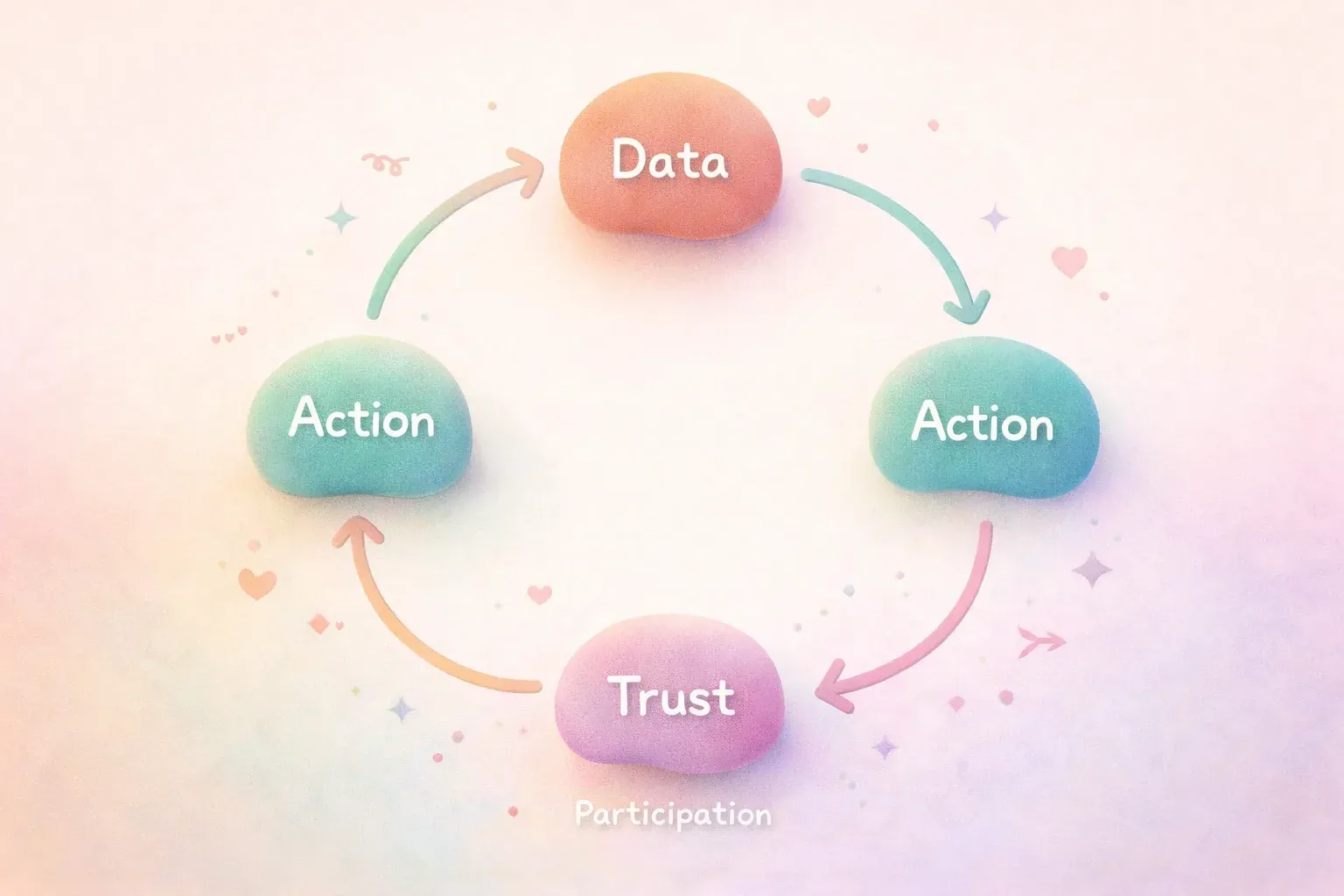
Early wins create a virtuous cycle: data leads to action, action builds trust, trust increases participation, and more participation improves data quality.
Measuring What Matters: Amazon's Three Drivers
Amazon's research across 300 million annual Connections responses surfaced a finding worth paying attention to: the top three drivers of employee satisfaction are not compensation, perks, or even manager quality. They are:
- A sense of career progress. Employees who feel they are growing and advancing are more satisfied, even during difficult periods.
- The ability to use strengths at work. Being asked to do what you are good at correlates more strongly with satisfaction than workload or hours.
- Seeing work as a positive challenge. Not easy work, and not overwhelming work. Challenging work that feels meaningful.
These findings align with Gallup's research showing that managers account for 70% of the variance in team engagement. Managers control all three levers: they assign projects (career progress), match tasks to strengths (ability), and frame work in ways that feel challenging or overwhelming.
For organizations adopting daily feedback tools, this research points to what you should measure. Career development, strengths alignment, and challenge perception are the metrics that predict satisfaction. Traditional metrics like eNPS remain useful as a summary indicator, but they do not tell you which lever to pull. If your daily questions do not touch these three areas, you are measuring the wrong things.
Frequently Asked Questions
What employee survey tool does Amazon use?
Amazon uses an internal tool called Amazon Connections. It presents one question per day on a 1-5 Likert scale to 1.5 million employees across 55 countries and 26 languages, generating over 300 million responses annually. Amazon Connections is not available for purchase. The closest external alternatives for daily employee feedback are Happily.ai (daily, 97% voluntary adoption) and Workday Peakon (automated weekly to monthly pulses).
Can I use daily surveys like Amazon Connections for my company?
Yes. Off-the-shelf tools now offer similar continuous listening functionality without requiring a custom engineering build. Happily.ai is specifically designed for daily voluntary use, achieving 97% adoption through behavioral science and gamification rather than mandates. Implementation takes days to weeks rather than the months or years required for a custom build.
What is the best daily pulse survey tool for a 3,000-person company?
For true daily frequency, Happily.ai is the only major platform designed for voluntary daily participation (97% adoption rate). For weekly or monthly pulse frequency, Workday Peakon and 15Five are established alternatives. For comprehensive periodic surveys with deep benchmarking, Culture Amp and Qualtrics lead the market. The best choice depends on whether you prioritize measurement frequency or measurement depth.
Which companies use daily employee surveys?
Amazon is the most prominent example through its Connections program. Organizations using Happily.ai also collect daily feedback signals. However, most enterprises still rely on quarterly or annual surveys. The trend is moving toward continuous listening: the Employee Engagement and Feedback Software market is growing at 17.3% CAGR, largely driven by demand for more frequent measurement.
Is a daily survey better than an annual engagement survey?
Daily and annual surveys serve different purposes. Daily micro-surveys capture real-time trends and enable early intervention (detecting sentiment shifts within days rather than months). Annual surveys provide comprehensive benchmarking and deeper psychometric analysis. The strongest approach combines both: daily signals for trend detection and early warning, supplemented by annual deep-dives for strategic planning and industry comparison.
How do you measure employee engagement during a CEO change?
Leadership transitions create the highest need for continuous measurement because employee sentiment can shift within hours of major announcements. Biannual surveys create six-month blind spots during these critical periods. Daily micro-surveys detect sentiment changes within days, allowing incoming leadership to understand organizational mood and respond proactively. Tools like Happily.ai provide real-time signals, while comprehensive platforms like Culture Amp can run targeted pulse surveys around specific transition milestones.
Making the Shift to Continuous Feedback
Amazon did not build Connections because daily feedback was trendy. They built it because measuring once a year at their rate of change was like checking the weather forecast from last month.
Your organization probably changes faster than your measurement tools can capture. The question is not whether continuous feedback is better than annual surveys (it depends on what you need). The question is whether your current cadence matches your rate of organizational change.
If your company is navigating growth, leadership shifts, or distributed work, and your last engagement data is six months old, you already know the answer.
Start with a pilot. Pick one team. Run it for 60 days. Let the data tell you whether daily signals reveal things your current approach misses.
If you want to explore what daily employee feedback looks like in practice, see how Happily.ai compares to traditional survey tools or book a demo to see the daily experience firsthand.
Sources:
- Inside Amazon's Daily Employee Survey - Fortune (2015)
- Amazon's Employee Feedback Mechanism - CNBC (2018)
- Amazon Connections: A Day One Approach to Employee Feedback - Fortune (2024)
- Employee Engagement & Feedback Software Market Report - Fortune Business Insights (2025)
- State of the Global Workplace - Gallup (2024)
- The Right Culture: Not Just About Employee Satisfaction - Harvard Business Review (2015)