The geometry of trust
How trust forms, what modern work is doing to it, and how to rebuild it.
The symptoms come before the diagnosis
Ask leaders what is wrong and they rarely say "trust." They describe symptoms. Decisions that should take a day take three weeks, and nobody can quite say why. Collaboration narrows until people work only with the handful of colleagues they already know. Teams feel disconnected even when they share a room. And good people leave without a clear reason on the way out, the kind of departure that surprises everyone except the person leaving.
Treated separately, each symptom gets its own initiative: a decision-making framework here, a connection program there, an engagement survey to chase the attrition. The programs rarely stick, because the symptoms were never separate problems. They are readings off one structure underneath, and that structure is trust. When trust thins, every one of these behaviors follows, and it follows quietly. The crisis is silent because the diagnosis almost always arrives late, after the best people are already gone.
In our study of 5,713 employees, the people who eventually left did not go quiet first. They stayed engaged while growing persistently less happy, which means the usual disengagement alarm never trips for them. Departure without a clear reason is often trust eroding before anyone says a word.
Trust is a prediction, not a switch
We tend to talk about trust as a switch: you trust someone or you do not. It is better understood as a prediction, a working estimate of how someone will behave when you cannot watch them and cannot control the outcome. It is the forecast you run, often without noticing, every time you depend on another person.
The prediction is only real when you act on it. You hand over the work without checking every line. You share the half-formed idea before it is safe. You take the meeting, make the introduction, say the thing you are not yet sure about. Each of those is a small bet placed before the result is in. That bet, not the warm feeling, is what trust actually is. Researchers put it precisely: trust is the willingness to be vulnerable to another party based on positive expectations of their behavior (Mayer, Davis & Schoorman, 1995).
And the prediction never finishes. Every interaction returns a result that confirms the forecast, revises it, or breaks it. Trust is a model you keep updating, not a verdict you reach once and file away. That shift, from verdict to living prediction, is what makes the rest of this possible. If trust is a model, it has inputs, it has structure, and it can be measured, deformed, and rebuilt.
The three corners
When you run the prediction, you are not weighing one quality. You are weighing three at once, and they are not interchangeable. Researchers have converged on the same triad for decades: ability, benevolence, and integrity. The same shape, in plainer words, is competence, benevolence, and character.
Competence is ability in context, and the last two words carry the weight. Someone can be excellent in one domain and entirely unproven in the next, and the common mistake is to let competence travel further than the evidence does. A brilliant engineer is not automatically a brilliant manager. The honest question is narrow: are they good at this.
Benevolence is whether your outcome actually matters to the other person. You cannot read it when helping you is free. You read it in the moment helping you costs them something: their time, their standing, their own priorities. That is when benevolence stops being a value on a wall and becomes information.
Character is consistency when things get tense. Not agreement, consistency. Even when you disagree, even when cutting a corner would be easier, you can predict the line the person will not cross. That predictability under pressure is what lets people take risks around each other.
This is why trust rarely fails all at once. It fails one corner at a time. A manager can be capable and principled but visibly indifferent to your career, and the benevolence corner gives way. A colleague can be warm and reliable but out of their depth, and competence does. When you can name which corner moved, "I do not trust them" stops being a feeling and becomes a diagnosis you can act on.
Borrowed, then earned
Where does the prediction get its data? Two channels feed it. The first is reputation, which is borrowed trust. Before you have met someone, you already hold an estimate built from what others say, the title on the door, the track record, the referral from a colleague you rely on. Reputation is what lets you extend a little trust to a stranger on day one.
The second channel is direct experience, and it is the one that lasts. Every interaction confirms the borrowed estimate, revises it, or breaks it. Reputation opens the door; experience decides whether it stays open. A glowing referral buys only a few meetings. After that, you are running on what you have seen for yourself.
Experience does not arrive all at once either. It deepens in a fixed order. First you ask whether it is safe: can I be honest here without it being used against me. Only once safety holds do you begin testing predictability, whether they do what they say, repeatedly, when it is inconvenient. The deepest stage is shared goals, the point where you stop hedging because you believe you want the same outcome. Each stage rests on the one before it, and you cannot skip to the top.
Most organizations reset the relationship before it ever reaches depth. A reorg, a new manager, a new pod, a new tool, and people are quietly sent back to stage one with someone new. We keep restarting the climb, then wonder why trust feels shallow everywhere. The stages themselves are well documented (Lewicki & Bunker, 1996). What gets less attention is how routinely the modern organization resets them.
Trust needs surface area
There is one more property of the shape to name, because everything that follows depends on it. A prediction can only update where it has contact. Every interaction is a surface, a place where you get to watch how someone actually behaves and read it against the three dimensions. No surface, no new evidence.
This is the part people underestimate. Take the contact away and the prediction does not slowly get worse. It freezes. It holds whatever value it had at the last reading and stops moving, because nothing is arriving to move it. A frozen prediction feels like distance even when no one has done anything wrong. Hold onto that word, frozen, because the next part of this is about everything in modern work that quietly removes contact.
Surface area also explains where trust actually pools, and it is not where the org chart says. When we mapped trust directly from peer-feedback choices and reciprocal recognition, most of the highest-trust people turned out to be individual contributors, not managers.
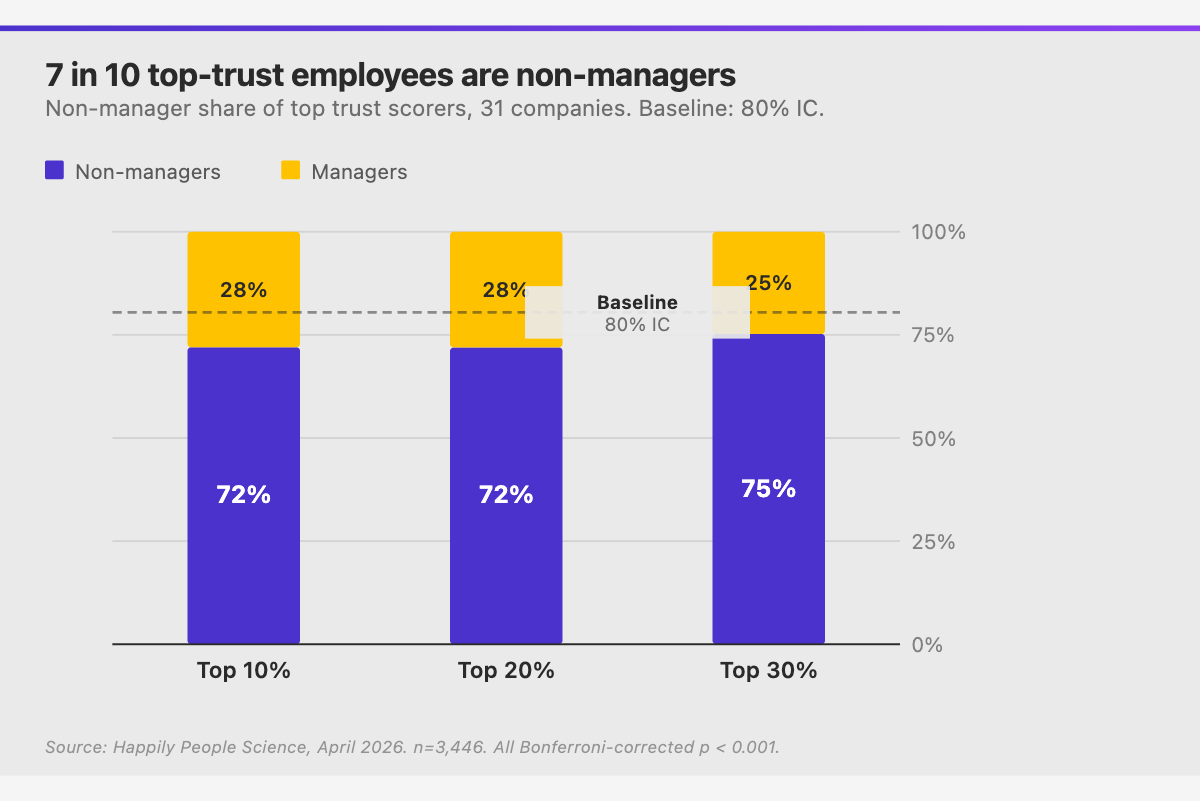
That is not a story about titles. It is a story about contact. Per head, a manager is actually a little more likely to be highly trusted, which fits the model exactly: managers get structured contact, the one-to-ones and reviews where evidence has somewhere to land. But the bulk of an organization's trust still sits out in the individual-contributor network, because that is where most of the people, and most of the everyday contact, are: the colleague who answers the question, reviews the draft, gets pulled aside for advice, day after day. Trust accumulates wherever evidence can land. Which is exactly why it is so fragile when the contact goes away.
Four forces deforming the shape
Everything so far describes the shape in good conditions. The conditions have changed. Four forces in modern work are bending it out of true, and underneath they all do the same thing: they make vulnerability harder to place safely. Take them one at a time.
Distance
We thought the office was about desks and meetings. It was also trust infrastructure we never put on the books. Decades ago, Tom Allen at MIT found that the likelihood of two people communicating drops steeply as the distance between them grows.
The fall is sharp and it comes early. Most of the decline happens within the first eight meters, long before the fifty-meter mark where regular technical contact basically bottoms out. The hallway, the nearby desk, the run-in at the coffee machine: that was surface area, and it was doing more trust work than anyone realized. Because the loss was invisible, it never showed up as a line item. No one decided to dismantle the trust network. It simply stopped being maintained the day the desks emptied.
Async tools
What replaced proximity was mostly text, and mostly asynchronous. Trust builds in a loop: a signal, a response, repetition, with enough context to read intent. Async tools snap that loop into fragments, and the fragments are not neutral. A negative read travels fast, because a single clipped message or a screenshot carries on its own. A positive read does not, because it needs context and repetition to mean anything. Think of how often a terse one-line reply gets read as irritation when the sender was simply busy. The medium strips out the tone that would have corrected you in person. So the channel is biased: it amplifies the worst interpretation of someone and starves the best one, and at scale that asymmetry quietly lowers trust.
AI mediation
Now add the newest force. Put AI in the middle of the channel and the output goes up: the message is cleaner, the work ships faster. But intent, care, and accountability get harder to read, because you can no longer tell how much of the person is actually in it.
The strange part is that AI can read as high character. It is consistent, it is calm, it never snaps at you under pressure. It can feel trustworthy while carrying no human intent at all. That is the risk worth naming plainly. It is not that AI is bad. It is that AI can hide the very signal trust was built to read.
Fear
The last force is the quietest, and it is about how people feel rather than which tools they use. Trust is a personal risk, so anything that raises the cost of risk suppresses it. When the market turns or layoffs feel possible, people do not wait for the announcement. They go quiet first. They stop floating the half-formed idea, stop admitting they are stuck, stop putting themselves out there. The withdrawal happens well before any policy changes, which is exactly why leaders miss it. And it compounds, because the people most worth hearing from, the ones with something risky to say, are usually the first to fall silent. By the time the formal signals arrive, trust has already contracted.
Four forces, one effect. Each removes contact, raises the cost of vulnerability, or both.
The rebuild
Four forces, all removing contact and raising the cost of vulnerability. So how do you rebuild the shape? It starts with a single move, and it does not begin with a tool.
Initiate vulnerability
Trust is a personal risk taken with a positive expectation, which means someone has to take the risk first. You go first. You share the rough draft, you admit you do not know, you extend a little trust before it has been earned. We cannot sit and wait for trust to arrive on its own, because waiting is exactly how the freeze sets in. The manager who says in a meeting that they got something wrong is not losing authority; they are showing the team that honesty is survivable here. That is why psychological safety matters so much: a group where it is safe to be wrong is a group where people keep making the first move (Edmondson, 1999). Initiating vulnerability is the real work of leadership, and everything below is about making that move easier and more frequent.
Make trust observable
Trust grows through microinteractions: a clear signal, a response, and then repetition. The practical instruction is almost boring. Not louder, not more polished, just more readable and more often. And the signals are not generic; they land on the three dimensions, a bit of competence shown here, a bit of care there, a bit of consistency held under pressure.
Two findings from our own data sharpen what "readable" means. First, the signal has to carry something. When we looked at manager feedback, reply quality beat reply speed: across 542 managers in 100 companies, the fastest responders did not earn the most trust, because speed without substance is just a checkbox. A rhythm of evidence is not a rhythm of empty acknowledgments. Second, the signal has to be witnessed. When we traced how recognition spreads, it did not flow from your direct boss. It propagated from senior leaders two levels up, across 908 managers. Visible signals from the top set the rhythm for everyone below. If you take one principle from all of this, it is this one: make trust observable, then make it repeat.
Build the system
Modern work actively suppresses the signals trust needs, so good intentions are not enough. The rhythm cannot depend on one conscientious manager remembering to keep it going, because that manager reorganizes, burns out, or moves on, and the shape resets. It needs a deliberate layer that creates, captures, and repeats those signals on purpose. Continuous, so the model never freezes. Reliable, so the signals repeat often enough to matter. Visible, so trust becomes observable instead of assumed. That is not a perk or a culture slogan. It is plumbing, and it is what lets the shape hold under all four forces.
Restoring the shape
We started by saying trust has a shape. It forms through contact, it stands on three dimensions, and it is being deformed by distance, async tools, AI, and fear. None of that reverses by mood or by message. But the rebuild is not complicated, even if it is deliberate. Initiate vulnerability. Make trust observable. Put a system behind the signals so they keep coming when the office, the calendar, and the market are all working against them.
Do that, and something powerful happens. Decisions speed up. Collaboration widens past the people you already know. The good people stop leaving without a reason. The symptoms we opened with were never separate problems to be solved one at a time. They were the shape, telling you it had lost its oxygen. Give it back, and it holds.
References
- Mayer, R. C., Davis, J. H. & Schoorman, F. D. (1995). An Integrative Model of Organizational Trust. Academy of Management Review, 20(3), 709–734.
- Allen, T. J. (1977). Managing the Flow of Technology. MIT Press. Origin of the Allen curve relating communication frequency to physical distance.
- Lewicki, R. J. & Bunker, B. B. (1996). Developing and Maintaining Trust in Work Relationships. In Trust in Organizations. Sage. Calculus-, knowledge-, and identification-based trust stages.
- Edmondson, A. C. (1999). Psychological Safety and Learning Behavior in Work Teams. Administrative Science Quarterly, 44(2), 350–383.
- Happily Research (2026). Trust Networks; The Engaged Exit; Response Time Is a Red Herring; The Recognition Cascade. Internal analyses cited inline.
Trust forms through contact, lives in three dimensions, and is deformed by distance, async tools, AI, and fear. The rebuild is deliberate: initiate vulnerability, make trust observable, and put a system behind the signals so they keep coming.