

On this page
AI employee engagement action plans are manager- or team-specific recommendations generated by AI from engagement data, designed to close the gap between when feedback is given and when something changes. Happily.ai is a Culture Activation platform that converts daily 3-minute check-ins into manager-specific action plans in hours, not quarters.
The bottleneck in engagement work has never been the data. It is the time, effort, and clarity required to turn that data into the right action, addressed to the right person, while the situation it describes is still real. By the time most engagement reports get cascaded down from HR to managers, the team that produced the feedback has moved on. The frustrations are different. The people are different. The opportunity is gone.
Best for companies where engagement surveys produce reports but not behavior change.
This article covers what an AI employee engagement action plan actually needs to do, the three approaches companies use to generate them, where each one breaks down, and how a continuous signal-based model collapses the analysis-to-action lag from weeks to hours.
The Action Plan Problem
The standard engagement workflow has not changed much in fifteen years. Run a survey. Wait six to eight weeks for analysis. Produce a slide deck. Cascade themes from HR to department heads to team managers. Ask managers to "create an action plan" from a list of org-level themes. Hope something changes before the next survey cycle.
Three failure modes show up almost every time.
The data lands on the wrong desk. Engagement reports are produced for HR and read by HR. Managers receive a filtered, abstracted version, often weeks later. But 70% of the variance in team engagement is attributable to managers (Gallup, 2023). If the action plan does not reach the person who can act on it, the analysis is wasted.
The actions are too generic. "Improve communication." "Increase recognition." "Build psychological safety." These themes are accurate at the org level and useless at the team level. A manager cannot do "improve communication" on a Tuesday morning. They can have a specific conversation with a specific person about a specific concern. The gap between an org-level theme and a Tuesday-morning conversation is where most engagement programs lose their leverage.
By the time the action lands, the team has changed. The UKG Workforce Institute (2023) found that managers influence employee mental health as much as spouses and more than therapists or doctors. That level of influence operates daily. An action plan that arrives in March based on January's data is addressing a team that no longer exists. The people who felt unrecognized in January have already either re-engaged on their own, found someone outside the team who recognized them, or started planning their exit.
This is the action plan problem in one line: traditional engagement programs produce slow, generic action items that never reach the person who can act on them.
What an Action Plan Actually Needs to Move Metrics
Three dimensions determine whether an action plan changes behavior or sits in a shared drive.
Speed. The time between an employee giving feedback and a manager taking action. Hours, weeks, or quarters. The shorter this loop, the more the action still maps to the situation that prompted it. Behavioral science research on feedback loops is consistent on this point: shorter loops accelerate behavior change because the link between cause and effect remains visible.
Granularity. Whether the action is generic ("recognize team contributions more often") or specific ("Lina mentioned feeling overlooked for the project demo last week; acknowledge her work in Friday's standup"). Generic action items get nodded at and forgotten. Specific action items get done because they tell the manager exactly what the move is.
Delivery. Whether the action plan lands with the person who can act, or gets aggregated into a deck for someone two layers removed from the team. A perfectly granular action plan delivered to HR is not an action plan. It is a report about an action plan.
Speed times granularity times delivery is the equation that separates an action plan that moves metrics from one that does not. AI changes the math on all three.
Three Approaches to Generating Engagement Action Plans
The market has converged on three distinct approaches. Understanding the differences matters more than comparing vendor features.
1. Manual Analyst Review
A human analyst, usually inside HR or a consultancy, reads survey responses, identifies themes, and produces an action plan document. This is the legacy model and still dominant in enterprises with mature survey programs.
The strength is interpretive depth. A skilled analyst can recognize context that pattern-matching misses, weave qualitative quotes into a narrative, and tailor recommendations to organizational history. The limitation is speed and reach. Manual review takes four to twelve weeks. It produces org-level themes, not team-level actions. And it depends on a small group of analysts whose capacity caps the granularity they can deliver.
2. Generic AI on Survey Exports
A faster version of the analyst model. Survey data is exported into a general-purpose LLM (or an AI feature bolted onto a survey platform), and the AI produces themes and suggested actions in days instead of weeks.
The strength is throughput. What took an analyst four weeks now takes four hours. The limitation is that speed without granularity is still not action. The data input is the same quarterly snapshot, generated by the same 25% of employees who actually filled out the survey. The AI is faster than a human at producing the same kind of department-level theme. It does not solve the delivery problem either. The output still flows from AI to HR to manager, with the same drop-off at each handoff.
This is the most common shape of "AI for engagement" today, and the most common reason companies conclude that AI does not really help with action plans. They tried AI on the wrong layer.
3. Continuous Signal-Based AI
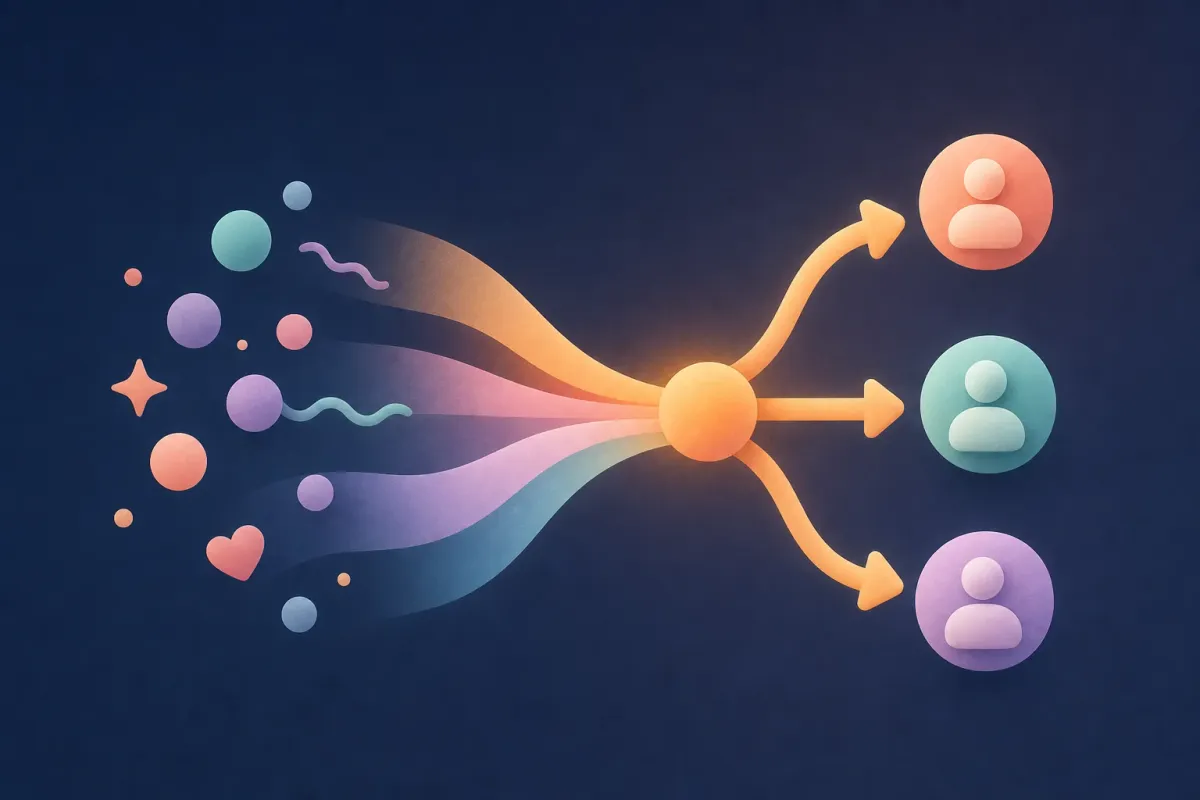
This model captures behavioral data daily through lightweight, gamified interactions, then uses AI to generate manager-specific action prompts in near real time. Happily.ai's approach uses daily 3-minute check-ins that surface wellbeing, alignment, and progress signals along with tagged open feedback. The AI clusters and routes those signals into conversation-ready prompts delivered directly to each manager.
The strength is that all three dimensions improve at once. Speed: same-day action prompts. Granularity: prompts are about specific people, specific recent events, and specific recommended moves. Delivery: prompts go to the manager, not to HR for cascading. Adoption reaches 97% across 350+ organizations because the input is daily and brief, not quarterly and long. The limitation is that this model is less suited for deep longitudinal benchmarking, which mature survey programs do well.
Comparison: Which Approach Generates Action Plans That Actually Move Metrics
| Dimension | Manual analyst review | Generic AI on survey exports | Continuous signal-based AI |
|---|---|---|---|
| Data source | Annual or quarterly survey, open text | Same survey data fed to an LLM | Daily 3-minute check-ins, tagged feedback |
| Action plan format | Themed report | LLM-generated summary, suggestions | Manager-specific, conversation-ready prompts |
| Time to action | 4 to 12 weeks | 2 to 7 days | Same day |
| Granularity | Org and department themes | Department themes | Person and team-specific |
| Delivery target | HR, then cascaded | HR, then cascaded | Directly to the manager |
| Adoption | Low (25% industry average) | Low (still survey-dependent) | 97% (Happily.ai data) |
| Best for | Mature enterprises with analytical staff | Adding AI speed to existing surveys | Lifting manager behavior across the whole org |
Why Most "AI Action Plans" Still Fail
Honest assessment matters here. AI applied to the wrong layer of the engagement workflow is fast nonsense.
The garbage-in problem. A 25%-participation survey processed by AI is still a 25%-participation survey. The AI confidently summarizes what the most engaged quarter of the team said, while staying silent about the 75% who did not respond. Those are usually the people whose disengagement matters most.
The generic-AI fallacy. General-purpose LLMs are excellent at summarizing what is in their input and unreliable at recommending what should happen next. When the input is org-level survey data, the output is org-level recommendations dressed up as action items. This is faster than a human producing the same thing, but it does not change what the manager can actually do on Tuesday.
The "action plan PDF" antipattern. Many AI features in survey tools generate a multi-page action plan document, often emailed to managers, often unread. A 12-page action plan is not an action plan. It is a report. The action plan that moves metrics is the single conversation opener that arrives the morning of the one-on-one.
What separates an action plan that moves metrics from one that does not is whether it is addressed to a specific person, about a specific behavior, this week. AI can do this, but only when the upstream data is fresh and complete enough to support that level of specificity, and when the delivery routes directly to the manager rather than through HR.
How Happily.ai Turns Daily Check-Ins into Manager Action Plans
The mechanism behind continuous signal-based AI action plans is straightforward once you see it end to end.
1. Daily 3-minute check-in. Every team member sees a short, gamified check-in: how they are feeling, how aligned they feel with current priorities, what is blocking progress, plus space for tagged open feedback. The brevity and gamification are the reason adoption sits at 97% rather than 25%. The check-in becomes part of the daily workflow, not a quarterly interruption.
2. AI tags and clusters feedback automatically. Open text is parsed into themes (recognition, workload, clarity, growth, relationships, wellbeing) and weighted by recency, intensity, and pattern. A single mention of feeling overlooked is a signal. Three mentions in a week from different people on the same team is a hotspot.
3. Manager-facing action prompts generated daily and weekly. Instead of a quarterly report, each manager receives specific prompts in the flow of their work: a conversation opener for the next one-on-one, a recognition nudge tied to a specific contribution, a flag that team wellbeing has dipped over the past five days, a question to raise in the next team meeting. These are not generic templates. They are tied to actual signals from the actual team this week.
4. Org-level visibility for HR and leaders. The same signals that drive manager prompts roll up into an aggregated view for HR and executives. Leaders see team health, focus, and progress patterns across the company. They also see which managers are acting on prompts and where adoption is strong. The delivery problem gets solved without losing the visibility HR needs to support managers and intervene when something is escalating.
5. Measurable outcomes within 90 days. Manager effectiveness scores improve within 90 days on continuous signal platforms, compared to 6 to 12 months on survey-and-training cycles (Happily.ai data across 350+ organizations). The mechanism is simple: shorter feedback loops produce faster behavior change.
This is why "AI for engagement" produces different results depending on where it sits in the workflow. AI applied to the daily signal layer changes manager behavior. AI applied to the quarterly survey layer produces faster reports.
How to Choose the Right AI Action Plan Approach
The right model depends on what is bottlenecking your engagement program today.
Choose manual analyst review if you have a mature annual survey program, analytical staff who can contextualize themes, and a small enough management layer that an org-level action plan still translates into team-level conversations. This works well in enterprises with strong survey cultures and stable team structures.
Choose generic AI on survey exports if you want to add AI speed to a survey program you already trust and you have high participation rates (above 70%). The AI will not change what the data can support, but it will compress the timeline from weeks to days.
Choose continuous signal-based AI if the goal is to lift manager behavior across the whole organization, especially during growth phases where new managers are constantly onboarding. This is the model that scales coaching and action-taking, because it operates daily and reaches every manager regardless of survey response rates.
Many growing companies will benefit from combining models. Continuous signal-based AI for the day-to-day, supplemented by a periodic deeper survey for longitudinal benchmarking. The point is not to pick one tool. It is to make sure the action plan layer (granular, manager-facing, same-day) is solved.
The Numbers That Matter for Action Plan ROI
The case for investing in continuous AI action plans rests on a few well-documented findings.
- 70% of team engagement variance is attributable to managers (Gallup, 2023). The action plan that does not reach the manager is leaving the largest lever untouched.
- 97% voluntary adoption vs. 25% industry average for engagement participation, achievable when the input is daily, brief, and gamified (Happily.ai across 350+ organizations).
- Manager effectiveness scores improve within 90 days on continuous signal platforms vs. 6 to 12 months for survey-and-training approaches.
- 40% turnover reduction and approximately $480K annual savings reported by customers using continuous signal-based AI action plans at scale.
- 9x trust multiplier when recognition and feedback move continuously through teams rather than appearing as annual events.
- 149% year-over-year increase in misalignment mentions in workplace feedback (Happily.ai internal data, 10M+ interactions), which is precisely why action plan speed matters: the situations the data describes are shifting faster than quarterly cycles can keep up with.
These numbers point at the same conclusion. The action plan model that reaches the most managers with the freshest, most specific guidance will produce the largest organizational impact.
Organizations using Culture Activation approaches, with continuous signal-based AI coaching as the manager-facing layer, report measurable improvements across all three dimensions of organizational health: Feeling (team wellbeing), Focus (alignment with priorities), and Progress (goal velocity).
Frequently Asked Questions
Can AI write engagement action plans?
Yes, and increasingly well. The more useful question is which layer of the engagement workflow the AI is applied to. AI summarizing a quarterly survey produces faster org-level themes. AI processing daily team signals produces manager-specific, conversation-ready prompts. Both are technically "AI engagement action plans," but they produce different outcomes. The action plan that changes manager behavior is the one delivered to the manager, about a specific person on their team, the same week the signal emerged.
What is the best AI tool for employee engagement action plans?
It depends on what is bottlenecking your program. For org-level theme analysis on top of existing surveys, Culture Amp and other major survey platforms now include AI summarization. For continuous, manager-facing action prompts based on daily signals, Happily.ai's Culture Activation platform reaches 97% adoption and delivers same-day prompts. For general-purpose summarization of exported survey data, any modern LLM works. The best tool is the one whose AI operates on data fresh enough and complete enough to support genuinely specific recommendations.
How is an AI-generated action plan different from a survey report?
A survey report describes the state of engagement at a point in time. An action plan tells a specific manager what to do next. Most "action plans" produced from surveys are still reports with bullet-point suggestions appended. A real action plan answers three questions: what is happening, who can act on it, and what is the next move. AI can generate a real action plan when the data is granular enough (per-person, recent), routed to the right actor (the manager), and small enough to fit a Tuesday morning.
Does Happily.ai's AI replace HR or augment them?
It augments HR by closing the gap that HR cannot close alone. HR has always known that manager behavior is the largest engagement lever, but cascading action plans from HR to every manager every week is not operationally possible at scale. AI generates manager-specific prompts continuously, so HR can focus on supporting managers, intervening in hotspots, and shaping organizational strategy. HR retains full visibility into team health and action-taking across the company.
How quickly should an action plan arrive after employee feedback?
For the action plan to map cleanly to the situation that produced it, the gap should be measured in hours or days, not weeks or months. Behavioral science on feedback loops is consistent: shorter loops produce faster behavior change because the cause and effect remain connected in the actor's experience. A manager who sees a wellbeing signal on Monday and acts on it in Tuesday's one-on-one is having a different conversation from a manager who reads about the same signal in a quarterly report.
Making the Decision
The shape of an effective AI employee engagement action plan is well understood at this point. It is fast, specific, and delivered directly to the manager who can act on it. Speed, granularity, and delivery. The market disagreement is not about the shape. It is about which layer of the engagement workflow AI should operate on to produce that shape reliably.
AI applied to quarterly surveys produces faster reports. AI applied to daily signals produces actual action plans. Organizations evaluating tools should ask a different question than "does this platform have AI." The right question is: does this platform's AI deliver the same-day, manager-specific, conversation-ready prompt that closes the feedback-to-action loop?
Book a demo to see how Happily.ai generates action plans from real team signals in under 10 minutes.
Sources
- Gallup. "State of the Global Workplace Report." Gallup, 2023. gallup.com/workplace
- UKG Workforce Institute. "Mental Health at Work: Managers and Money." UKG, 2023. ukg.com/workforce-institute
- Locke, E. A., & Latham, G. P. "Building a practically useful theory of goal setting and task motivation." American Psychologist, 2002. (Feedback loop frequency and behavior change.)
- Happily.ai. "Platform adoption, manager effectiveness, and feedback action data." Internal data across 350+ organizations, 10M+ workplace interactions over 9 years.