


On this page
The first time a team agrees to share feedback only behind a wall of anonymity, the survey has already lost. The mechanism that promises honesty is the same mechanism teaching the team that honesty is unsafe. Every anonymous response confirms a quiet hypothesis: people here cannot say this with their name attached. That hypothesis becomes the culture.
Anonymous employee engagement surveys were designed to surface what teams could not say in the open. They were meant to give voice to the quiet majority and expose risks before they became attrition, burnout, or scandal. Most of them do something else. They generate aggregate sentiment that no one can act on, while teaching the organization that meaningful feedback requires hiding. The tool meant to detect a trust gap quietly widens it.
This piece is about why that happens, what people problems actually need, and what to build instead.
What Anonymous Surveys Were Designed to Do
Anonymous engagement surveys exist to solve a real problem. Employees often see things leaders cannot. A struggling manager. A project drifting from strategy. A pattern of small slights that adds up to disengagement. Without a way to surface those signals, organizations fly blind until the warning lights of turnover or grievances start flashing.
The promise of anonymity is simple. Strip identity from feedback, and people will say what they actually think. The data will be honest. The risks will be visible. Leaders will respond.
The promise rests on three assumptions:
- People will only share difficult truths when their identity is hidden.
- Aggregate sentiment is enough to drive change.
- Honest data automatically translates into honest action.
Each assumption is fragile. Together they form a system that often produces the opposite of what it was built to deliver.
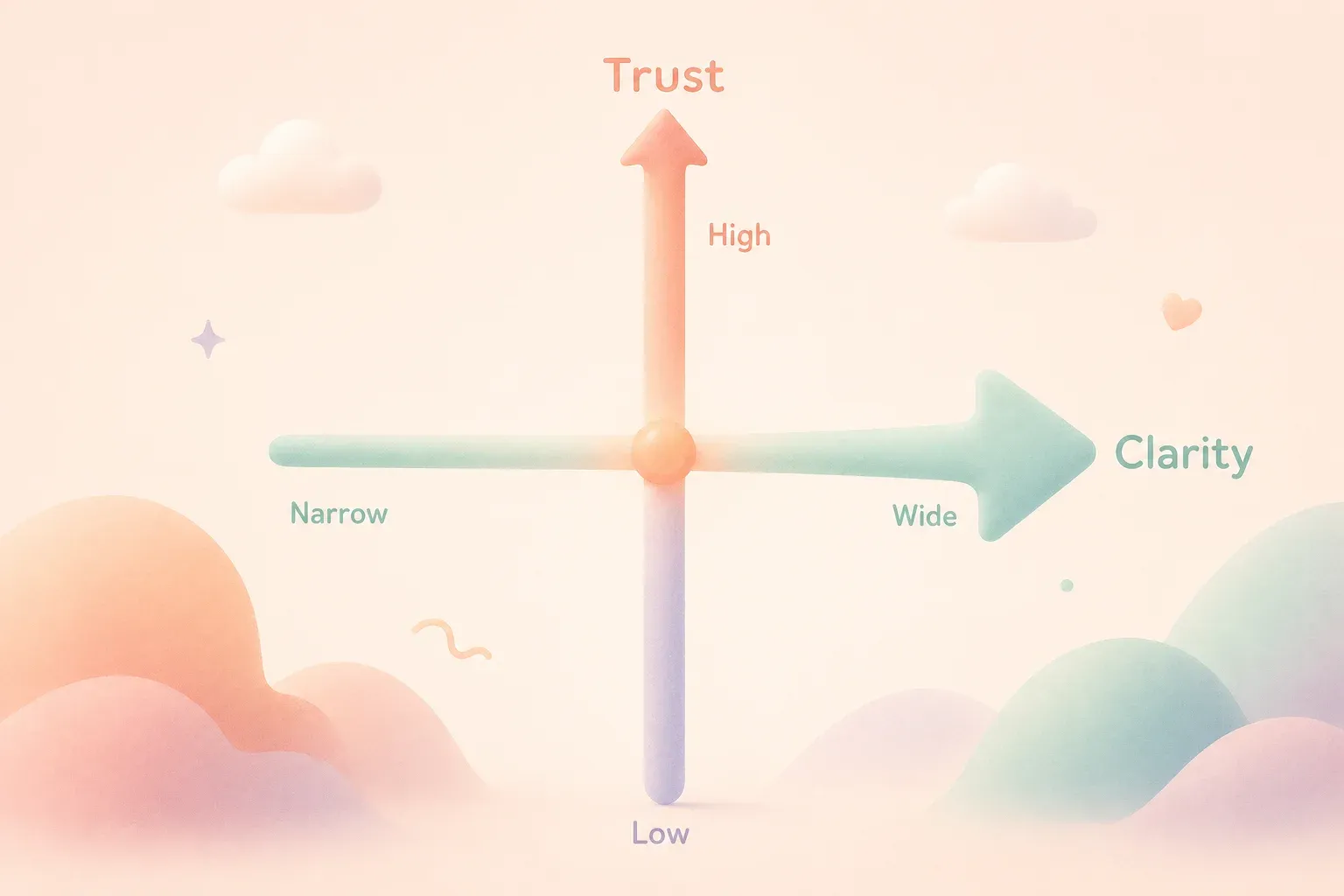
The Two Roots of Every People Problem: Trust and Clarity
Spend enough time in any organization, and patterns repeat. Strategy disagreements escalate into personal conflicts. Performance issues stall in unspoken resentment. New initiatives launch with energy and quietly stop. Talented people leave for reasons that surprise their managers.
Almost every one of these patterns reduces to one of two failures.
Lack of trust. People do not feel safe enough to disagree, raise concerns, ask for help, or admit mistakes. Information flows along carefully selected paths. Feedback is filtered through what feels survivable. Conflict goes underground.
Lack of clarity. People are not sure what success looks like, who owns what, or how their work connects to the priorities above them. Energy disperses across competing interpretations. Decisions get made twice. Misalignment compounds.
Anonymous surveys were built to surface both. In practice, they cannot fix either. Trust is not built by hidden voices. It is built by visible vulnerability that gets met with care. Clarity is not produced by aggregate scores. It is produced by knowing exactly which team, which manager, which dynamic needs attention. Anonymity is, by design, the absence of that information.
How Anonymity Quietly Erodes Trust
The most overlooked cost of anonymous surveys is what they teach. Each round of anonymous feedback delivers an implicit lesson to the entire workforce. The lesson is: real feedback is the kind you cannot put your name on. Polite feedback gets your name. Honest feedback gets a hidden form.
Over time that lesson hardens into a norm. Employees learn that day-to-day conversations are for performance, and that the truth lives in the quarterly survey. Managers learn that the comments they are reading came from people who did not feel they could speak up directly. The relationship between manager and team gets mediated by an instrument that sits between them.
This is the inversion. Anonymous surveys exist because trust is low. Their use teaches employees that trust should remain low. The very tool meant to diagnose the problem starts producing it.
Amy Edmondson's three decades of research on psychological safety make a sharp distinction here. Psychological safety is not the absence of risk. It is the shared belief that interpersonal risk-taking will be met with respect rather than punishment. It is built in named, visible interactions. A leader admitting a mistake. A peer raising a concern that gets thanked rather than dismissed. A junior person asking a question that turns out to matter. Anonymous channels do not build that capacity. They route around it.
The practical consequence is that organizations relying on anonymous surveys often produce the same survey scores year after year. The signal stays flat because the underlying mechanism, the willingness to speak up in named conversation, never gets exercised.
How Anonymity Destroys Clarity
The other half of the problem is operational. A survey result that says "wellbeing is at 6.4" tells you almost nothing useful. You do not know which team is at 5.0 and which is at 8.2. You do not know whether the average reflects two struggling pockets or a broad malaise. You cannot tell whether the issue is workload, manager behavior, role design, or something happening in someone's life outside work.
Anonymity guarantees this fog. It is the design intent. The cost is that the organization knows there is a problem but cannot locate it. The signal arrives without a return address.
Aggregate-only data forces a particular kind of response. HR creates company-wide initiatives. Leadership communicates broad themes. Managers receive generic action plans. The intervention is sized to the data, which means it is too coarse for the reality on the ground. A team with a struggling manager does not need a company-wide wellbeing campaign. It needs that manager to get specific, timely support. Anonymous data cannot direct that support to where it would matter most.
When sentiment moves quarter to quarter, the organization debates what changed. Was it the new office policy? The product launch? The reorg? The lack of clarity makes every conversation directional, and most of those conversations end without a decision because no one can prove what is happening underneath the score.
Why Honest Feedback Doesn't Actually Require Hiding
There is a stubborn assumption underneath the case for anonymity: that people only tell the truth when they cannot be identified. Decades of research on workplace voice suggest the opposite. People share difficult truths when three conditions are met. They believe the listener can handle it. They believe action will follow. They believe their identity will be respected, not weaponized.
None of those conditions require anonymity. All of them require relationship. A team member will tell their manager that a project is failing if past disagreements ended in collaborative problem-solving rather than punishment. A direct report will say they are burning out if previous admissions of struggle were met with adjustment rather than suspicion. The willingness to speak up is a function of the history between two people, not the architecture of a survey tool.
This is why the highest-trust organizations often have the lowest reliance on anonymous channels. Not because they suppress dissent, but because dissent has somewhere named to go. Anonymity becomes a workaround for the absence of those channels, not a substitute for them.
What Meaningful Feedback Loops Look Like
The alternative to anonymous surveys is not "no feedback." It is feedback designed to build the trust and clarity that anonymous surveys were meant to extract. The architecture is different. The intent is different. The results are different.
A meaningful feedback loop does five things that an anonymous survey cannot.
1. It Runs Continuously, Not Periodically
Quarterly surveys treat feedback as an event. Continuous loops treat it as a habit. The difference is structural. A team member who shares how they are doing every day rarely needs a 30-question instrument to surface a problem. The signal is in the daily check-in, the small recognition, the brief 1:1 note.
Continuous feedback also dissolves the artificial intensity of survey season. Each individual signal carries less weight, which paradoxically makes people more honest. The smaller the act of sharing, the lower the perceived risk.
2. It Practices Vulnerability in Small Doses
Trust is not built by one large act of disclosure. It is built by many small acts of vulnerability that compound. Edmondson's research describes this as the "ladder of psychological safety." You do not start at the top. You start by asking a clarifying question and being met with a thoughtful answer. The next time, you raise a small concern. The time after that, you say something harder.
A feedback system that asks only the big questions ("Do you trust your manager?") skips every rung of that ladder. A system that asks small, frequent questions ("How are you feeling about your work this week?") gives people the practice that builds capacity for the harder conversations.
3. It Preserves Identity Where Identity Is the Point
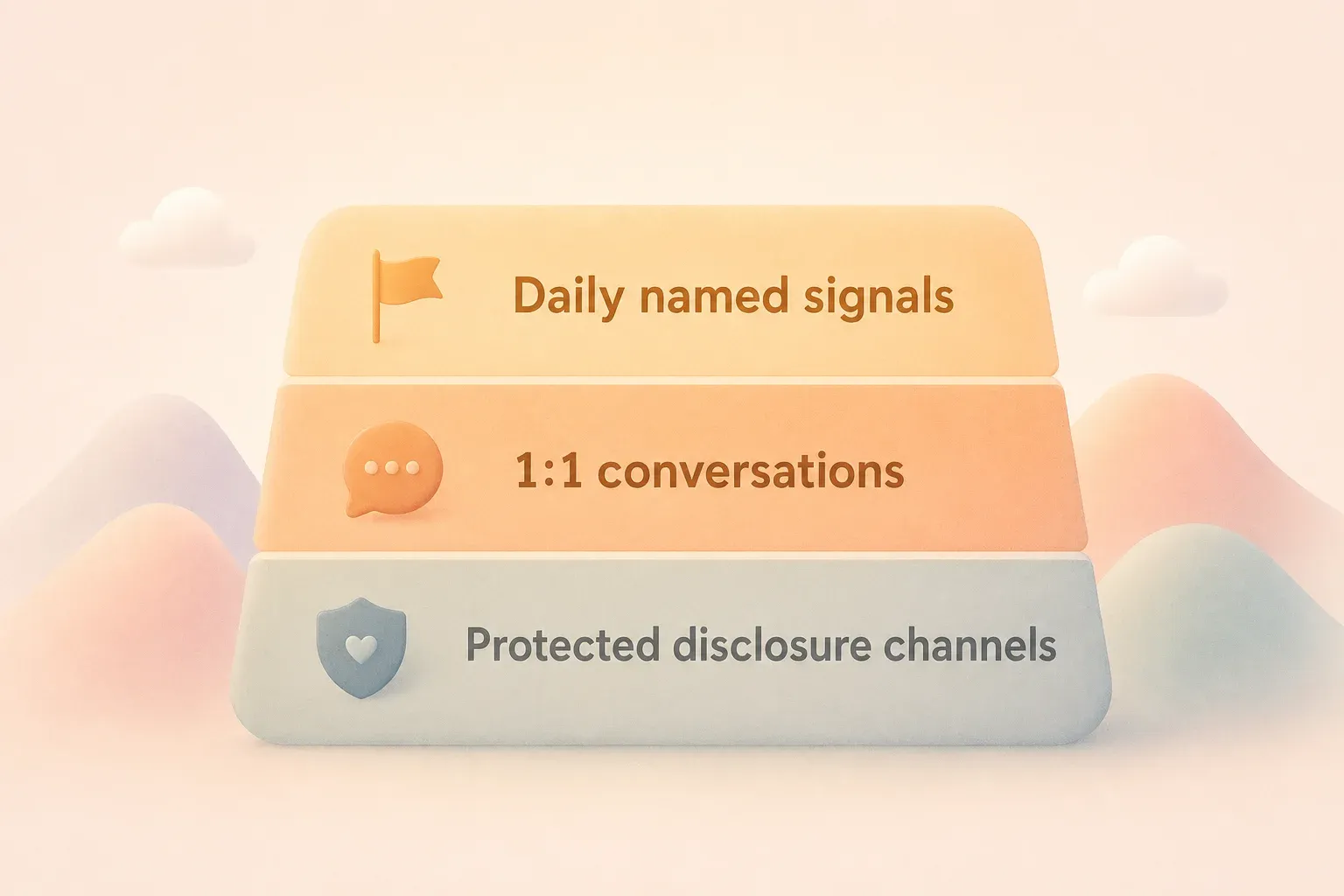
The case for some confidentiality is real. Disclosure of harassment, ethics violations, or serious mental health struggles often requires protected channels. But the case for anonymity collapses for routine engagement signals. A team member's experience of their workload, their alignment, their relationships at work, is not threat-level information. It is the day-to-day data that managers need by name, not by aggregate.
The right architecture is layered. Daily signals are identity-attached so they can drive specific action. Sensitive disclosures have separate, protected channels. The two do not collapse into a single anonymous form that fails at both.
4. It Closes the Loop Visibly
The single biggest predictor of whether employees will share again is whether the last share led to anything visible. This is the action gap that anonymous surveys consistently fall into. Data is collected. Dashboards are presented. Action plans are written. Months pass. Most employees never see what happened.
A meaningful loop closes in days, not quarters. A team raises a concern in a check-in. The manager responds in the next 1:1. The team sees the response. The next signal arrives, more honest because the last one mattered.
5. It Trains Managers to Receive Feedback Well
A feedback system is only as good as the manager on the other end of it. Most organizations train managers to give feedback. Few train them to receive it. The difference shows up immediately in named feedback. A manager who hears a hard signal and responds with curiosity rather than defensiveness produces a team that will share again. A manager who responds with explanation, justification, or quiet retaliation produces a team that retreats to anonymous channels and waits for the next survey.
The shift from anonymous surveys to named feedback is partly about tools. It is mostly about manager craft.
How Happily.ai Activates This at the Micro-Level
Happily.ai was built for this architecture. The platform does not replace anonymous surveys with a different anonymous instrument. It replaces the survey model itself with daily, identity-aware signals that compound into trust over time. The mechanism is small, and the smallness is the point.
Daily two-minute check-ins. Each day, employees share how they are feeling, what they are focused on, and where they need support. The interaction is short, the friction is low, and identity stays attached. That makes the data immediately useful to the right manager.
Real-time, named signals to managers. When a team member's check-in suggests a struggle, the relevant manager sees it within hours. Not in a quarterly report. Not as an aggregate. As a specific signal about a specific person, with enough context to start a conversation.
AI coaching that turns signal into action. Most managers want to respond well. They are unsure how. The platform gives personalized, behavioral-science-based prompts: how to open the conversation, what to listen for, what to follow up on. The signal does not sit in a dashboard. It becomes a coached interaction.
Recognition that builds trust as a byproduct. Daily peer recognition is the platform's quiet engine. People who give recognition publicly are trusted 9x more by witnesses than people who stay silent (Happily.ai analysis of 10M+ workplace interactions). The platform makes that act easy and frequent. Trust accumulates as a side effect of small, repeated public acknowledgment.
Layered confidentiality for genuinely sensitive disclosures. Routine engagement signals stay named. Sensitive issues route to protected channels designed for that purpose. The two functions stop competing inside a single anonymous form.
The result is operational. Happily.ai sees 97% voluntary daily adoption versus the 25% industry average for engagement tools (Gartner, 2024). Organizations using the platform report 48-point eNPS improvements and 40% reductions in turnover. Those numbers are not produced by a better survey. They are produced by replacing the survey model with hundreds of small, named, daily acts of trust-building, each one too small to feel risky and large enough in aggregate to change the culture.
The point is not that survey data is bad. The point is that culture is built in micro-interactions, and a system designed for those interactions produces information surveys cannot reach.
When Anonymous Channels Still Make Sense
There are situations where anonymity is the right answer. Reports of harassment, discrimination, or ethics violations require protected reporting channels by design. Whistleblower protections exist for serious reasons. Some organizations operate in cultural or legal contexts where named feedback genuinely puts employees at risk.
The argument here is not against anonymity in those contexts. It is against using anonymous engagement surveys as the primary mechanism for understanding day-to-day team health. That is the wrong tool for the job. It produces low-resolution data, blocks targeted action, and trains the organization that ordinary feedback is unsafe.
Use anonymity where it is genuinely needed. Build named feedback loops for everything else.
A Realistic Transition Path
Most organizations cannot abandon their existing engagement survey overnight. Boards expect benchmarks. HR teams have existing processes. The question is how to begin shifting weight from the survey to a system that builds trust rather than substituting for it.
A practical sequence:
- Keep the survey for now, but downgrade its operational role. Treat it as one input among many, not the central source of truth for team health.
- Introduce a daily or weekly named check-in for one team or division. Pick a leader who is willing to model receiving feedback well. Resource them with manager coaching.
- Close one loop visibly each cycle. Pick a single signal from the new feedback system. Act on it. Tell the team what happened. Repeat.
- Measure participation and signal quality, not just sentiment. A 97% participation rate with detailed weekly signals is a stronger indicator of culture health than a quarterly 7.4 score.
- Phase down survey reliance as named feedback matures. Many organizations find their quarterly surveys become redundant for decision-making within a year of running real feedback loops.
The transition is not from "more honest data" to "less honest data." It is from extracting honesty through hiding to building honesty through practice.
Frequently Asked Questions
Are anonymous employee engagement surveys ever appropriate?
Yes, in narrow cases. Anonymity makes sense for whistleblower channels, ethics reporting, and disclosures that could expose employees to genuine retaliation. It is the wrong default for routine engagement signals because it gives you low-resolution data, blocks targeted action, and teaches the organization that ordinary feedback requires hiding. The right architecture uses protected channels for sensitive disclosures and named, continuous loops for day-to-day team health.
Won't people only share negative feedback if it's anonymous?
Research on workplace voice suggests the opposite. People share difficult truths when three conditions are met: they believe the listener can handle it, they believe action will follow, and they believe their identity will be respected. None of those require anonymity. All require relationship. The willingness to speak up is a function of the history between two people, not the architecture of the survey. Organizations that invest in manager listening skills and visible follow-through see candor rise even as anonymous channels become less necessary.
How do we build psychological safety in a low-trust environment?
Start small and consistent. Amy Edmondson's research describes psychological safety as a ladder built by repeated small acts of vulnerability met with care. A leader admitting a mistake in a team meeting. A manager thanking someone for raising a concern rather than defending against it. A daily check-in question that asks for honesty in a tiny dose. Each rung practiced in public makes the next one possible. Anonymous surveys skip the ladder, which is why low-trust organizations using them tend to stay low-trust for years.
Is daily feedback overwhelming for employees?
Not when designed well. The right interaction takes under two minutes and produces a sense of being heard. The wrong interaction takes ten minutes and feels like compliance. The Fogg Behavior Model is useful here: behavior happens at the intersection of motivation, ability, and prompt. Lower the ability cost (make it short), raise intrinsic motivation (make it useful for the employee, not just HR), and place the prompt where employees already work. Done correctly, daily feedback feels lighter than a quarterly survey, not heavier.
How does Happily.ai handle the cases where anonymity really matters?
Happily.ai treats routine engagement as named, identity-attached data so managers can act on specific signals in real time. For genuinely sensitive disclosures, the platform supports separate confidential reporting paths designed for that purpose. The two functions are kept distinct. That separation is the point. Most organizations collapse them into a single anonymous survey, which then performs both jobs poorly.
What to Build Instead
The case against anonymous engagement surveys is not that they collect bad data. It is that they collect the wrong kind of data for the job people are actually trying to do. They produce sentiment without source. They protect honesty by removing its conditions. They teach organizations that trust is an aggregate score rather than a daily practice.
The alternative is feedback designed for what people problems actually need. Trust built through small, named, repeated acts of vulnerability met with care. Clarity produced by knowing exactly which team, which manager, which dynamic needs attention. Loops that close in days, not quarters. Managers trained to receive feedback as well as give it.
That is the architecture Happily.ai was built for, and it is the reason the platform sees 97% daily adoption while the industry average sits at 25%. Culture is built in micro-interactions. A system designed for those interactions reaches information surveys cannot.
Ready to see what continuous, named feedback looks like in practice? Book a demo to explore how Happily.ai works for your team. To learn more about the model behind it, see our deep dive on Culture Activation vs Engagement Surveys or read Daily Pulse Check-ins vs Annual Surveys for the operational comparison.